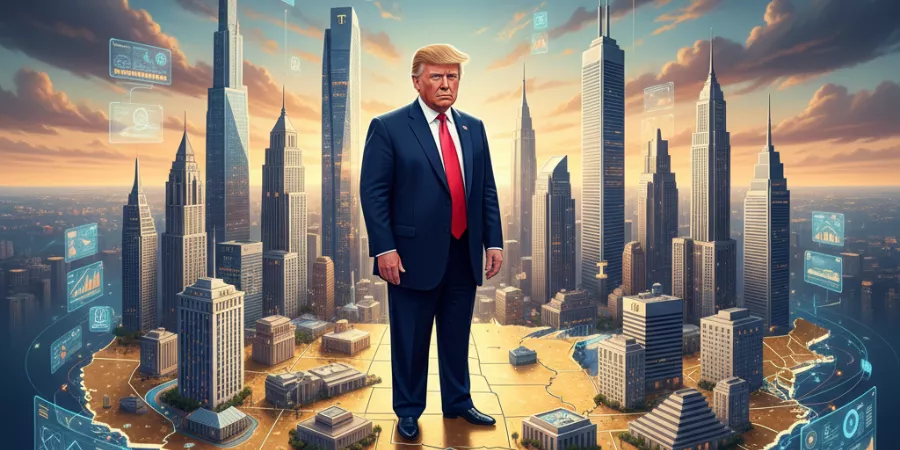
Donald Trump’s business world in 2026 looks like a giant web of companies, brands, holding firms, and operating entities under the Trump Organization. From the outside, people see Trump Tower, golf resorts, and luxury hotels. Behind the scenes, the structure is far bigger, because the Donald Trump business model has always relied on creating many separate companies to own, operate, license, or protect each asset.
So if you are asking the big question, How many companies does Donald Trump own in 2026? the answer depends on what you mean by “own.”
If you mean physical businesses, you will count far fewer.
If you mean the legal business entities connected to Donald Trump’s business empire through the Trump Organization, the number climbs into the hundreds.
By 2025, The Trump Organization was widely associated with over 500 business entities, with estimates touching 540+ entities when you include direct ownership, trust-controlled entities, and licensing structures. In 2026, the total still remains in that range, because the Trump ecosystem operates through layered corporate design, and these structures do not disappear overnight.
This article breaks down Donald Trump’s empire in a way that makes beginners understand it instantly, while giving experts enough structure, detail, and clarity to trust the analysis.
The Trump Organization in 2026: The Engine Behind the Empire
At the center of Donald Trump’s business empire stands The Trump Organization, a privately held conglomerate that acts as the umbrella for most Trump-related ventures. Founded in 1927 by his paternal family through early business roots linked to E. Trump & Son, the organization scaled aggressively over decades and grew into a global brand under Donald Trump’s leadership.
By 2025, the Trump Organization was tasked with supervising over 500 business entities, with leadership visibility often involving figures like Eric Trump, which collectively bore the Trump brand name in distinct sectors:
- Real estate development
- Property management
- Hospitality and hotels
- Golf resorts and private clubs
- Commercial leasing
- Merchandising and licensing
In 2026, that structure remains the foundation. What changes is the weight distribution between classic real estate revenue and the newer pillars like media, branding, and political ecosystem monetization.
How Many Companies Does Donald Trump Own in 2026?
Donald Trump does not run his empire through one corporation, and the Trump Organization structure explains why the count stays high. He runs it through a system of entities.
So the real answer looks like this:
Estimated entity network in 2026: 500+ companies
Donald Trump remains associated with over 500 companies and entities, with past audits and disclosures indicating totals exceeding 540 business entities when you include:
- Direct ownership companies
- Trust-controlled business entities
- Licensing-related subsidiaries
- Dormant companies kept alive legally for legacy projects
Active companies vs dormant entities
A major detail most articles skip is the difference between active and registered entities.
A realistic breakdown of the Donald Trump empire includes:
- Around 350 active entitiesproducing revenue or supporting operations
- Remaining companies dormant, under restructuring, or used for one-time transactions
This is why the entity number stays large even when Donald Trump closes a business line, a pattern analysts like Jonah E. have pointed out in corporate tracking discussions or exits a deal. Entities can remain legally alive for years.
Real Estate Holdings in 2026: The Core Revenue Machine
Donald Trump’s real estate empire has always been the most stable pillar of his business wealth. Even when headlines shift to politics or media, real estate remains the anchor.
Domestic Real Estate Assets
The Trump family portfolio includes several iconic US properties held under the Trump Organization network, including:
- Trump Tower (New York City)
- 40 Wall Street
- Trump Parc East
- Trump Plaza
- Trump International Hotel and Tower Chicago
These properties often sit under LLC structures, created to isolate liability, simplify accounting, and protect assets.
Examples include entities like:
- Trump Tower Commercial LLC
- 40 Wall Street LLC
This structure matters in 2026 because it explains the “how many companies” question better than any headline ever will.
A single building can produce multiple companies such as:
- Ownership entity
- Leasing entity
- Property management entity
- Payroll and staffing entity
- Maintenance vendor entity
That is how one property turns into a stack of corporate registrations inside the Trump Organization ecosystem.
International Trump Properties: Licensing Over Ownership
Internationally, Donald Trump’s model leans heavily toward licensing and management contracts rather than full ownership. This approach reduces capital risk while expanding global footprint.
Key international branded projects include:
- Trump International Hotel & Tower Vancouver
- Trump Towers Pune (India)
- Trump Ocean Club (Panama), later rebranded but historically linked
In licensing models, Trump benefits through:
- Branding fees
- Royalty income
- Management-style agreements
That income still runs through Trump-linked corporate entities, which increases the total company count even when Trump does not hold full equity ownership abroad.
Hospitality and Golf Resorts in 2026: The High-Value Lifestyle Business
By 2025, Donald Trump’s hospitality and leisure division evolved into one of the most visible segments of the empire. In 2026, this continues to be a core brand pillar because golf and luxury hospitality fit perfectly with the Donald Trump image.
Golf resorts and clubs
The Trump Organization owns and manages 17 golf resorts and clubs, including:
- Trump National Doral Miami
- Trump National Golf Club Bedminster
- Trump Turnberry (Scotland)
- Trump International Golf Links (Ireland)
Each property operates as a separate corporate entity, often under management structures like:
- Trump Golf Management LLC
This is another major reason Trump’s empire reaches 500+ entities. A golf property has complex revenue streams:
- Memberships
- Event hosting
- Sponsorships
- Accommodation
- Food and beverage
- Pro shop merchandise
Each stream can trigger separate entities depending on the business design.
Trump hotels rebound effect
Trump hotels faced major pressure during the pandemic years, a decline widely reported by outlets like NBC News. Yet by 2023, several Donald Trump hotel operations regained profitability, especially in markets like:
- Washington D.C.
- Las Vegas
- New York
That rebound strengthened the hospitality layer of his empire moving into 2026.
Trump Media & Technology Group: The Digital Expansion
One of the most important shifts in Trump’s business portfolio has been his move toward Trump Media ownership and digital influence.
Trump Media & Technology Group (TMTG)
A major growth engine in the Trump ecosystem is Trump Media & Technology Group, which gained attention through the Digital World Acquisition deal, the parent company tied to Truth Social, a social media platform positioned as an alternative to mainstream networks.
By 2025, TMTG expanded into areas like:
- Podcasting
- Streaming
- Conservative digital publishing
Even though TMTG operates as a public company structure, its corporate path including Digital World Acquisition shows how Trump’s modern empire blends media with business mechanics, Trump maintains a strong stake through entities such as:
- TMTG Holdings LLC
In 2026, this sector matters because it moves Trump’s empire away from pure property-based wealth into attention-based wealth.
And attention scales fast.
Branding and Licensing: Trump’s Most Profitable Asset Is His Name
The Trump brand itself is a business engine, strengthened over the years by public-facing influence from figures like Ivanka Trump.
Trump has continued to monetize his name through brand licensing deals, a strategy often highlighted in legacy coverage by the Daily News and historical product ventures like:
- Trump Home luxury furniture
- Trump Vodka in limited markets
- Trump Steaks online delivery model
- Trump University, defunct yet historically significant
Even when Trump does not own these businesses outright, the income flows through brand management entities such as:
- Trump Marks LLC
This keeps licensing money structured, trackable, and enforceable through contracts.
In 2026, licensing remains one of the cleanest ways to expand without heavy capital investment.
Political and Legal Entities: The Trump Ecosystem Beyond Business
Trump’s active participation in politics has resulted in a parallel universe of organizations, a shift frequently discussed across major outlets like CBS News that sit beside the Trump Organization, even if they do not operate like classic businesses but are still recognized and admitted through legal corporate frameworks. Among them are:
- Save America PAC
- Make America Great Again Inc.
- com, the office of the former president entity
Such entities are not conventional commercial properties like hotels, and legal scrutiny including allegations of civil fraud also shapes how the public views the larger Trump network.
For discussions regarding the number of companies in 2026, these entities will present one more layer of complexity, especially when a federal judge review adds pressure to restructure operations.
Private Aviation and Lesser-Known Ventures
Trump has also maintained business interests in aviation through:
- DJT Aviation LLC, linked to private aircraft operations including the heavily branded Trump Force One identity.
Other smaller Trump-linked ventures include:
- Trump Productions, tied historically to The Apprentice
- Trump Ice Natural Spring Water
- Trump Model Management, inactive yet connected historically through legal registrations
Even when these businesses fade from public attention, their corporate entities can remain part of the registered network.
Final Answer
So where does that leave us?
In 2026, Donald Trump’s business empire still operates through a massive corporate framework tied to:
- Real estate holdings
- Golf resorts and hospitality
- Brand licensing and merchandising
- Trump Media digital expansion
- Political entities and legal structures
- Aviation and legacy ventures
The most realistic estimate remains 500+ entities, a scale that has repeatedly appeared in coverage from CBS News and other national publications, with past disclosures pointing to 540+ business entities tied to Trump through direct ownership, trust-controlled structures, or licensing networks.
If you are a beginner, this means Trump owns far more than buildings.
If you are an expert, this confirms the empire is structured like a traditional high-net-worth real estate conglomerate, built for risk separation, scalability, and brand monetization.
In 2026, Trump’s corporate empire stays one of the largest and most layered personal business ecosystems in modern American history.