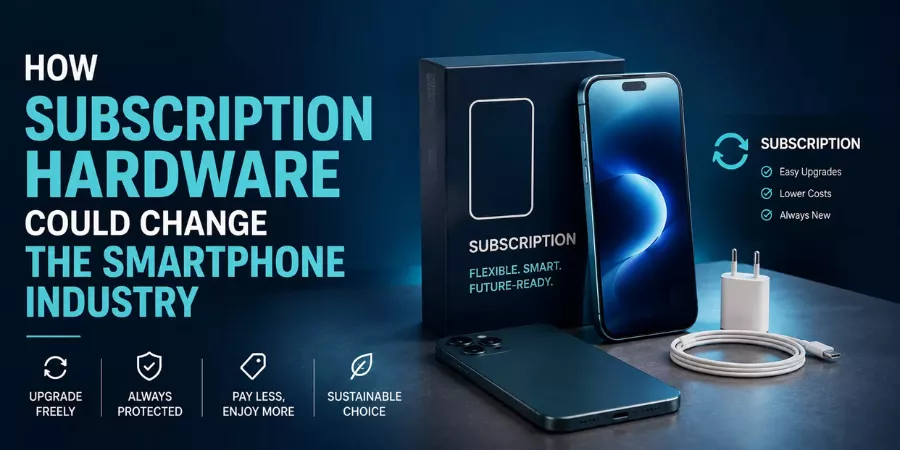
The hardware subscription model replaces one-time device purchases with monthly payments, giving consumers lower upfront costs and predictable upgrades, while giving manufacturers recurring revenue, better customer retention, and a steady pipeline of refurbished devices. It is not replacing outright ownership yet. But it is changing how the industry makes money, and the shift is accelerating.
TL: DR:
Shifting from outright phone ownership to hardware subscriptions, like leasing and upgrade programs, lowers upfront costs, shortens upgrade cycles, and stabilizes manufacturer revenue. This model changes how consumers buy phones, how companies handle used devices, and how brands make money.
What is the Hardware Subscription Model?
The hardware subscription model is when a consumer pays a monthly fee to use a device, a smartphone, laptop, or wearable, rather than buying it outright. At the end of the term, they return it, upgrade into a new device, or pay to keep it.
It is the same logic as a car lease, applied to consumer electronics.
Apple launched Apple Upgrade in the US in late July 2026 in partnership with Klarna, allowing consumers to lease an iPhone, Mac, iPad, or Apple Watch for a monthly fee with the option to upgrade, return, or eventually purchase the device.
Samsung is running parallel programs: the Galaxy Forever scheme in India combines financing with a guaranteed buyback, and the New Galaxy Club in the US charges a monthly subscription fee on top of device financing in exchange for an annual upgrade path.
This is not the first time the industry has tried monthly device payments. Carriers have offered installment plans for years. What is different now is that the manufacturers themselves are taking ownership of that relationship, cutting out the carrier and building the subscription directly into the brand experience.
Why is this Happening Right Now?
Two things are colliding.
- Phones cost more: Rising prices, driven by tighter memory supplies and component costs, and incremental hardware improvements have kept older devices capable for longer. A flagship phone now routinely costs $1,000 to $1,500. At that price, the upfront purchase is a harder sell than it was 5 years ago.
- People are keeping phones longer: Analyst firm Counterpoint Research expects the average global replacement cycle to stretch to four years in 2026, up from 3.5 years in 2025. Premium smartphone owners in the US now keep their devices for an average of 42 months, up from 38 to 40 months in previous years, according to IDC.
Fewer people upgrading means fewer units sold. The hardware subscription model is, in part, manufacturers engineering their way around that problem, making the upgrade financially painless enough that consumers do it more often.
What the Economic Shift Looks Like for Manufacturers
The business case is straightforward, and it goes well beyond selling more phones.
- Predictable cash flow: One-time hardware sales are lumpy. they spike at launch and taper off. Monthly subscription payments spread that revenue across 12, 24, or 36 months. For a company like Apple, which already generates over $30 billion per quarter in services revenue, adding hardware into a recurring payment model smooths out the quarterly volatility that comes with annual product cycles.
- Higher lifetime value per customer: Rather than simply trying to get consumers to replace their phones more often, brands are increasingly trying to turn costly smartphone purchases into more predictable monthly payments that keep customers within their ecosystems, according to IDC associate vice president Navkendar Singh. When a consumer leases an iPhone, pays for iCloud storage, subscribes to Apple Music, and adds AppleCare, all billed monthly, the total annual spend on that one customer is substantially higher than a one-time device purchase every four years.
- A refurbished device pipeline: The primary objective is to increase customer lifetime value by improving retention, creating predictable upgrade cycles, and securing a steady pipeline of trade-in devices for certified refurbishment and resale, according to Tarun Pathak, research director at Counterpoint Research. Returned lease devices, in good condition after 12 to 24 months of use, feed directly into refurbished markets. That creates a second revenue stream from the same device, and makes premium hardware accessible to buyers in lower-income segments who would never pay full retail price.
What It Means for Consumers: The Real Math
The honest answer is that hardware subscriptions make sense for some buyers and genuinely do not for others.
“Leasing definitely is not for everyone, but it can make sense, especially for someone who upgrades often,” said Matt Schulz, chief consumer finance analyst at LendingTree. Consumers who keep their phones for three, four, or five years are often better off buying outright than opting for a subscription or leasing model.
Here is the basic comparison for an iPhone 17 Pro ($999 retail):
| Scenario | Total Cost Over 24 Months |
| Buy outright, keep 24 months | $999 + no resale if kept |
| Buy outright, sell at 24 months | ~$999 minus trade-in (~$450–$550 depending on condition) |
| Apple Upgrade lease (24 months) | $31.99 × 24 = $767.76 (no ownership) |
| Apple Upgrade lease (12 months) | $45.99 × 12 = $551.88 per year |
Based on analysis of Apple’s new program, analyst Max Weinbach at Creative Strategies found that consumers who already replace their phones frequently could pay roughly the same, or in some cases even less, than they would by buying a device outright and trading it in later, particularly on higher-storage models whose trade-in values do not always reflect their higher purchase prices.
AppleCare is billed separately. That is a meaningful addition to the monthly cost that most users leasing a device will add.
How It Changes Consumer Behavior
The deeper consequence of hardware subscriptions is not financial. It is psychological.
Ownership of a physical device has always been the assumed end state. You buy the phone, it is yours, you can sell it, keep it, pass it on. Under a lease model, you never own it. You pay for access.
This mirrors what already happened in music, movies, and software. People stopped buying CDs and DVDs and accepted that paying monthly for a streaming service was simply how you consumed media. The same transition is being engineered for hardware, what analysts have started calling the “usership” mindset.
More than 80% of BytePe’s customers in India opt for subscriptions over outright purchases or traditional installment plans. BytePe’s typical customers are young professionals in their first or second jobs who want access to premium smartphones without paying the full price upfront or committing to long ownership cycles.
Younger consumers, who are the most valuable long-term customers for both Apple and Samsung, are already more comfortable with access-over-ownership than older buyers.
The Risks Manufacturers are Not Advertising
- Consumer fatigue is real: Subscription fees for streaming, cloud storage, fitness apps, and now physical hardware accumulate into a monthly bill that can feel oppressive. There is a growing backlash from consumers who feel nickel-and-dimed by subscriptions for things they previously owned outright.
- The value perception problem: Charging a monthly fee for hardware features that are built into a device the consumer never owns creates friction. If Apple or Samsung ever charge subscription fees to unlock features on a leased device, as has been trialled in the automotive industry, the consumer reaction would likely be severe.
- Lock-in cuts both ways: Deep ecosystem subscription bundles make it easier to retain customers. They also make it harder for new entrants or smaller manufacturers to compete, because switching cost is no longer just about the device, it is about unwinding an entire financial relationship.
Will This Replace Buying Outright?
Not soon. Probably not fully, ever.
“All three business models have a place to exist, and they will continue to do so,” said Mandeep Manocha, co-founder and CEO of Cashify, India’s largest smartphone trade-in and refurbishment platform. “There is a natural transition that may happen from complete ownership to leasing, but it is a long journey.”
IDC’s Nabila Popal expects Apple’s Upgrade program to have a bigger impact on Mac sales than iPhones, saying the offering is more likely to expand financing options than fundamentally change how Americans buy their next smartphone, particularly given the depth of carrier financing that already exists in the US market.
The hardware subscription model is not the death of phone ownership. It is a new lane alongside it, one that will grow as prices rise, upgrade cycles extend, and manufacturers get better at packaging hardware, services, and protection into a single monthly number that feels manageable.
Whether that is genuinely better for consumers or just better for manufacturers’ revenue forecasts is a question worth asking with every monthly payment.
Key Stats
| Metric | Figure | Source |
| Average smartphone replacement cycle 2026 | 4 years | Counterpoint Research |
| Average US premium replacement cycle 2026 | 42 months | IDC |
| Apple services revenue FY2025 | $109.16 billion | Apple 10-K |
| Apple paid subscriptions | 1.5 billion | Apple Q3 2026 earnings |
| Apple services gross margin | 75.30% | Apple earnings disclosure |
| BytePe subscribers choosing subscription over outright | 80%+ | BytePe / TechCrunch |
| iPhone 17 Pro 24-month lease total | $767.76 | Apple Upgrade program |
| Global smartphone market value 2026 | $556.4 billion | Grand View Research |