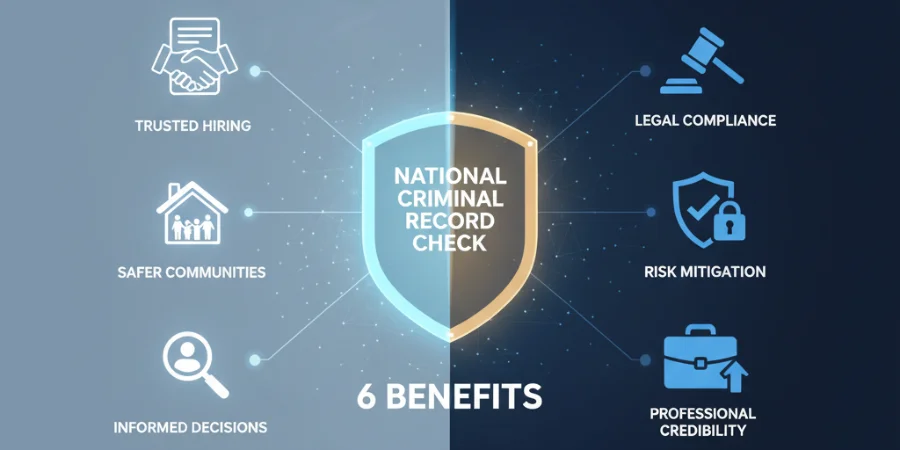
| Key Takeaways for Applicants and Employers Regulatory Alignment: A check is often a non-negotiable legal requirement under various Australian State and Territory acts, including the Aged Care Act, NDIS Quality and Safeguards Framework, and Working with Children legislation. Recruitment Velocity: Having a ready-to-go check processed through an ACIC-accredited agency can reduce onboarding time by up to 70% in high-demand sectors. Risk Mitigation: Comprehensive vetting is the primary organizational defense against internal fraud, workplace safety incidents, and regulatory non-compliance penalties. Digital Shift: In 2026, digital identity verification has made ACIC-accredited checks faster, more secure, and increasingly required for remote and contract workforce onboarding. Character Credential: For freelancers, gig workers, and consultants, a current check functions as a verified credential of integrity for clients, licensing boards, and international partners. |
In 2026, a national criminal record check is no longer just an administrative requirement. It is a digital passport for the modern Australian workforce, a verified credential that signals integrity, compliance readiness, and professional credibility to employers, licensing boards, landlords, and community organizations alike.
Whether you are a healthcare professional entering the aged care sector, a contractor onboarding with a new enterprise client, or a volunteer preparing to work with vulnerable populations, completing a National Criminal Record Check through an accredited provider is increasingly the first step in any professional engagement. Processed by the Australian Criminal Intelligence Commission (ACIC), these checks draw on the National Police Reference System to provide a comprehensive disclosure of an individual’s criminal history across all Australian jurisdictions.
What has changed in 2026 is the speed, the scope, and the stakes. Digital identity verification has compressed processing timelines from days to as little as 24 to 48 hours for most applicants. Sector-specific legislative requirements, particularly in aged care, the NDIS, and early childhood education, have made the check a legal barrier to entry rather than an optional due diligence step. And the expansion of the gig economy has created an entirely new cohort of independent workers for whom a current check functions as a standing professional credential rather than a one-time onboarding formality.
This guide covers the six most critical benefits of completing a national criminal record check in 2026, with specific context for employers, applicants, volunteers, and independent professionals navigating Australia’s evolving compliance landscape.
High-Risk vs. Proactive Vetting Culture: Key Signals
| High-Risk Culture Signals | Proactive (Safe) Culture Signals |
| Ad-hoc or optional vetting processes | Standardized, automated criminal history checks for all staff |
| Reactive response to safety incidents | Proactive risk mitigation through comprehensive screening |
| Manual, slow document chasing | Digital-first verification with real-time updates |
| No legal compliance review process | Regular audit of checks against current regulatory requirements |
| Vetting seen as an HR formality | Vetting embedded as a non-negotiable compliance milestone |
| No differentiation between roles | Risk-tiered screening based on position sensitivity |
Benefit 1: Accelerates High-Trust Recruitment and Onboarding
| The Challenge In a competitive 2026 labor market, slow onboarding is the primary cause of candidate drop-off, particularly in high-demand sectors like healthcare, finance, and technology. | 2026 Strategy Initiate checks early in the recruitment process to demonstrate Recruitment Readiness. Use an ACIC-accredited digital provider to compress timelines to 24 to 48 hours for most applicants. | Actionable Step Ask your screening provider whether they offer digital identity verification. ACIC-accredited agencies with digital ID capability process checks significantly faster than those using manual document submission. |
Expert Insight: Research from Australian HR peak bodies shows that recruitment processes extending beyond two weeks see a 40% increase in candidate withdrawal rates in high-demand professional sectors.
For employers, the business case is straightforward. Every day a position sits vacant in a revenue-generating or compliance-critical role has a quantifiable cost. For sectors operating under chronic workforce shortages, including aged care, disability services, and early childhood education, the ability to onboard a qualified candidate in days rather than weeks is not a convenience. It is a competitive and operational necessity.
For applicants, having a current national criminal record check ready before beginning a job search positions you as an exceptionally prepared candidate. In sectors where all shortlisted candidates require a check before commencement, the applicant who arrives with one already completed removes the single most common delay from the employer’s onboarding process. This is a meaningful differentiator in competitive fields.
ACIC-accredited agencies operating with digital identity verification can process most standard applications within 24 to 48 hours. Applications that require manual review due to disclosed records or identity complexity take longer, but even these are typically resolved within five business days. For comparison, checks processed through non-accredited or manual providers can take two to three weeks. Choosing an accredited digital provider is not just a speed decision; it is a compliance decision, as only ACIC-accredited bodies are authorized to access the National Police Reference System.
What to Do Now
If you are an employer, review your current onboarding workflow and identify at which stage you currently request a check. If it is after a verbal offer, consider moving it earlier. If you are a professional in a high-demand sector, complete a check now and keep it current so it is available on request.
Benefit 2: Meets Strict Industry and Legal Mandates
| The Challenge For regulated sectors, a national criminal record check is not a benefit. It is a legal barrier to entry. Operating without one exposes both the individual and the employer to significant regulatory and financial penalties. | 2026 Strategy Maintain a valid, current check as a standing compliance document. Review sector-specific legislative requirements annually, as thresholds and renewal periods vary by industry and state. | Actionable Step Map your role against the relevant legislative framework: the Aged Care Act 1997, the NDIS Quality and Safeguards Commission requirements, or Working with Children legislation in your state or territory. Use this map to set a calendar reminder for renewal. |
Expert Insight: Non-compliance with mandatory criminal history screening requirements in aged care and the NDIS can result in penalties exceeding $100,000 per incident for registered providers under the current regulatory framework.
Australia’s regulatory environment for criminal history screening has become significantly more stringent in the period following the Royal Commission into Aged Care Quality and Safety. The current framework requires that all aged care workers, NDIS providers, and anyone working in direct contact with children complete a national criminal record check before commencing work, with ongoing obligations for renewal and disclosure of new charges or convictions.
The specific legislative instruments vary by sector and jurisdiction. For aged care, the Aged Care Act 1997 and the supporting Quality of Care Principles set the baseline. For NDIS providers, the NDIS Quality and Safeguards Commission’s Worker Screening requirements apply. For work involving children, each state and territory operates its own Working with Children scheme, which in most cases requires a police check as a component of the broader screening process.
For employers, the compliance obligation extends beyond simply requesting a check. It includes verifying that the check was processed by an ACIC-accredited agency, that it covers the relevant jurisdictions, and that it has been renewed within the required timeframe for the specific role. Relying on checks processed by non-accredited providers, or accepting checks that are beyond their validity period, does not satisfy the legal obligation and will not protect the organization in the event of a regulatory audit or incident.
What to Do Now
Review the specific legislative requirements for your sector and confirm that your current screening process, including the accreditation status of your provider and the renewal schedule, is fully compliant. If you are unsure, the ACIC website provides a current list of accredited bodies and sector-specific guidance.
Benefit 3: Fortifies Workplace Safety and Psychological Safety
| The Challenge Organizations that cannot verify the criminal history of their workforce carry unquantified risk exposure, particularly in roles involving vulnerable populations, financial data, or sensitive intellectual property. | 2026 Strategy Implement risk-tiered screening where the depth and frequency of checks scales with the sensitivity of the role. All staff should be screened, but roles with elevated risk exposure should be subject to more frequent review. | Actionable Step Create a simple role-sensitivity matrix for your organization with three tiers: standard, elevated, and high-sensitivity. Assign a check renewal period to each tier and enforce it through your HR system. |
Expert Insight: Google’s Project Aristotle research identified psychological safety as the single strongest predictor of team performance. Knowing that every team member has been vetted creates a verified baseline of trust, particularly critical in roles involving financial access, client data, or vulnerable individuals.
Workplace safety in 2026 has two dimensions that are equally important and often conflated. Physical safety, the prevention of harm to people and property, is the dimension most organizations focus on. Psychological safety, the confidence that colleagues are who they present themselves to be and that the work environment is free from hidden risk, is the dimension that most organizations underinvest in, yet it is the one that determines whether people bring their full capability to work.
A national criminal record check contributes directly to both. For physical safety, it identifies individuals with relevant prior convictions before they enter roles where those convictions create foreseeable risk. For psychological safety, it signals to every team member that the organization has taken a baseline step to verify the integrity of the people they work alongside.
This is particularly significant in roles involving financial data, client information, or direct care of vulnerable people. In these contexts, the absence of a verified screening process is not a neutral position. It is a statement that the organization has chosen not to take a step that was available to it, and that choice carries both practical and reputational risk.
What to Do Now
Review your current role-sensitivity framework. If you do not have one, map your roles by the access they provide to finances, sensitive data, or vulnerable individuals. Use this map to set differentiated screening and renewal requirements rather than applying a single standard across the entire workforce.
Benefit 4: Enhances Personal Brand and Professional Reputation
| The Challenge In the gig economy and freelance consulting market, professional reputation is the primary currency. Clients, licensing boards, and international partners have no direct way to verify the integrity of an independent professional without a formal credential. | 2026 Strategy Treat a current national criminal record check as a standing professional credential, not a one-time onboarding document. Renew it proactively and make its availability known to prospective clients as part of your professional profile. | Actionable Step Add a line to your professional bio or LinkedIn profile noting that you maintain a current national criminal record check. This is standard practice in high-trust freelance sectors, including healthcare consulting, financial advisory, and legal support services. |
Expert Insight: In the 2026 gig economy, independent professionals who can provide immediate verification of their background screening close engagements 35% faster than those who require clients to initiate the process.
The freelance and independent consulting market has grown substantially in the post-pandemic period, and with it has come a significant shift in how clients evaluate independent professionals. Organizations engaging contractors for sensitive roles, including healthcare, financial services, legal support, and technology, are increasingly requiring criminal history verification as a standard pre-engagement requirement rather than an optional due diligence step.
For independent professionals, the strategic response is to get ahead of this requirement rather than wait for clients to ask. Maintaining a current national criminal record check and making its existence visible in your professional profile transforms a reactive compliance step into a proactive competitive differentiator. It signals transparency, preparation, and a professional standard that many independent practitioners have not yet adopted.
For those operating across multiple jurisdictions or with international clients, a check processed through an ACIC-accredited agency carries the regulatory authority of the Australian Criminal Intelligence Commission, which is recognized internationally as a credible and verifiable source. This matters for professionals whose clients include multinational organizations or government bodies that require documented screening from their contractor base.
What to Do Now
If you are an independent professional in a high-trust sector, complete or renew your national criminal record check this month and document it as a standing credential in your professional profile. Frame it proactively in client proposals as evidence of your commitment to transparency and compliance.
Benefit 5: Streamlines Volunteer and Community Participation
| The Challenge Community organizations operating on limited resources cannot absorb the delays and administrative costs of extended vetting processes. Unverified volunteers in roles involving children, elderly care, or emergency response create unacceptable risk exposure. | 2026 Strategy Encourage volunteers to obtain and maintain a current national criminal record check before approaching organizations, reducing the administrative burden on community groups and enabling faster deployment to critical roles. | Actionable Step If you are a regular volunteer in roles involving vulnerable populations, set a personal calendar reminder to renew your check 30 days before its expiry. This ensures you are always deployment-ready without creating gaps in your availability. |
Expert Insight: Community organizations that implement proactive volunteer screening report a 60% reduction in administrative vetting time and a significant improvement in the speed with which they can respond to urgent need, particularly in aged care support and emergency services contexts.
Australia’s volunteer sector supports millions of people across aged care, disability services, youth development, emergency response, and community health. The organizations delivering these services frequently operate with minimal administrative capacity, and the burden of conducting background checks on every new volunteer from scratch can meaningfully delay the deployment of people who are ready and willing to contribute.
The most effective solution is for volunteers who regularly work in regulated roles to maintain a standing national criminal record check and present it to organizations as part of their initial approach. This shifts the verification process from a reactive administrative task that the organization must manage to a proactive professional standard that the volunteer maintains as part of their commitment to the sector.
For volunteers entering roles covered by specific legislation, including working with children checks and NDIS worker screening, the national criminal record check is typically one component of a broader verification requirement. However, having it ready in advance significantly accelerates the remaining steps. Organizations like the Australian Criminal Intelligence Commission provide clear guidance on the specific requirements for different volunteer roles and jurisdictions.
What to Do Now
If you volunteer regularly in a regulated sector, check the current validity of your national criminal record check and the specific legislative requirements for your role and state. If your check is within six months of its expiry, renew it now rather than waiting until it lapses.
Benefit 6: Protects Against Internal Financial Risk
| The Challenge Internal fraud costs Australian businesses hundreds of millions of dollars annually. Organizations without documented screening processes for roles involving financial access have no verified deterrent and no defensible response when incidents occur. | 2026 Strategy Implement regular criminal history auditing for all roles with financial access, not just at the point of hire but at defined intervals throughout employment. Make the renewal requirement explicit in employment contracts for sensitive roles. | Actionable Step Add a renewal clause to employment contracts for all roles classified as financially sensitive. Specify the renewal interval, the accreditation standard required, and the consequences of non-compliance. This creates both a deterrent and a documented compliance trail. |
Expert Insight: The Australian Institute of Criminology estimates that workplace fraud costs Australian businesses over $3.5 billion annually, with the majority of incidents involving employees in trusted financial roles who had never been subject to repeat screening after initial hire.
The most significant gap in most organizations’ criminal history screening programs is the absence of ongoing review. Most employers conduct a check at the point of hire and never revisit it. For roles with elevated financial access, this approach creates a window of unmonitored risk that grows wider every year the check remains unrepeated.
Criminal history is not static. A clean record at the point of hire does not guarantee a clean record five years later. For roles involving direct financial access, treasury management, procurement authority, or client funds, the case for periodic re-screening is both practically and legally defensible. It demonstrates that the organization has maintained an active compliance posture rather than relying on a single point-in-time verification.
The deterrent effect of regular re-screening is also significant. Research in behavioral compliance consistently shows that people subject to periodic verification are less likely to engage in financial misconduct than those who believe their background will not be reviewed again. The knowledge that a check will be repeated creates an ongoing accountability signal that point-in-time screening cannot replicate.
What to Do Now
Review the financial access controls in your organization and identify which roles have not had a criminal history check renewed since initial hire. For any role with direct access to funds exceeding a defined threshold, implement a scheduled renewal process and document it in the relevant position description and employment contract.
The National Criminal Record Check in 2026: A Professional Standard, Not a Formality
The six benefits covered in this guide reflect a fundamental shift in how Australia’s workforce, regulatory bodies, and professional community understand the role of criminal history verification. A national criminal record check is no longer a paperwork formality completed reluctantly at the end of an onboarding process. It is a professional standard that signals readiness, integrity, and compliance commitment across every sector of the economy.
For employers, the question in 2026 is not whether to screen but how to build a screening program that is fast, legally compliant, and appropriately scaled to the risk profile of each role. For individual professionals, the question is how to leverage a current check as a standing credential that differentiates you in a competitive market. For volunteers, it is how to stay deployment-ready without creating administrative burden for the organizations you serve.
The organizations and individuals who treat criminal history screening as a strategic compliance investment rather than a box-ticking exercise are the ones who will maintain the trust, avoid the regulatory exposure, and build the verified reputation that the 2026 professional environment demands. For related reading on how integrity and resilience function as professional foundations, explore the article on resilience lessons and character from history’s most tested figures, and for a study of how trust and loyalty function as community infrastructure, read the collection on the Marathon philosophy and community investment.
FAQ Section
How long does a National Criminal Record Check last in Australia?
There is no universal expiry date. Most employers and regulatory bodies in regulated sectors treat a check as current for 12 months, after which renewal is recommended. However, the specific validity period depends on the sector and the legislative requirements of your role. Aged care and NDIS roles typically require more frequent review than standard employment.
How long does it take to get a National Criminal Record Check in Australia?
When processed through an ACIC-accredited agency using digital identity verification, most standard applications are returned within 24 to 48 business hours. Applications requiring manual review due to disclosed records or identity complexity typically take three to five business days.
Who needs a National Criminal Record Check in Australia?
Anyone working in aged care, the NDIS, early childhood education, or any role involving direct contact with children is subject to mandatory screening requirements under relevant state, territory, or federal legislation. Beyond these mandated sectors, most professional roles involving financial access, sensitive data, or vulnerable clients will require or strongly benefit from a current check.
Is a National Criminal Record Check the same as a Police Check?
Yes. A National Criminal Record Check is also commonly referred to as a National Police Check or National Police Certificate. When processed through an ACIC-accredited agency, it draws on the National Police Reference System and covers criminal history across all Australian states and territories.
Does a National Criminal Record Check show spent convictions?
This depends on the state or territory and the purpose of the check. Most jurisdictions have spent convictions legislation that limits the disclosure of older convictions that meet specific criteria. However, exceptions apply for certain regulated roles, particularly those involving children or vulnerable adults. Your ACIC-accredited provider can advise on the specific disclosure rules applicable to your role and jurisdiction.