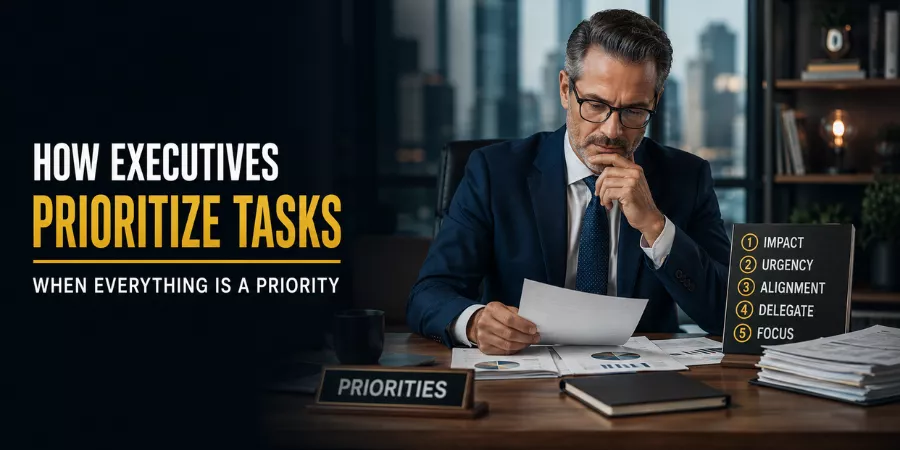
When each corporate fire demands instantly water, CEOs will mostly decide on the task prioritization by very harshly changing from time management to energy and impact filtering. In fact, 54% of top officials regard rapid operational and technological adaptation as their biggest challenge, per the SHRM 2026 CEO Priorities Report.
Successful executives triage this chaos by deploying the Impact-to-Effort Matrix, immediately delegating or deleting any task that falls below a predetermined return-on-investment threshold, and blocking immovable windows for singular deep focus. They do not manage time; they manage system alignment.
Have you ever looked at your daily homework list and felt like a juggler who was suddenly handed five running chainsaws? You are not alone! It feels like every single email, message, and project is screaming, “Pick me! I am the most important thing in the world!”
When you are trying to figure out how to prioritize tasks, it can feel like you are trying to drink water from a giant fire hose. If you feel tired just looking at your calendar, we get it. It is exhausting! But guess what? Big business bosses face this exact same giant mountain of work every single morning.
Here is exactly how they sort through the noise to get the right things done without losing their minds.
Why Does Everything Feel Like an Emergency?
Before we talk about prioritizing tasks, we have to understand why your inbox looks like a battlefield.
These days work goes at rocket speed. Together with instant chat apps, video calls, and loud phone alerts, people expect their response in two minutes anyway. Microsoft did a fascinating study of the workplace in 2026 that revealed the average worker is interrupted by buzzing notifications about 275 times a day. It would be like having a small, irritating woodpecker pecking your mind all day long!
When you get hit with that many alerts, your brain starts to play tricks on you. It makes you think that the newest message is the most urgent one, even if it is just a silly meme from a coworker.
Executives know this trap well. They understand that there is a massive difference between something that is urgent (needs attention right now, like a ringing phone or a barking dog) and something that is important (actually helps you win in the long run, like studying for a big final test). If you spend your whole day putting out tiny fires, you will never have time to build the house!
How Do Top Bosses Decide What Matters Most?
When executives look at a giant pile of work, they do not just start from the top and work their way down. They use smart mental frameworks to map out how to prioritize tasks at work.
Imagine you have a school backpack, and you need to fill it for a big hike. If you put the sand in first, the big rocks will not fit. You have to put the big rocks in first, and let the sand fill in the tiny cracks around them.
Here are the specific tools and habits leaders use to sort their big rocks from their sand.
1. The Quad Matrix (The Eisenhower Box)
This is a 4-box square that will help you sort tasks into 4 clear buckets so you do not get confused:
- Bucket 1 (Do First): Both urgent and important. These are the genuine fires which have to be completed immediately, for example a project due in one hour.
- Bucket 2 (Schedule): Important, but not urgent. This is where the magic happens. This is your deep-focus work, like planning your science fair project early.
- Bucket 3 (Delegate): Urgent, but not important. This is a task that needs to happen now, but someone else can handle it.
- Bucket 4 (Delete): Neither urgent nor important. Trash it. Drop it. Say goodbye to it!
2. The 80/20 Rule
Executives love this rule because it lets them be successfully lazy! It states that 80% of your best results come from just 20% of your actual efforts. Leaders look at their list and ask, “Which two items on this page will give me the biggest reward?” They focus heavily on those two things and do not sweat the small stuff.
3. Aggressive Delegation (The 14-Hour Gain)
You cannot do everything yourself. You are only one human being, not a superhero robot with eight arms! Executives are masters at passing tasks to talented teammates who can handle them.
While standard management advice says “delegation saves time,” internal ecosystem audits from 2026 show that delegation saves an average of 14 hours per week for Series A founders, provided they implement the Level-5 Ownership Framework.
Under this special framework, tasks are not just passed off like a hot potato; they are assigned by five clear levels of ownership:
- Level 1: Go look at the problem and report back to the boss.
- Level 2: Go look at the problem and suggest a smart way to fix it.
- Level 3: Create a full plan, but get approval from the boss before starting.
- Level 4: Do the job completely on your own and send a weekly report.
- Level 5: Total freedom! Take full ownership of the goal without needing the boss to look over your shoulder at all.
How to Prioritize Tasks: Guide for Your Team
If you need a super quick cheat sheet to share with your team or to save for later, here are the core points:
- Stop Context Switching: Toggling back and forth between different apps destroys your focus. A 2026 report by Conclude.io revealed that jumping around between tasks can waste up to 40% of your brain’s productive time. Focus on one single thing at a time!
- Eat the Frog: Do your hardest, ugliest, most important task first thing in the morning. Once you eat the metaphorical frog, the rest of the day feels like eating cake!
- Block Your Time: Guard your calendar like a giant, grumpy dragon guards gold. Set aside two hours every day where your notifications are turned off completely so you can work in total peace.
- Learn to Say No: You cannot say yes to every single project request. Saying yes to a silly, low-priority task means you are saying no to a truly important one.
- Review Daily: Take five minutes at the end of every single workday to map out your top three goals for tomorrow morning.
How Can You Use These Secrets in Your Daily Job?
You do not need a fancy corner office, a million dollars, or a shiny business suit to use these executive secrets. You can start prioritizing tasks like a total pro right now at your own desk.
- First, give yourself some grace. Accept that you will never finish every single tiny thing on your giant to-do list, and that is completely okay! The goal is not to finish everything; the goal is to finish the correct
- Second, try using the “Rule of Three.” Every morning, look at your messy list and pick exactly three things that must get done before you go home. Write them down on a bright sticky note. Stick that note right on your computer screen so it stares at you. If you get those three things done, your day is a massive success! Everything else is just extra gravy on the mashed potatoes.
- Finally, communicate clearly with your team. If your manager hands you a brand-new project when you are already buried under a mountain of work, ask them a polite question: “I want to make sure I do a great job on this. Should I prioritize this over the project I am currently running, or should I finish that one first?” This simple question keeps everyone on the exact same page!
Frequently Asked Questions
What is the absolute fastest way to prioritize tasks when I am overwhelmed?
The fastest way is to pick just one single thing. Ask yourself: “If I could only get one single thing done today before going home, which task would make me feel the most proud and relieved?” Do that task first and ignore everything else until it is done.
How do I figure out how to prioritize tasks at work when my manager says everything is urgent?
When everything is labeled as an emergency, nothing is! Have a quick, friendly chat with your boss. Show them your list of current projects and ask them to help you rank them from 1 to 5 so you can focus your brainpower where the company needs it most.
Is multi-tasking a good way to get more work done?
No, multitasking is a trap! Your brain cannot actually focus on two tough things at the exact same time. It just switches back and forth really fast, which tires your brain out and makes you make silly mistakes. Stick to single-tasking for the win!