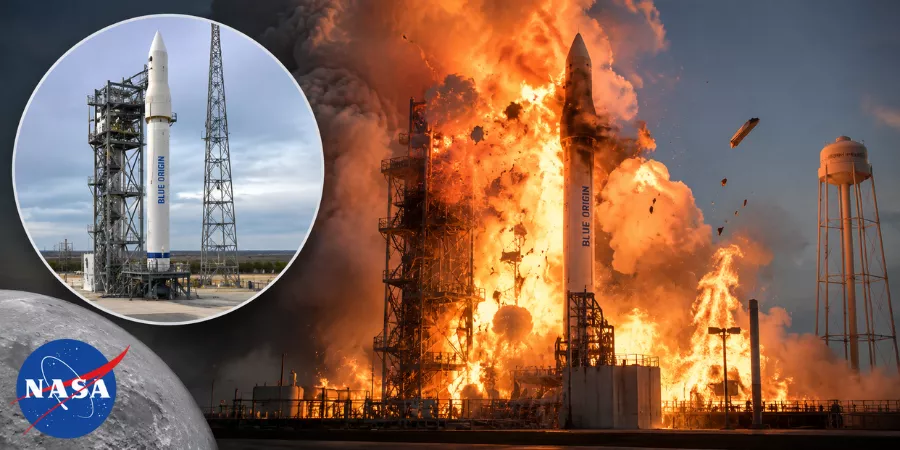
Blue Origin’s New Glenn rocket exploded in a massive fireball at Cape Canaveral on May 28, 2026, during a pre-launch ground test. No one was injured. The rocket was completely destroyed. And the timing could not have been worse, just two days after NASA awarded Blue Origin a $188 million contract to land rovers on the Moon.
What Happened to the New Glenn Rocket on May 28, 2026?
Around 9 p.m. EDT on May 28, 2026, Blue Origin was, kinda conducting a hotfire test of the New Glenn’s seven methane fueled BE-4 first stage engines at Cape Canaveral Space Force Station, in Florida.
The 188-foot-tall first stage became enveloped in a rapidly growing fire. Moments later, the 86-foot-tall upper stage tilted and began to fall as the first stage collapsed. Then the vehicle suddenly exploded as its load of methane fuel and liquid oxygen ignited in a roiling fireball.
The New Glenn booster, named “No, It’s Necessary,” exploded before the static fire could even be completed. It is unknown how far along in the static fire process the test was before the explosion occurred.
Blue Origin confirmed the incident in a statement on X: “We experienced an anomaly during today’s hotfire test. All personnel have been accounted for. We will provide updates as we learn more.”
Jeff Bezos also posted on X: “All personnel are accounted for and safe. It’s too early to know the root cause but we’re already working to find it. Very rough day, but we’ll rebuild whatever needs rebuilding and get back to flying. It’s worth it.”
What is a Static Fire Test and Why Do Rockets Do Them?
A static fire test, also called a hotfire test, is when a rocket’s engines are ignited while the vehicle is still physically bolted to the launch pad. The engines run at full power for a short duration, then shut down. The rocket goes nowhere.
The purpose is to verify that all engine systems, fuel lines, ignition sequences, and ground support equipment are working correctly before committing to an actual launch. It is essentially the final major checkpoint before a rocket is cleared to fly.
For New Glenn, the goal was to complete this pre-launch static fire, the final test before getting ready to launch for its fourth mission, designated NG-4.
Static fires are standard practice across the industry. SpaceX runs them before every Falcon 9 launch. They are considered lower-risk than actual launches. An explosion during one is unusual and serious, it destroys the vehicle, damages the pad, and triggers a full investigation before any return to flight.
What Was the New Glenn Supposed to Be Doing?
Blue Origin was preparing for the rocket’s fourth launch, which was slated to deploy a batch of satellites for Amazon’s Leo, a rival satellite network to SpaceX’s Starlink. None of the satellites were on the rocket when it exploded, an Amazon spokesperson confirmed.
Amazon Leo, formerly known as Project Kuiper, has more than 100 rockets across four launch providers lined up to get thousands of satellites into orbit. NG-4 was set to be the first of 24 missions that Amazon Leo booked on New Glenn rockets.
What is New Glenn’s Full Launch History?
New Glenn is a relatively new rocket with a short and already troubled track record. Here is the complete picture:
| Mission | Date | Result |
| NG-1 | January 16, 2025 | Successful orbital launch; booster landing failed |
| NG-2 | November 2025 | Successful launch; NASA ESCAPADE Mars probes; booster landed successfully |
| NG-3 | April 19, 2026 | Upper stage engine failure; satellite placed in wrong orbit; booster landed successfully |
| NG-4 static fire | May 28, 2026 | Rocket exploded on pad during ground test |
During NG-3 on April 19, the rocket’s second stage suffered a malfunction prior to its engine burn, and one of the engines failed to achieve enough thrust to reach its target orbit.
The company’s investigation found that one of its two BE-3U engines had suffered a cryogenic leak that froze a hydraulic line, leading to a thrust anomaly. The FAA grounded New Glenn following NG-3 while that investigation was completed.
The FAA cleared New Glenn to return to flight after accepting Blue Origin’s results and proposed corrective actions, with NG-4 cleared to launch as early as June 4, 2026. The May 28 explosion happened during the hotfire test that was supposed to confirm the rocket was ready for that June launch.
This was the first on-pad explosion at Cape Canaveral since a SpaceX Falcon 9 blew up on nearby Pad 40 on September 1, 2016. That Falcon 9 failure grounded the vehicle for three and a half months, and the pad was out of action for more than a year.
How Does This Affect NASA’s Artemis Moon Missions?
The incident came a day after NASA Administrator Jared Isaacman praised Blue Origin for playing a crucial role in NASA’s Artemis program, an effort to return American astronauts to the Moon’s surface in 2028. During a speech Wednesday, he also revealed that NASA had awarded Blue Origin a $188 million contract to help build a Moon Base.
NASA is heavily relying on Blue Origin and its New Glenn rocket to support the Artemis program and its Moon Base ambitions. Blue Origin was tapped to deliver a pair of lunar terrain vehicles to the lunar surface using its Blue Moon Mark 1 lander. Blue Origin’s Blue Moon Mark 2 crewed lander was also selected as one of two landers for the Human Landing System program, alongside SpaceX’s Starship, to dock with the Orion spacecraft and bring astronauts to the lunar surface.
After the explosion, NASA Administrator Isaacman wrote on X that the agency is “aware” of the incident and would “provide information on any impacts to the Artemis and Moon Base programs as it becomes available.” “Spaceflight is unforgiving, and developing new heavy-lift launch capability is extraordinarily difficult,” he said.
What is at stake for Artemis specifically:
- Blue Origin’s Blue Moon Mark 1 uncrewed lander was planned to launch to the Moon’s South Pole on a New Glenn rocket in 2026.
- Blue Moon Mark 2 is one of two crewed landers selected for Human Landing System missions alongside SpaceX Starship.
- NASA awarded Blue Origin a $3.4 billion contract in 2023 to develop the Blue Moon crewed lander for Artemis V.
- The Artemis program aims to return astronauts to the Moon in 2028, a timeline already under scrutiny.
Given that oversight officials were already skeptical that either lander, SpaceX’s Starship or Blue Moon, could be ready for a lunar touchdown in 2028, it remains to be seen whether either vehicle could be ready to complete a crewed test mission in low-Earth orbit by next year as NASA hopes.
How Does This Compare to SpaceX’s Position?
The explosion comes less than a week after SpaceX carried out a largely successful test of its next-generation Starship rocket, a company that is years ahead in development.
The explosion dealt a major setback to Blue Origin in its efforts to challenge a dominant SpaceX.
Both companies hold NASA contracts to develop lunar landers and both are competing for national security launch contracts. Blue Origin has also been seeking to get New Glenn certified for national security missions, taking a four-flight approach to certification. Completion of NG-4 could have lined up the rocket to begin getting lucrative task orders under the National Security Space Launch Phase 3 contract alongside ULA and SpaceX. That timeline is now significantly disrupted.
What Happens Next for Blue Origin?
The US Space Force confirmed its responders were at the scene of the explosion, working with Blue Origin engineers to determine the cause.
With damage to the pad and the need to investigate what caused the explosion, Blue Origin’s New Glenn rocket is likely grounded for the near future, with the planned June launch no longer possible.
The investigation process follows a standard sequence:
- Blue Origin conducts an internal investigation and identifies root cause
- Results are submitted to the FAA
- FAA reviews findings and required corrective actions
- FAA must verify those corrections are implemented before clearing New Glenn to fly again
- Launch pad at LC-36 must also be assessed and repaired before use
The Eastern Range at Cape Canaveral confirmed it “remains fully mission capable for National Security Space Launch and continues to support operations at all other launch complexes,” meaning other operators including SpaceX are unaffected.
Blue Origin CEO Dave Limp had previously indicated the company wanted to get at least eight launches up in 2026. That target now looks very difficult to reach.
Frequently Asked Questions
Was anyone hurt in the New Glenn explosion? No. Blue Origin confirmed all personnel were accounted for and safe following the explosion.
What caused the New Glenn explosion on May 28, 2026? The root cause is not yet confirmed. Blue Origin and the US Space Force have launched an investigation. Bezos said it is “too early to know the root cause” and that the team is already working to find it.
Will the New Glenn explosion delay NASA’s Moon missions? NASA said it would assess potential impacts on its plans to return astronauts to the Moon in 2028 and provide updates on any effects on the Artemis and Moon Base programs. The full scope of delays depends on the investigation timeline and how long pad repairs take.
How many times has New Glenn flown successfully? New Glenn has completed three launches, NG-1 in January 2025, NG-2 in November 2025, and NG-3 in April 2026. NG-3 placed its satellite in the wrong orbit due to an upper stage engine failure. NG-4 never launched, the rocket was destroyed during the pre-launch hotfire test on May 28, 2026.
Key Takeaways
- New Glenn exploded at Cape Canaveral on May 28, 2026, during a ground hotfire test ahead of its NG-4 mission, no injuries reported.
- The rocket was carrying no satellites; it was destroyed along with infrastructure at Launch Complex 36.
- This is New Glenn’s second significant failure in two months, following the NG-3 orbit miss in April 2026.
- NASA awarded Blue Origin a $188 million Moon Base contract just two days before the explosion.
- Blue Origin holds a $3.4 billion NASA contract for the Blue Moon crewed lunar lander, a key part of Artemis.
- The investigation timeline and pad repair duration will determine how severely this disrupts NASA’s 2028 Moon landing target.