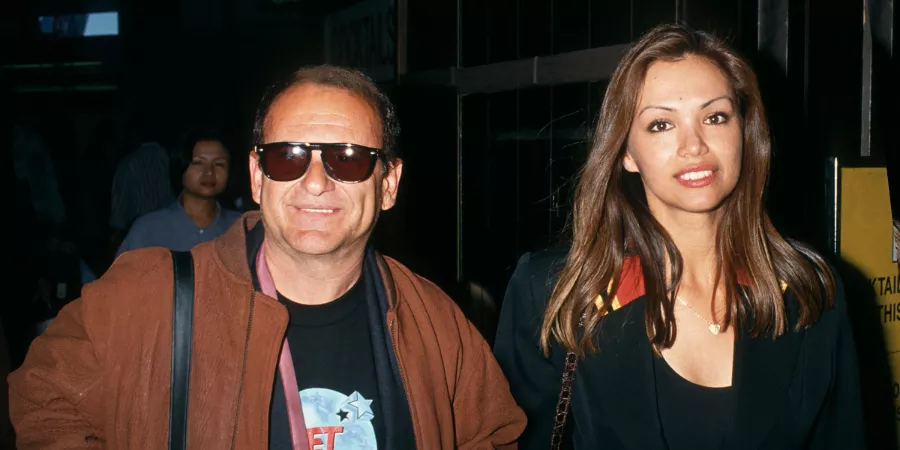
Claudia Haro’s life contains two entirely different public narratives separated by a single violent event. In the first, she is a working actress in 1990s Hollywood, married to one of the industry’s most acclaimed character actors and building a screen resume through roles in major films. In the second, she is the subject of a criminal case that attracted national media attention, resulting in a prison sentence that kept her incarcerated for most of a decade. Understanding both narratives is essential context for understanding the family background of Tiffany Pesci, whose mother’s story has shaped the privacy imperative that defines Tiffany’s own approach to public life. For the full profile of Tiffany, see our complete guide to Tiffany Pesci’s private life.
Early Life and Entry Into Hollywood
Specific details about Claudia Haro’s early life, including her birth date and background before her entry into Hollywood, are not comprehensively documented in public sources. Her emergence into public record is primarily through her marriage to Joe Pesci and her subsequent film appearances, which places her professional and personal identity within the context of that relationship from the outset.
The dynamic of being an actress whose career was substantially intertwined with her famous husband’s was not unusual in Hollywood of that era, but it created a dependency between professional visibility and personal relationship that would leave her public identity significantly reduced after their marriage ended.
Acting Career: Films and Screen Roles
Claudia Haro’s acting career produced a small but notable filmography concentrated in the mid-1990s. Her appearances include Jimmy Hollywood in 1994, a crime comedy directed by Barry Levinson in which Joe Pesci also starred. She appeared in With Honors in 1994, a drama featuring Joe Pesci alongside Brendan Fraser. Her role in Casino in 1995, Martin Scorsese’s crime epic, placed her in one of the most significant films of the decade, again alongside Joe Pesci and also Robert De Niro and Sharon Stone. She appeared in Gone Fishin in 1997, a comedy in which Joe Pesci co-starred with Danny Glover.
The pattern across her filmography is consistent: the majority of her professional opportunities came through productions featuring her then-husband. This is not an unusual dynamic for spouses in the entertainment industry, where personal connections frequently open professional doors, but it meant that her screen career and her marriage were deeply intertwined. When the marriage ended in 1992, the professional context that had generated her most visible roles dissolved with it.
Marriage to Joe Pesci and Birth of Tiffany
Claudia Haro and Joe Pesci were married from 1988 to 1992. The marriage produced one child, Tiffany Pesci, born in 1992. The divorce occurred the same year as Tiffany’s birth, a timing that placed the end of the marriage and the beginning of parenthood in extremely close proximity. The specific circumstances of the divorce, including the grounds and any custody or financial arrangements, are not part of the public record, consistent with Joe Pesci’s consistent approach to keeping personal matters outside of public documentation.
For Claudia, the divorce from Joe Pesci marked both the end of her most professionally productive period and the beginning of a period that would eventually lead to the legal circumstances that defined the second chapter of her public story. Her subsequent marriage to stuntman Garrett Warren from 1998 to 2000 would prove to be the relationship with the most significant consequences.
The Garrett Warren Shooting: What Happened
On May 20, 2000, Garrett Warren was shot four times at his apartment in Westlake Village, California. He survived the attack but sustained serious injuries, including the permanent loss of his right eye. The investigation that followed was extensive and ultimately pointed to Claudia Haro as the person responsible for arranging the attack. The case involved evidence of a hired shooter, and the investigation took several years to build a prosecutable case.
Claudia Haro was arrested in December 2005, more than five years after the shooting. The delay between the incident and the arrest reflects the complexity of the case and the time required to develop sufficient evidence for prosecution. The charges against her related to solicitation of attempted murder, which carries a different legal framework than direct commission of violence but nonetheless reflects the most serious category of criminal conduct.
Trial, Conviction, and Sentencing
The trial and legal proceedings attracted significant media attention due to Claudia’s Hollywood connections through her marriage to Joe Pesci and her own screen appearances. Entertainment media covered the case extensively, and the combination of celebrity adjacency, a dramatic violent incident, and a years-long investigation created a news narrative that sustained public attention through multiple phases of the legal process.
In April 2012, Claudia Haro was sentenced to 12 years and 4 months in prison. The sentence reflected the severity of the conduct and the premeditated nature of the attack on Warren. She served the majority of her sentence before being released on parole in August 2019, having spent approximately seven years incarcerated.
Garrett Warren: The Victim’s Perspective
Garrett Warren, the stuntman who was the target of the attack, gave interviews following the legal proceedings that provided a victim’s perspective on both the event and its aftermath. He spoke publicly about the physical consequences of surviving four gunshot wounds and losing his right eye, as well as the psychological impact of learning that his former wife had been responsible for orchestrating the attack.
Warren continued his career in the stunt industry following his recovery, a choice that reflected both professional resilience and the practical reality that his livelihood depended on his continued participation in film production. His public statements about the case were measured and focused on factual description rather than emotional performance, consistent with the professional culture of stunt performers who routinely manage physical risk as part of their work.
Impact on Tiffany Pesci
The timeline of Claudia Haro’s legal case places it directly across the span of Tiffany Pesci’s adolescence and early adulthood. Tiffany was approximately eight years old when the shooting occurred in 2000, thirteen when her mother was arrested in December 2005, nineteen when Claudia was sentenced in April 2012, and twenty-seven when her mother was released on parole in August 2019. These are not peripheral dates in someone else’s story. They are markers that correspond to formative stages of Tiffany’s own development.
The sustained media attention that each phase of the case generated created specific and repeated incentives for Tiffany to maintain distance from public visibility during exactly the years when many young people of her background and resources might have been establishing a public presence. The legal case did not cause Tiffany’s commitment to privacy, but it almost certainly reinforced and deepened a tendency that her father’s own example had already established.
A Life Shaped by Its Complications
Claudia Haro’s story is not reducible to the legal case that defined its most public chapter. She was a working actress in a major film era, a participant in one of Hollywood’s most prominent marriages, and the mother of a daughter who has built a life of evident purpose and integrity despite the turbulence of the family circumstances she was born into. The full account of those circumstances, from the film roles through the marriage and divorce to the arrest and imprisonment, forms the essential backdrop for understanding both who Tiffany Pesci is and why she has made the choices she has. For the complete picture of how those choices have shaped her adult life, read our full guide to Joe Pesci’s career and family history, which provides the broader context for everything that follows.