It is easy to get tricked into thinking that the loudest voice in the room is the one worth following. We live in a world so full of noise that we start to mistake a big show for actual leadership. We naturally look for the person at the front, commanding the room with high energy, and we forget that real power often speaks much softer.
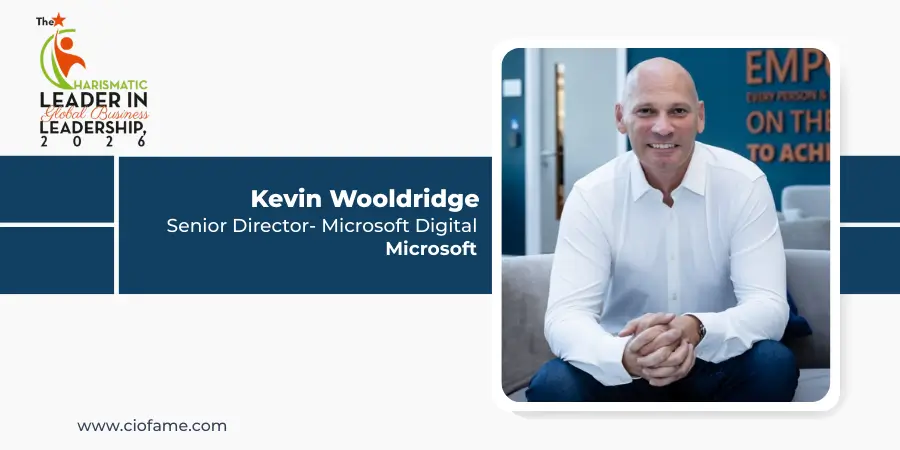
Kevin Wooldridge takes a different view. For him, the most powerful signal in a noisy world is clarity. As the Senior Director of Business Programs at Microsoft, Wooldridge operates at the intersection of massive scale and human nuance.
Woolridge’s role is to orchestrate programs that pressure-test enterprise capabilities and shape product direction. But his philosophy is rooted in a much quieter, more potent truth. He believes that in a landscape defined by constant change, the leaders who truly matter are not the ones putting on a show. They are the ones making others feel capable.
The New Charisma
The traditional definition of the charismatic leader is shifting. We often imagine a leader as someone who captivates an audience with showmanship, a figure who stands apart from the team they lead. Wooldridge argues that this version of charisma is obsolete. He asserts that charisma is not showmanship at all. Instead, it is a blend of clarity, conviction, and connection.
This redefinition is essential for the current global business environment. Wooldridge notes that in a world saturated with information, genuine presence and transparent communication are far more powerful than theatrics. The goal is not to impress the team but to connect with them. For Wooldridge, charismatic leadership today means making others feel seen and capable. It requires a leader to bring purpose to the surface, especially when the work itself is complex and difficult.
This brand of leadership demands authenticity. It asks a leader to be real enough that people trust their direction, even when the outcomes are not guaranteed. It is a stark departure from the “fake it until you make it” mentality. It is about grounding a team in reality and giving them the confidence to move forward. Wooldridge advises aspiring executives to lead with purpose rather than polish. The world does not need more perfect leaders, he argues. It needs more human ones.
The Three Pillars of 2026
Looking toward the future, specifically the leadership landscape of 2026, Wooldridge identifies three qualities that will define success. These are not merely nice-to-have traits. They are the essential toolkit for anyone hoping to navigate the next decade of business.
The first is Adaptive Clarity. This is the ability to provide direction even when information is incomplete. Leaders can no longer wait for perfect data before making a move. They must offer a clear path forward through the fog of ambiguity.
The second is Technological Fluency. Wooldridge is careful to distinguish this from technical skill. It is not about coding. It is about understanding how digital capability drives strategic advantage. A leader must know the tools well enough to understand their potential impact on the business model.
The third is Human Leadership. This encompasses empathy, cultural awareness, and the ability to build belonging. This is the glue that holds the other two pillars together. When leaders blend these three qualities, Wooldridge observes that a powerful shift occurs. Teams follow not because they are told to do so, but because they want to.
Customer Zero: The Proving Ground
This philosophy is not theoretical for Wooldridge. It is tested daily in what Microsoft calls its “Customer Zero” mission. This is the company’s commitment to be its own first and best customer. Wooldridge leads teams that ensure Microsoft does not just build cutting-edge products but proves them in its own environment at a global scale.
The scope of this work is immense. It involves running Microsoft on Microsoft across AI, cloud, cybersecurity, and platform innovation. By doing so, they create a feedback loop that keeps the company ahead. Wooldridge’s responsibility is to connect engineering, leadership, and customers. He translates real-world business challenges into actionable insights that improve products and the company itself.
He describes the role as a mix of technical oversight, organizational leadership, and storytelling. It is about helping the world understand how Microsoft runs on Microsoft. This “Customer Zero” thinking goes beyond implementation. It is about shaping what the future looks like. By pressure-testing capabilities internally, his teams generate guidance, product improvements, and customer confidence for the external market. They test early, iterate quickly, and share transparently.
The Anatomy of Momentum
Leading such complex programs across a global organization requires a specific approach to motivation. Wooldridge focuses on three operational levers to keep his teams moving: clarity, empathy, and momentum.
His view on burnout is particularly insightful. He believes that people do not burn out from hard work. They burn out from uncertainty. Therefore, his primary job is to ensure teams always know where they are heading and why. Clarity removes friction.
Empathy is the second lever. Wooldridge operates on the assumption that everyone is carrying more than can be seen. Pausing to understand the human context changes everything about how a team functions.
The third lever is momentum itself. Progress is energizing. To maintain this energy, Wooldridge breaks big missions into meaningful wins so that teams feel traction even in the midst of complexity. He notes that challenging times are not when leaders become different people. They are when leaders become more visible.
Balancing innovation, performance, and people management is a tension by design. Wooldridge manages this by optimizing across different horizons. He looks at performance quarterly, innovation monthly, and people daily. He creates frameworks of “structured autonomy” that give teams freedom without descending into chaos.
Stewards of the Artificial Age
As we approach 2030, Wooldridge sees the role of leadership evolving in response to AI and cloud technologies. The fundamental shift will be a move from decision-making to decision-stewarding. In this new reality, AI will produce options, and leaders will provide judgment.
Cloud-scale capability will compress innovation cycles dramatically. Organizations will need leaders who can pivot weekly rather than yearly. In this environment, emotional intelligence, ethical reasoning, and strategic narrative-building will become the new executive skillset.
Wooldridge prepares his teams for this future by focusing on two mindsets. The first is cocreation rather than competition. He views AI as a partner, not a threat. The second is a focus on capability over tasks. Skills evolve, but capabilities endure. By empowering teams to be adaptable, curious, and AI-literate, he ensures they stay relevant no matter how the landscape changes.
The Anchors of Resilience
Wooldridge’s professional journey began far from cloud architecture. He started with a fascination for how people, systems, and organizations work, and more importantly, how they break. Early roles in operations and customer-facing environments taught him that value is driven by clarity, empathy, and execution.
Moving into Microsoft was a defining shift. The scale and ambition of the company force rapid growth. Leading global programs taught him the importance of narrative leadership and the ability to translate complexity into direction.
To stay grounded amidst these global responsibilities, Wooldridge relies on sport. He cites football as a key influence, noting that in sport, culture is everything and leadership is felt long before it is spoken. His community work with organizations like MOJOE, Fair Game, and Access Sport reminds him daily why inclusion and accessibility matter. These experiences keep him connected to communities where impact is tangible and human.
He protects his routines ruthlessly. This includes reflection time in the morning and clarity-setting at the start of each week. He ensures his calendar reflects his priorities, not the other way around.
A Legacy of Empowerment
Ultimately, Kevin Wooldridge’s leadership is defined by a simple ambition. He hopes to be remembered as a leader who lifted people up. He wants to be known as someone who made organizations better, teams stronger, and individuals more confident in their own capabilities.
His legacy, he hopes, will be a blend of technological impact and human contribution. It is about building systems that scale and communities that thrive. Where the world is overwhelmed by technical complexity, Wooldridge remains focused on the human element. He believes that global leadership starts with local accountability. It is about how you show up each day.