From Early Tech Builder to a Voice Shaping AI
Long before artificial intelligence became the center of boardroom conversations, Hocine Ousmer was already experimenting with technology.
At just 11 years old, he built his first website. By 15, he had created his first mobile application. For many teenagers, technology is something to consume. For Ousmer, it was something to build.
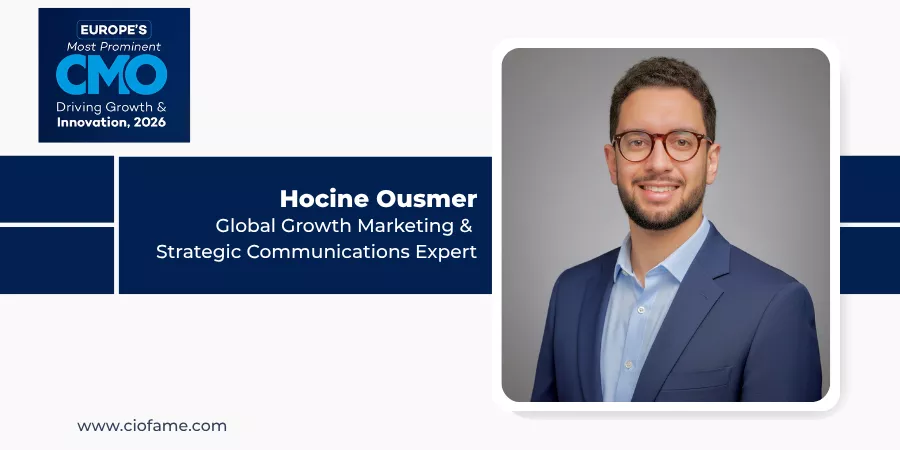
That early instinct, to create rather than observe, would quietly shape the trajectory of his career. Today, Ousmer is recognized as one of the marketing leaders to watch in 2025, serving as Chief Marketing Officer at Datategy, a company focused on deploying advanced data and AI systems for organizations around the world.
But to understand Ousmer’s perspective on artificial intelligence today, one has to go back to those early years when experimentation mattered more than perfection.
“What those early projects taught me,” he often reflects, “is that technology should always be about making something useful. Not just talking about innovation, but actually building it.”
That mindset, deeply rooted in experimentation and impact, has remained constant throughout his career.
A Career Built on Impact, Not Activity
Ousmer’s professional journey began in the world of marketing and brand strategy, where storytelling, positioning, and audience understanding were central to his work.
Early in his career, he joined Swatch Group, becoming one of the youngest marketers in the organization. The experience proved formative. In an environment defined by global competition and strong brand heritage, Ousmer quickly learned that credibility does not come from age or titles, it comes from clarity and results.
Preparation became a discipline. Overdelivering became a habit.
Later, at 28 years old, he took on the challenge of leading a startup as general manager, stepping into full leadership responsibilities during one of the most complex periods for businesses: the COVID-19 pandemic.
Those years forced difficult decisions and reinforced lessons about leadership under uncertainty. Ousmer learned that effective leaders cannot wait for perfect information before acting. They must instead create alignment, clarity, and momentum, even when the path forward remains uncertain.
For him, leadership has never been about control.
“Leadership is about creating energy and direction,” he says. “It’s about helping teams understand why their work matters.”
This focus on impact rather than activity became one of the defining principles of his professional philosophy.
From Marketing to Artificial Intelligence
While marketing was the starting point of Ousmer’s career, the rapid evolution of artificial intelligence began reshaping his ambitions.
Traditional marketing is about persuasion and storytelling. But AI offered something more powerful: the ability to help organizations make better decisions.
This realization gradually led him toward the world of data and machine learning systems, where he now works through his role at Datategy.
At the company, Ousmer helps drive the strategic vision behind platforms designed to industrialize AI projects, helping organizations move from isolated experiments to scalable systems integrated into daily operations.
The problems AI can address are vast: predictive maintenance in transportation systems, economic forecasting in the public sector, optimization of supply chains, and data-driven decision support for complex organizations.
For Ousmer, these applications represent something larger than technological progress. They represent a shift in how humans interact with information and complexity.
“Artificial intelligence is not about replacing human intelligence,” he explains. “It’s about augmenting it, giving people better visibility, better predictions, and better tools to act.”
The Responsibility Behind AI Innovation
As AI systems become more powerful, Ousmer believes the conversation must move beyond performance metrics and technical sophistication.
The real challenge is trust.
Artificial intelligence increasingly influences decisions that affect economies, infrastructure, and everyday life. That influence makes transparency and accountability essential.
Ousmer has been particularly vocal about the need for ethical frameworks that allow organizations to evaluate the integrity of their AI systems.
This conviction led him to develop the TPE Score, a methodology designed to measure AI systems according to three essential pillars:
- Transparency
- Privacy
- Explainability
The framework aims to give organizations a clearer understanding of how their algorithms operate and how responsibly they are deployed.
“AI is not neutral,” Ousmer often emphasizes. “It reflects the data it learns from and the choices made by the people who build it.”
For that reason, he argues that ethical AI cannot be treated as an afterthought. It must be embedded into the design, deployment, and monitoring of systems from the beginning.
Marketing in the Age of Intelligent Systems
Artificial intelligence is also transforming the field where Ousmer first built his reputation: marketing.
In the coming years, he believes the discipline will shift dramatically as companies gain the ability to analyze massive amounts of behavioral data and predict consumer responses with increasing precision.
Predictive analytics will guide marketing budgets. AI-driven systems will personalize communication at scale. Campaign optimization will happen in real time.
But perhaps the most important transformation lies in the rise of knowledge-driven AI models, such as Retrieval-Augmented Generation (RAG), which allow organizations to generate content and insights grounded in verified data sources.
These technologies are creating entirely new forms of interaction between companies and their audiences.
Yet despite the rise of intelligent automation, Ousmer insists that one fundamental element of marketing will remain unchanged: storytelling.
Why Storytelling Still Matters
In a digital economy where products are easily replicated and information circulates instantly, trust has become the most valuable currency.
For Ousmer, storytelling is the mechanism through which companies communicate their values, their mission, and the human dimension behind their technologies.
Today’s audiences are no longer satisfied with polished advertising campaigns. They want authenticity. They want to understand the purpose behind innovation.
That is why Ousmer encourages organizations to talk openly about the real challenges, real people, and real use cases behind their products.
At Datategy, storytelling often revolves around how AI systems are used to solve tangible problems,improving railway maintenance, helping financial institutions analyze risk, or supporting governments in complex planning decisions.
By highlighting the human impact of technology, Ousmer believes companies can build deeper connections with their audiences.
Building the Habit of Innovation
Despite the sophistication of the AI systems he works with, Ousmer often returns to a surprisingly simple idea: innovation is not created by large projects alone.
It is built through daily practice.
One of the most common mistakes he sees in organizations is treating artificial intelligence as a one-time initiative, launching a pilot project without integrating the technology into everyday workflows.
Instead, Ousmer encourages teams to use AI consistently, even for small tasks.
“AI is like learning a language,” he explains. “You only become fluent by using it every day.”
When teams adopt AI tools for routine activities, analyzing data, generating reports, exploring insights, they gradually discover new applications and unlock unexpected efficiencies.
Over time, this continuous use builds what Ousmer describes as the muscle for innovation.
A Competitive Advantage for the Next Decade
Looking toward the future, Ousmer believes the defining competitive advantage of the next decade will not simply be access to artificial intelligence.
It will be the speed at which organizations learn to adopt it.
AI acts as a powerful multiplier. It shortens decision cycles, improves analytical accuracy, and frees human talent to focus on strategic thinking and creativity.
But technology alone does not create leadership.
The organizations that will lead the coming decade are those willing to experiment, adapt quickly, and integrate AI into the fabric of their operations.
“Those who learn fastest,” Ousmer says, “will move fastest.”
A Personal Philosophy That Has Never Changed
Despite the growing complexity of the technologies he works with, Ousmer’s guiding philosophy remains remarkably consistent with the mindset he had when building his first website as a child.
Technology must always serve people.
Artificial intelligence, in his view, should not be designed to impress audiences with its sophistication but to help individuals and organizations make better decisions and solve real-world problems.
For companies still hesitant to embrace AI, his advice remains direct.
Start small.
Experiment with real use cases.
Learn by doing.
Because ultimately, artificial intelligence will not define the future on its own.
The future will be defined by how humans choose to use it.
Who Is Hocine Ousmer?
Hocine Ousmer is a passionate technologist and innovation leader who has been shaping the digital world. From building websites as a child to leading complex AI projects today, Hocine has always believed that technology’s true power lies in its ability to create impact, not just noise.
As Chief Marketing Officer, he combines his deep understanding of marketing with a hands-on maker’s mindset to help organizations adopt AI responsibly and effectively.
Recognized for his impact on the industry, Hocine was named one of the Top Influential Marketing Leaders to Watch in 2025, alongside receiving other prestigious awards that highlight his contributions to technology, ethics, and innovation.
His work is driven by a commitment to ethics, transparency, and human-centric design, ensuring that every solution he promotes not only solves a problem but also makes life easier, smarter, and more meaningful for the people who use it