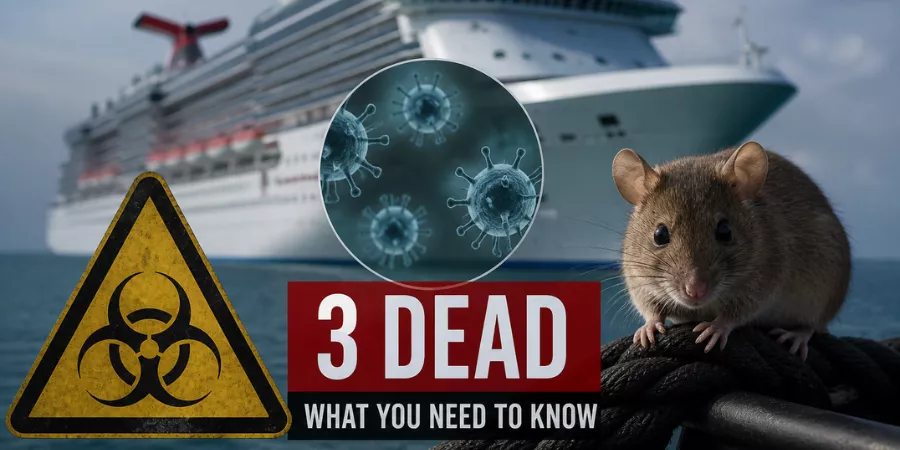
Three people are dead and at least three others are seriously ill after a suspected hantavirus outbreak on a cruise ship crossing the Atlantic Ocean. The MV Hondius, a Dutch-flagged polar cruise ship operated by Oceanwide Expeditions, is now anchored off the port of Praia, Cape Verde, as the World Health Organization coordinates emergency evacuations and a full public health investigation.
5 things to know right now:
- Three passengers died; hantavirus confirmed in at least one case, suspected in five others.
- One patient is in intensive care at a South African hospital.
- The ship carried around 150 tourists and 70 crew members.
- There is no cure for hantavirus, early treatment is the only way to improve survival.
- WHO has notified global health authorities under international health regulations.
This is a developing story. Here is everything confirmed so far.
What Happened on the MV Hondius?
The MV Hondius left Argentina roughly three weeks ago on a polar expedition cruise. The route included Antarctica, the Falkland Islands, and St. Helena, with the final destination being Spain’s Canary Islands.
Passengers started falling ill during the voyage. Two of the three people who died were a Dutch married couple, a 70-year-old man who was declared dead on arrival at St. Helena, and his 69-year-old wife who collapsed at Johannesburg’s OR Tambo International Airport while trying to fly home to the Netherlands. She died at a health facility shortly after.
A third passenger, a UK national, tested positive for hantavirus and is currently being treated in intensive care in Johannesburg. His condition remains serious.
The ship is currently stationary off Praia, the capital of Cape Verde. Cape Verde authorities have boarded the vessel to assess conditions but have not yet approved disembarkation for those still showing symptoms. Dutch authorities are working to repatriate affected passengers from Cape Verde to the Netherlands.
What WHO is Saying?
WHO confirmed it is aware of and supporting a public health event involving a cruise vessel in the Atlantic Ocean, and said detailed investigations are ongoing, including laboratory testing, epidemiological investigations, and virus sequencing.
Of the 6 people sickened, hantavirus was confirmed in one case and is suspected in 5 others.
WHO has notified global health authorities under international health regulations and said it is conducting a full public health risk assessment alongside national authorities and the ship’s operators.
South Africa’s National Institute for Communicable Diseases is running contact tracing in the Johannesburg area to identify anyone else who may have been exposed when infected passengers passed through the airport.
What is Hantavirus?
Hantavirus is a group of viruses found worldwide. Most people who get it have been in contact with infected rodents, specifically their urine, droppings, or saliva. You do not need to handle a rodent to get infected. Breathing in dust contaminated with rodent droppings in enclosed spaces is enough.
It has been confirmed that there is no specific treatment or cure for hantavirus infections, however early medical attention can increase the chance of survival.
There are two main forms of the disease:
| Type | Region | Main Symptom |
| Hantavirus Pulmonary Syndrome (HPS) | Americas | Fluid in the lungs, breathing failure |
| Hemorrhagic Fever with Renal Syndrome (HFRS) | Europe, Asia | Kidney failure, bleeding |
Symptoms typically appear in two stages:
- Early stage (days 1-5): Fatigue, fever, severe muscle aches, headaches, dizziness, chills, nausea, vomiting, abdominal pain.
- Late stage (days 5-10): Coughing, shortness of breath, chest tightness as fluid builds in the lungs.
The CDC states that more than 35% of patients who develop respiratory symptoms from Hantavirus Pulmonary Syndrome die from it. That fatality rate is what makes this outbreak alarming.
Can Hantavirus Spread Between People?
This is the question most people are asking right now, and the honest answer is: usually no, but not never.
WHO said: “While rare, hantavirus may spread between people, and can lead to severe respiratory illness and requires careful patient monitoring, support and response.” (Source: Digi Invent)
Person-to-person transmission is extremely rare in most hantavirus strains. The Andes virus, found in South America, is one exception, it has documented cases of human-to-human spread. Investigators are currently sequencing the virus from this outbreak to determine which strain is involved, which will answer this question definitively.
For now, WHO’s message is clear: careful monitoring of all close contacts is essential.
The Gene Hackman Connection
Many people first heard about hantavirus earlier in 2025. In February 2025, Betsy Arakawa, wife of Hollywood actor Gene Hackman, died of hantavirus pulmonary syndrome. Hackman, 95 and in poor health, died from heart disease and Alzheimer’s disease, likely about a week after his wife. The couple’s bodies were found in their home in New Mexico.
That case was traced to rodent exposure in their home. The cruise ship outbreak is a completely separate incident, but it has brought renewed attention to how unpredictable this virus can be.
FAQ: Hantavirus Cruise Ship Outbreak
How do you catch hantavirus? Through contact with infected rodent urine, droppings, or saliva, or by breathing in contaminated dust in enclosed spaces.
Is there a vaccine for hantavirus? No. There is no approved vaccine or cure. Supportive care in a hospital is the only option.
What is the hantavirus mortality rate? Over 35% once respiratory symptoms develop, according to the CDC.
Can hantavirus spread on a cruise ship? Normally, hantavirus does not spread easily between people. WHO is actively investigating how this outbreak occurred aboard the MV Hondius.
What mice carry hantavirus? Deer mice are the primary carrier in North America. Other rodent species carry different strains across Europe, Asia, and South America.
Can I survive hantavirus? Yes, many people do, especially with early hospitalisation. The key is getting medical help the moment respiratory symptoms start.
What Happens Next
The MV Hondius remains anchored off Cape Verde. Two symptomatic passengers are still aboard, and their evacuation depends on approval from local health authorities. Dutch officials are coordinating repatriation for those affected.
WHO is sequencing the virus to identify the exact strain, which will clarify transmission risk. Contact tracing continues in Johannesburg. The remaining passengers, around 144 people, are under observation.
This is a still-developing public health event. As new information is confirmed, this article will be updated.
Key Takeaways:
On the ship’s status: The MV Hondius is a specialist polar expedition vessel, not a traditional large cruise ship. It carries far fewer passengers than ships like Royal Caribbean or Carnival, around 150 tourists in this case. That smaller, enclosed environment over a multi-week voyage is exactly the kind of setting where a rodent-linked infection could spread before anyone notices the pattern.
On how the virus likely got on board: No official source has confirmed the exact exposure point yet. But polar expedition ships frequently dock at remote ports and islands, the Falkland Islands, South Georgia, St. Helena, where rodent populations are significant and biosecurity controls are minimal. Investigators are almost certainly looking at these stops.
On the passengers still on board: As of the latest updates, Cape Verde authorities had still not authorized disembarkation for symptomatic passengers. That means people who may need urgent care are stuck on a ship while a diplomatic and logistical negotiation plays out. Oceanwide Expeditions said their priority is getting those two individuals to proper medical facilities, but the timeline remains unclear.
On the broader risk: The CDC tracks roughly 50 hantavirus cases per year in the United States alone. Globally, cases go widely underreported because early symptoms look exactly like flu. Many people in rural or rodent-exposed environments have likely had mild hantavirus exposure and recovered without ever being diagnosed.
One thing that genuinely matters for anyone reading: If you have been in an area with rodent activity, a cabin, a basement, a barn, an old building, and you develop fever, muscle aches, and then suddenly feel short of breath within a week or two, that combination is a red flag. Most doctors will not immediately think of hantavirus. You may need to specifically mention the exposure. Early hospitalisation is the single biggest factor in survival.