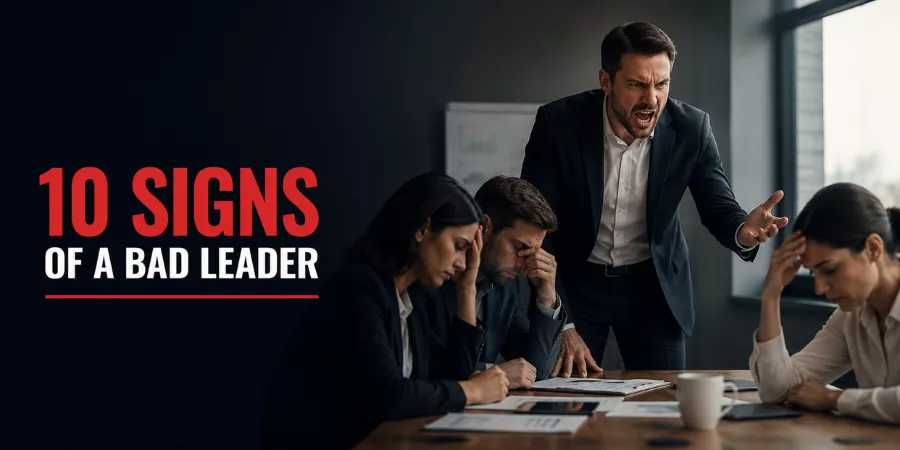
Most people do not leave a job because of the work itself. They leave because of the person leading it. A bad leader can drain confidence, silence good ideas, and turn a capable team into one that only survives the week.
The warning signs of bad head often show up early: in how they speak to people, how they handle pressure, and how they react when they are challenged.
Some leaders control through fear. Others confuse authority with arrogance. A few may look polished on the surface while damaging morale underneath.
Below are the 10 signs of a bad leader at work, grounded in how authority breaks down inside teams.
- They Confuse Control with Leadership
Some managers believe that if they are not constantly checking in, things will fall apart. So, they check in constantly. Micromanagement issues rarely come from malice, they come from anxiety dressed up as diligence.
Control reduces a leader’s discomfort, not the team’s risk. A bad leader monitors every email, rewrites finished work without explanation, and demands updates on tasks they’ve already approved. The message employees receive isn’t “I care about quality.” It’s “I don’t trust you to do your job.”
Gallup found that managers account for 70% of the variance in team engagement, and excessive control often causes employees to perceive coaching as micromanagement rather than support.
Over time, people stop making decisions on their own. Why bother, when it’ll get redone anyway?
- They Talk More Than They Listen
Poor communication in leadership doesn’t always look like silence. Sometimes it looks like someone who never stops talking but never exchanges information.
Watch a meeting. Does this person ask questions and wait for real answers, or ask rhetorically and answer themselves? Bad leaders mistake talking for communicating. They explain, announce, and instruct, but rarely check whether anyone understood, agreed, or saw the situation differently.
Example: During weekly meetings, the manager spends 45 minutes presenting updates and leaves 5 minutes for questions. Employees stop sharing ideas because every discussion becomes a lecture.
This is one of the clearest signs of poor leadership at work because it’s measurable. Count how often a leader pauses to ask “what am I missing?” If the answer is never, that’s data.
Gallup’s engagement research identifies employees whose opinions count at work as significantly more engaged. Managers who fail to listen contribute directly to disengagement, and manager behavior drives 70% of team engagement outcomes.
- They Punish Honesty Without Realizing It
A bad leader asks for feedback, then reacts badly when they get it. Maybe they get defensive. Maybe they go quiet for a week. Maybe it surfaces months later in a performance review.
A single sharp reaction to one piece of honest feedback teaches an entire team a lesson: don’t be honest here. That’s how lack of trust in teams actually forms, not from one dramatic betrayal, but from a dozen small moments where speaking up felt riskier than staying quiet.
BCG research shows psychological safety is essential because employees speak up only when they believe they will not be blamed or criticized for doing so. Teams lacking psychological safety experience higher attrition risk and lower innovation.
- They Take Credit and Distribute Blame
This is one of the oldest bad leadership traits, and it survives because it’s structurally convenient. Wins get attributed upward, “I restructured the process.” Losses get attributed downward, “the team didn’t execute.”
What makes this corrosive isn’t the unfairness alone. It severs the link between effort and recognition. Employees who do good work and watch someone else claim it eventually do less of it, because the incentive disappeared.
A simple test: in a project retrospective, does this leader say “we” for failures and “I” for successes? Or the reverse?
Research on toxic leadership found significant negative effects on employee motivation, satisfaction, and performance when leaders engage in self-serving behaviors.
- Their Mood Sets the Weather
A bad manager’s emotional state sets the team’s emotional climate. If they’re irritated, everyone tiptoes. If they’re in a good mood, problems can be raised again.
Employees stop managing their actual work and start managing their manager, reading body language before a 1:1, timing requests around good days, rehearsing how to phrase bad news. That’s cognitive energy stolen directly from the job.
This bad manager behavior is sneaky because it doesn’t look like a policy. It looks like personality. But a team shouldn’t have to function as weather forecasters.
- They Avoid Conflict Until It’s Unavoidable
Not every bad leader is loud. Plenty are conflict-averse to the point that real problems get ignored until they explode.
An underperforming employee gets vague hints instead of direct feedback for eight months. Then there’s a sudden termination, and the rest of the team is blindsided. This ineffective leadership style masquerades as kindness. It isn’t. It’s avoidance, and the cost gets paid later, with interest.
Characteristics of a bad leader often include this exact gap: what they say privately (“it’s fine, don’t worry”) and what they actually believe.
BCG notes that psychologically safe teams can engage in healthy disagreement and raise concerns openly. Avoiding difficult conversations is associated with weaker team learning and problem-solving.
- They Treat Their Title as the Argument
“Because I said so” rarely gets said out loud, but it gets implied constantly. A bad leader who can’t explain the reasoning behind a decision falls back on hierarchy instead: I’m the manager, so this is happening.
Reasoning is how people learn to trust judgment. A leader who explains their thinking, even when the decision is unpopular, builds credibility over time. One who simply asserts authority builds compliance, which looks similar on the surface but collapses the moment that person isn’t watching.
Gallup data shows only 19% of U.S. employees strongly agree they trust their organization’s leadership, highlighting how easily trust erodes when leaders rely on authority instead of credibility.
- They are Inconsistent in Ways That Feel Personal
Inconsistency is psychologically damaging because human brains look for patterns, and inconsistency denies that search any stable answer.
Same mistake, different consequences, depending on who made it and what mood the manager is in. One person gets coached gently; another gets reprimanded sharply for something nearly identical. Employees start interpreting this as personal, am I the problem, or are they just having a bad week, when it’s usually neither. It’s unmanaged inconsistency.
LinkedIn’s management research identifies inconsistency in expectations and decision-making as a common indicator of poor management because it damages morale and trust.
- They Confuse Busyness with Productivity
Some leaders measure commitment by visible exhaustion: long hours, constant messages at 11 PM, meetings stacked back-to-back. They expect the team to mirror this, explicitly or not.
This trait often comes from insecurity about their own value. If they can’t clearly demonstrate impact, busyness becomes the substitute. The team absorbs the pressure, working longer not because the work demands it, but because the optics do.
Gallup reports that engaged teams achieve 23% higher profitability and 18% higher sales productivity, demonstrating that outcomes matter more than visible activity. Productivity is driven by engagement and clarity, not exhaustion.
- They Don’t Grow, and Don’t Want Feedback That Suggests They Should
Ask a good leader “what would you do differently?” and they usually have an answer. Ask a bad one, and you’ll get deflection, a joke, or a reminder of their seniority.
This trait predicts almost everything else on this list. Leadership is a practice that requires constant correction. A leader who can’t be corrected stops improving the moment they stop being challenged.
Gallup reports that less than half of managers have received formal management training, yet manager behavior remains the strongest predictor of team engagement. Leaders who resist feedback often stop developing while their teams continue evolving.
Author’s Opinion
Most bad leaders show several of these signs at once, not because they’re uniquely flawed, but because the traits reinforce each other. Someone who avoids conflict often becomes inconsistent. Someone who can’t accept feedback often falls back on title instead of reasoning.
If several of these feel familiar from your own workplace, that’s the first real step toward deciding what to do next.
FAQs
How do you identify a bad leader at work?
Look for patterns, not single incidents. Repeated inconsistency, avoidance of direct feedback, and a gap between what they say and how they act under pressure are stronger signals than any one bad day.
What are signs your boss is a bad leader?
Mood-driven decisions, taking credit for wins while assigning blame for failures, and defensiveness toward honest feedback.
How does bad leadership affect employees?
It raises stress, reduces initiative, and erodes trust, leading to lower engagement, higher turnover, and employees who do the minimum instead of their best work.
What are real examples of bad leadership in the workplace?
Rewriting an employee’s finished work without explanation. Giving vague feedback for months before a sudden termination. Praising a team publicly while undermining its members privately.
How do you deal with a bad leader or manager?
Document patterns, not isolated incidents. Set clear boundaries around your workload and communication. Get an outside perspective, a mentor, HR, or trusted colleague, before assuming the problem can’t be solved.