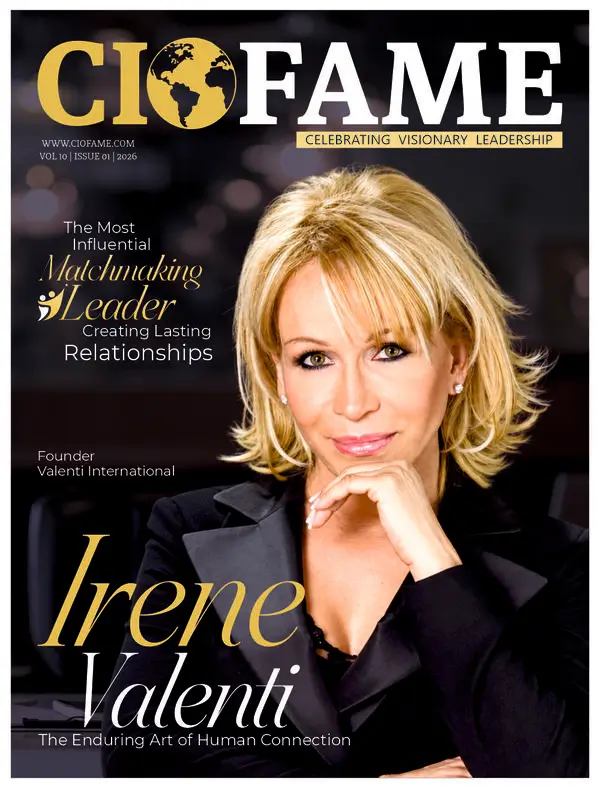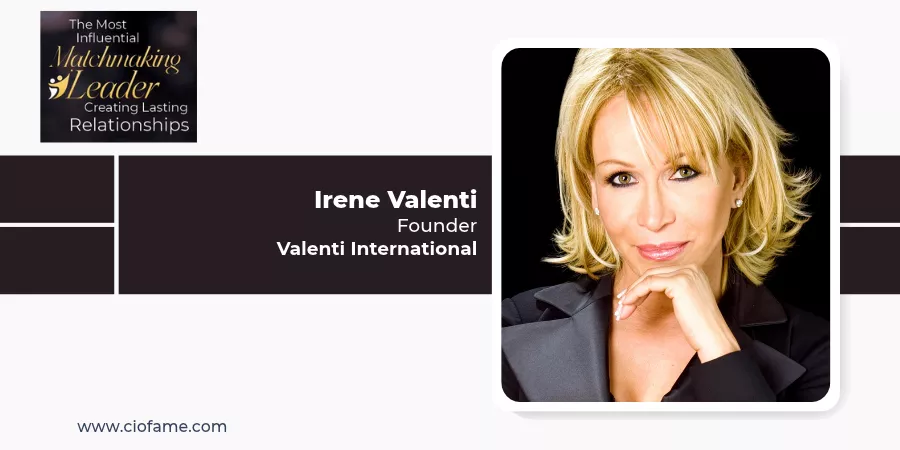
From a childhood shaped by family tradition to a career in personalized matchmaking, the founder of Valenti International reflects on love, achievement, and the relationships that give life meaning.
Professional accomplishment and personal fulfillment do not always arrive together. A successful career may bring recognition, security, and satisfaction, yet leave unanswered a personal question: With whom will these experiences be shared? For more than three decades, Irene Valenti has devoted her professional life to helping people navigate that question. As founder of Valenti International, established in Rancho Santa Fe, California, in 1990, she built a matchmaking enterprise around an understanding that has deepened with experience: finding a suitable partner involves far more than identifying two people whose circumstances appear compatible.
The origins of that understanding reach back to Valenti’s childhood. She grew up in a large family where affection was abundant, marriage was valued, and conversations about building a happy home were part of everyday life. Her parents remained married for 60 years, providing an enduring example of commitment. Although the family had limited financial resources, she recalls a household so rich in love that material deprivation scarcely registered. They were happy, and that happiness shaped her understanding of what mattered.
Around the dinner table, discussions of the future included education and work, but also marriage, children, and the importance of establishing a family. Matchmaking was part of her heritage, and her father helped introduce family members to prospective partners. Valenti learned by observing the care with which such decisions were approached, developing an appreciation for relationships as something worthy of intention rather than chance alone.
That perspective eventually found expression in an unconventional business venture. After relocating from Canada to Southern California, Valenti established her service in 1990, when exclusive, personalized matchmaking was less familiar in the American marketplace than it is today. Despite skepticism, she persisted, beginning with a single client and gradually building an international enterprise. Her work combined traditional European practices with discretion, individual attention, and an understanding of contemporary professional life.
Beyond the Perfect Match
When Valenti began her career, she approached compatibility through identifiable qualities: background, values, aspirations, and lifestyle. These considerations remain important, but experience has taught her that they offer only a partial picture of what sustains a relationship. “The most successful relationships aren’t necessarily between two people who appear perfect for one another on paper, but between individuals who make each other feel safe, appreciated, and genuinely loved,” she explains.
This distinction is particularly relevant among accomplished professionals accustomed to demanding standards. Valenti has encountered clients whose extensive lists of desired characteristics unintentionally exclude individuals with whom they might establish meaningful relationships. “There is nothing wrong with knowing what you want, but sometimes an extensive checklist can become an obstacle to finding something extraordinary,” she observes.
Her approach is not to persuade clients to lower their standards, but to distinguish between qualities essential to their happiness and preferences that may be less consequential. She encourages them to consider not only what they seek in another person, but how they hope to feel within the relationship itself. Understanding the experiences behind those preferences is often as important as evaluating tangible aspects of compatibility.
The Responsibility of Bringing People Together
Although matchmaking is associated with romance, elegant introductions, and the promise of lasting companionship, Valenti describes a profession carrying considerable emotional responsibility. Clients entrust her with private hopes and vulnerabilities, sometimes after years of disappointment. Their concerns do not disappear when an introduction is arranged, and she acknowledges that their difficulties can remain on her mind long after the working day ends.
There are moments of enormous satisfaction when a relationship flourishes, alongside sleepless nights spent worrying about someone who is struggling. Over time, she has developed an affection for many clients that resembles the concern one might feel for family. It is an aspect of the profession rarely visible to those who see only successful introductions.
Not every promising match develops into a lasting relationship. Even when backgrounds and aspirations align, attraction may not emerge, circumstances may intervene, or one person may be less emotionally prepared than anticipated. These disappointments have influenced Valenti’s judgment as profoundly as her successes. “Matchmaking is not simply about identifying compatible individuals; it’s also about understanding human emotions, timing, vulnerability, and readiness,” she explains. Such experiences have made her a more patient adviser and attentive listener, reinforcing her conviction that no formula can account for two individual lives.
Her work has also revealed the distinction between achievement and fulfillment. Valenti has encountered people who have built businesses, accumulated wealth, and realized ambitions, yet still long for someone who knows them beyond their accomplishments. “Ultimately, the greatest luxury in life isn’t material wealth. It’s genuine human connection,” she says. The sentiment resonates with her upbringing, when financial resources were limited but belonging was plentiful.
An Enduring Philosophy in a Changing World
The dating landscape has changed dramatically since Valenti established her company. Digital platforms have expanded opportunities for introductions, while social media has altered how people present themselves and evaluate prospective partners. Greater access, however, has not necessarily simplified the search for compatibility. Valenti International continues to emphasize personal consultations, discretion, and considered introductions, drawing upon human judgment rather than relying exclusively on technological selection.
For Valenti, this approach requires accepting the limits of matchmaking. An introduction may create an opportunity, but the individuals involved decide what to make of it. Respect, communication, flexibility, and the willingness to understand another person’s perspective cannot be supplied by a matchmaking service, however carefully the introduction is arranged.
Her professional interests extend beyond the business through philanthropic initiatives associated with the Valenti Foundation, including support for vulnerable children and older adults. Yet when she considers her legacy, her thoughts return to the family experiences that shaped her values.
Valenti believes young people are encouraged to plan for education, careers, and financial independence while devoting comparatively little thought to the relationships and family life they hope to establish. She would like future generations to consider those aspirations with similar seriousness, recognizing that professional ambitions and meaningful relationships need not compete.
Her advice reflects both a long career and the example she witnessed at home. “Never confuse perfection with compatibility, and never underestimate the importance of kindness.” She encourages people to maintain their values while remaining open to the unexpected, understanding that affection alone cannot sustain a partnership without mutual respect, compassion, and a willingness to grow together.
More than three decades after founding Valenti International, Valenti continues to measure the significance of her work through the lives it touches. Her career began with a family tradition and developed into a business devoted to helping others find companionship. Yet the principle underlying both remains much as it was around her childhood dinner table: a fulfilling life is shaped not only by what we achieve, but by the love we give and receive.
“At the end of our lives,” she reflects, “I believe we will be remembered far less for what we accumulated than for how deeply we loved and how we made others feel.”
Written by Dr. Mary Macedonio
Licensed Psychologist, CPC, ELI-MP, CLDS, CTDS, CWDS, CCTP, CMHIMP