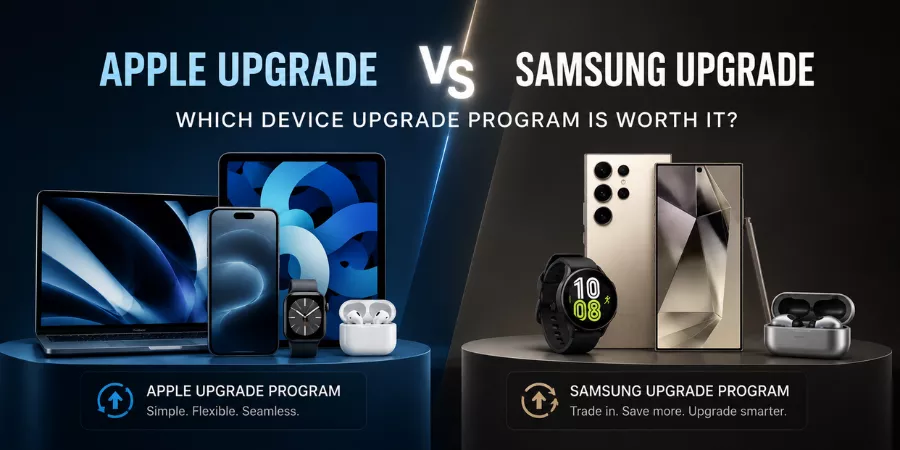
Both Apple and Samsung now want you to lease your tech instead of owning it. The pitch sounds the same from both companies, low monthly payments, easy upgrades, no big upfront cost. The details, once you look closely, are quite different.
TL; DR:
The contrast between Apple’s upgrade program and ecosystem versus Samsung reveals the major differences in the hardware, software flexibility, and the ways of upgrading. Apple is mainly dependent on its integrated ecosystem and leasing services like the AUP while Samsung, however, focuses more on the variety of hardware, offering multitasking capabilities, and setting up regional buyback systems such as Galaxy Forever.
Upgrade and Financing Plans:
- Apple: It comes up with monthly leasing and upgrade plans (further expanded through Apple partner programs) that pack together device service & easy swaps every year.
- Samsung: Mainly on carrier financing options or trade-in/buyback schemes that are region-specific (such as Galaxy Forever in some countries) instead of a worldwide subscription standard.
Below is a comparison of Apple Upgrade vs Samsung’s programs so you can decide which one makes sense for your situation.
What is Apple Upgrade?
Apple launched a new Apple Upgrade program in the month of July 2026, a monthly payment via Klarna option for getting an iPhone iPad Mac, or Apple Watch without having to buy the product upfront.
Just pick the product you want, make low monthly payments, then get your lease period to upgrade. For iPhone and Apple Watch, your lease periods could be either 12 or 24 months. As far as iPad and Mac are concerned, you can decide between a 24 – or 36 – month leased period.
Key pricing from Apple’s program page:
| Device | 24-Month Lease | 12-Month Lease |
| iPhone 17 | $22.99/mo | $32.99/mo |
| iPhone 17 Pro | $31.99/mo | $45.99/mo |
| MacBook Air | $24.99/mo (36mo) | $34.99/mo (24mo) |
| MacBook Pro | $38.99/mo (36mo) | $53.99/mo (24mo) |
| iPad Pro | $24.99/mo (36mo) | $31.99/mo (24mo) |
You do not own the device at the end. You return it and either upgrade into a new lease or pay the remaining balance to buy it outright. Leasing is provided by Klarna.
One important detail: AppleCare is not included. It is billed separately, and you have 60 days after enrolling to add it.
What is Samsung’s Upgrade Program?
Samsung runs two programs in the US, the Samsung Upgrade Program and the newer New Galaxy Club, with regional variations elsewhere including the Annual Upgrade Program in Canada.
The New Galaxy Club charges $6.20 per month for Galaxy S25, or $8.33 per month for Galaxy S25+ and Galaxy S25 Ultra, on top of your device financing. After making 12 monthly payments, you can trade in your phone and upgrade to a new model.
Samsung’s model is built around smartphones only. Unlike Apple Upgrade, there is no Mac or tablet equivalent. The monthly payment on Samsung’s program includes the device price, Samsung Care+, and services bundled together.
The Galaxy Forever program, launched in India in March 2026, works differently: you pay only 50% of the device cost over 12 instalments. At the end, you can upgrade and return the phone, keep it by paying the remaining 50%, or return it and walk away with nothing further owed.
Apple Upgrade vs Samsung: Side-by-Side
| Feature | Apple Upgrade | Samsung (New Galaxy Club) |
| Devices covered | iPhone, iPad, Mac, Apple Watch | Smartphones only |
| Lease provider | Klarna | Samsung / financing partners |
| Protection included | No ‒ AppleCare separate | Yes ‒ Samsung Care+ included |
| Minimum term to upgrade | End of lease (12 or 24 months) | 12 monthly payments |
| Early upgrade fee | Up to remaining payments | $100 before 9 months |
| Ownership option | Buy out at full original price minus payments | Pay off remaining balance |
| Trade-in at start | Yes ‒ reduces monthly payments | Yes ‒ reduces payments |
| Carrier required | Yes, for iPhone | No |
| Available in US | Yes | Yes |
Which Program Makes More Financial Sense?
This depends entirely on what you actually want from the arrangement.
Apple Upgrade suits you if you regularly use multiple Apple devices and want a single, structured way to cycle through them on a predictable monthly cost. The Mac and iPad coverage is genuinely useful, particularly now, with MacBook Air prices rising due to the memory shortage. Leasing a MacBook Air at $24.99 per month on a 36-month term costs considerably less upfront than paying $1,299.
The catch is that AppleCare is not included. Given that you are leasing a device you will need to return in good condition, most users will end up adding it, which adds to the monthly cost.
Samsung’s New Galaxy Club suits you if you upgrade your phone every year without fail, want device protection bundled in from the start, and do not want to think too hard about the mechanics. At $6.20 to $8.33 per month on top of device financing, the upgrade benefit is relatively cheap. But it only covers Galaxy phones, nothing else.
What Both Programs Have in Common?
Both Apple and Samsung are responding to the same market reality: device prices have risen sharply in 2026, and monthly payments are an easier sell than asking someone to absorb $1,299 upfront for a laptop or $1,199 for a flagship phone.
Apple specifically notes that the MacBook Air shortage, tied to the global memory crunch, makes financing increasingly relevant for buyers who still need a Mac but cannot find one in stock or justify the current retail price.
Both programs also require you to return the device in good condition to avoid fees. Neither is a great deal if you tend to drop things.
Bottom Line
Apple Upgrade covers more devices, which gives it genuine breadth, especially for households deep in the Apple ecosystem. Samsung’s program is tighter, cheaper in subscription cost, and bundles protection in, but it is limited to phones.
Neither program makes the devices themselves cheaper. They make the cost more manageable month to month, while keeping ownership firmly with the company until you either pay out or upgrade.
If you are comparing the two because you are trying to decide between an iPhone and a Galaxy, the upgrade program structure probably should not be the deciding factor. If you are already committed to one ecosystem and want to know whether the leasing layer is worth adding, the answer is: only if you genuinely upgrade on schedule and return devices in good condition. Otherwise, buying outright still works out better over time.