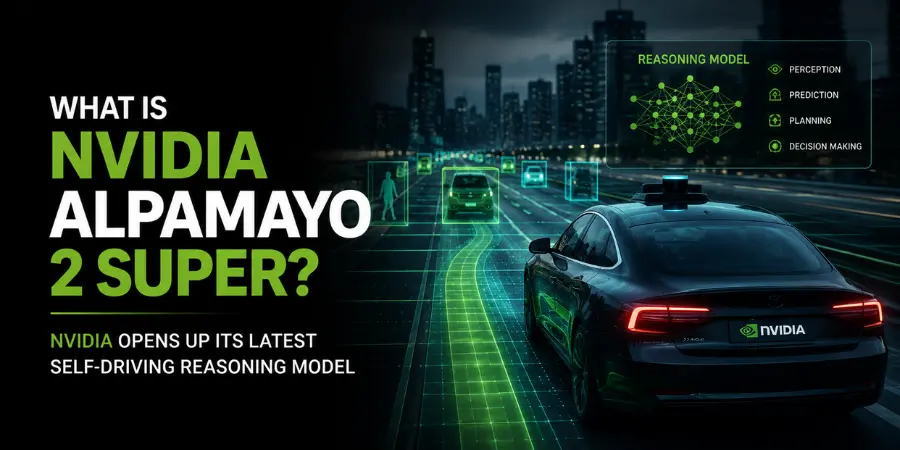
NVIDIA released Alpamayo 2 Super on August 4, a 34-billion-parameter open reasoning model for autonomous vehicles that generates driving trajectories, explains its own decisions in natural language, and auto-labels raw driving footage.
The company published the weights on Hugging Face and the inference code on GitHub, positioning the model as a shared foundation that AV teams can use across planning, evaluation, and data labeling instead of separate systems for each task.
The release is important because AV development has historically split those jobs across different models that do not share a common representation, making it hard to trace why a system made a given driving decision.
Alpamayo 2 Super combines a 32-billion-parameter Cosmos 3 Super Reasoner with a 2-billion-parameter diffusion-based Action Expert, post-trained with reinforcement learning, and processes video from up to 7 cameras for 360-degree coverage.
What is Alpamayo 2 Super?
NVIDIA Alpamayo 2 Super is an open reasoning AI model for autonomous vehicles that understands, plans, and acts in complex environments, enabling safer, scalable robotaxis and accelerating the future of robotics.
Jensen Huang’s LinkedIn Post:
“Today, we’re launching Alpamayo 2 Super, our frontier open reasoning model for autonomous vehicles.
Beyond seeing, Alpamayo understands and reasons through the complex world – thinks before it acts.
It’s a powerful backbone for robotaxis, trucks, shuttles, delivery vans, tractors and the long tail of mobile robots—billions of autonomous machines someday.
We’re releasing it for commercial use under OpenMDW-1.1 so teams can inspect it, fine-tune it and deploy it—open models advance safety and security.
The next wave of AI is robotics—and it starts with autonomous vehicles.”
From Alpamayo 1 to a Unified Reasoning Stack
Nvidia Alpamayo 1 introduced the company’s original approach to pairing driving trajectories with reasoning explanations, what Nvidia calls Chain-of-Causation traces.
Alpamayo 2 Super extends that lineage by folding meta-action prediction, visual question answering with 2D grounding, and structured auto-labeling into the same model, rather than requiring separate systems for each capability. Nvidia Alpamayo 1 established the trajectory-plus-reasoning pattern; Alpamayo 2 Super scales it and adds the labeling and scene-understanding layers on top.
That expansion determines a broader shift in how Nvidia frames its AV research: AI is robotics’ proving ground for reasoning systems that must justify their outputs, not just produce them. The company’s research leads describe the reasoning traces as a way to let engineers inspect whether a failure originated in perception, reasoning, or action generation, rather than treating the model as a black box.
Benchmark Results and How they Compare
On the Physical AI AV Dataset, Alpamayo 2 Super posts a 6.4-second minADE_6 of 0.911 meters across 1,434 challenging samples, edging out Alpamayo 1.5 Nano’s 0.916 meters. On LingoQA, a benchmark for driving-scene question answering, it scores 79.2, placing first among 37 evaluated models and ahead of Qwen2.5-VL 72B, Qwen3-VL 32B, Gemini 2.5 Pro, and GPT-4o, all larger or comparably sized systems from other labs.
In closed-loop testing through Nvidia’s AlpaSim simulator, which lets predicted actions actually affect the simulated scene rather than replaying a fixed recording, the model reaches an AlpaSim Score of 1.50 ± 0.13 across 913 reconstructed scenes. Nvidia frames closed-loop testing as the harder, more realistic evaluation, since open-loop metrics cannot capture how nearby vehicles would react to the ego vehicle’s own choices.
For scene understanding, Alpamayo 2 Super scores 0.652 on answer similarity against expert annotations, compared with 0.450 for Qwen3-VL 32B, and 0.71 on 2D grounding IoU against 0.17 for the same competitor.
Licensing and What it Signals about Nvidia’s Open Strategy
Nvidia released Alpamayo 2 Super under OpenMDW-1.1, the Linux Foundation’s permissive license for open model distribution. The license permits fine-tuning, derivative models, and commercial redistribution, and it places no conditions on model outputs. Distilled versions of the model can be deployed commercially without additional permission from Nvidia.
That licensing choice fits a pattern across Nvidia’s recent robotics releases, where the company has argued that open models advance safety and security in autonomous systems by letting outside researchers audit reasoning traces and stress-test failure modes rather than relying solely on internal validation.
The same OpenMDW-1.1 license underpins other recent Nvidia model releases in the Cosmos and Nemotron families, suggesting the company is standardizing its distribution terms across its physical AI portfolio rather than negotiating custom terms release by release.
What Happens Next
Nvidia says distilled versions of Alpamayo 2 Super are designed to run on its DRIVE AGX Thor hardware inside production vehicles, which sets up the next test: whether automakers and AV developers adopt the model as a teacher system for smaller, in-vehicle models, or treat it primarily as a research and labeling tool.
The company has not disclosed which AV manufacturers, if any, are testing the model in production pipelines. With the reasoning benchmark still trailing GPT-5.5′s reported score of 0.502 against Alpamayo 2 Super’s 0.433, how quickly Nvidia closes that gap in future releases may determine whether the model becomes a default AV foundation or one option among several open alternatives.