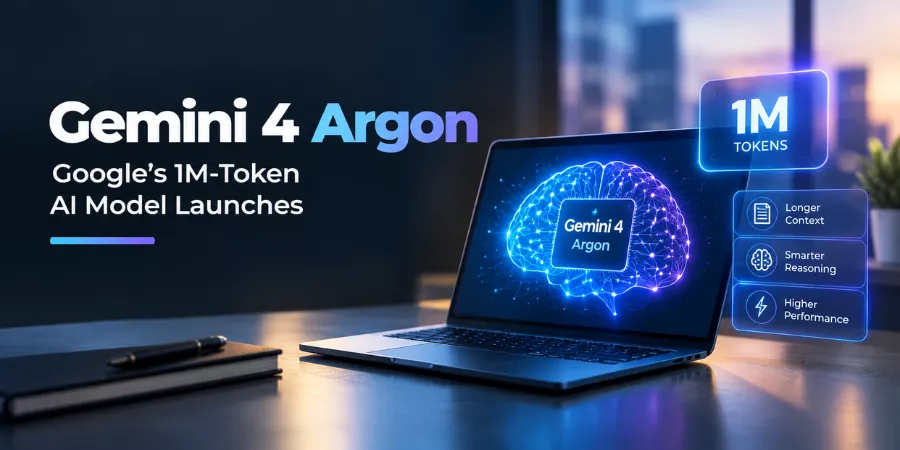
Google has officially launched Gemini 4 Argon, its latest frontier AI model, with a focus on software engineering, enterprise knowledge work, multimodal reasoning and cybersecurity. The September 30 announcement is also unusual for a major model release: most developers and consumers cannot use Argon yet. Google is initially giving access to a group of trusted cybersecurity defenders through its Fairwind Program while it continues testing the model’s safeguards.
The most visible specification is Argon’s 1-million-token output limit, which Google says is up from 64,000 tokens in its previous models. That is an output limit, meaning the model can generate substantially longer responses or work trajectories in a single run. Google is positioning the change around tasks that require sustained, multi-step reasoning rather than a series of short prompt-and-answer exchanges.
Also read: OpenAI Launches Always-On AI Agent Dots and a $500 Plan
What is Gemini 4 Argon Designed to Do?
Gemini 4 Argon is a model built for “long-horizon” workflows, where an AI system needs to reason through a problem, take multiple steps and continue working toward an outcome. The company is targeting real-world software engineering, finance, legal work and cybersecurity alongside broader reasoning and multimodal tasks.
That focus changes how the model is positioned. A conventional chatbot is generally judged by how well it responds to an individual request. Gemini 4 Argon is being presented more as an engine for work that can continue across a large number of steps.
According to Google, the model is already being used internally by thousands of Googlers for coding, research and writing. Some of the company’s examples reveal more about its practical ambitions than benchmark scores do.
How is Google Already Using Gemini 4 Argon?
One of the clearest examples involves Google’s own data centers. The company says a team of Gemini 4 Argon agents analyzed fleet-wide profiling telemetry and identified memory optimizations that, once rolled out, freed more than 300 TiB of memory. Google estimates the total potential savings from the work at between 500 TiB and 1 PiB. These figures are Google’s own reported results.
Another example involves large software migrations. Google says Argon agents are being used to migrate C and C++ codebases to Rust, ranging from tens of thousands of lines in libraries such as re2 and libgav1 to more than 800,000 lines in the Fuchsia Zircon kernel. The company says these migrations are subject to automated and manual auditing, emulation testing and review before production deployment.
Google also says Gemini 4 Argon helped optimize code in its open-source libgav1 video decoder. According to the company, an Argon-driven process replaced 32,000 lines of SIMD code with safe Rust, producing a version that ran 2.7 times faster than the existing Rust port while producing identical video output.
These examples offer a more concrete picture of what Google means by “long-horizon” AI: the model is being tested on engineering work that involves repeated experimentation, code changes and validation rather than simply generating a block of code from a prompt.
Also read: Google Launches Gemini 3 AI With Antigravity Coding Platform in Major OpenAI Challenge
What is the Gemini 4 Argon Benchmark Results?
Google has published strong results for Gemini 4 Argon across several evaluations, although the figures come from Google’s announced benchmark testing and should be understood in that context.
Argon scored 77.9% on DeepSWE v1.1, a benchmark focused on long-horizon software engineering. Google reports a 51.3% score on AutomationBench, which evaluates end-to-end execution of business tasks, and 91.7% on LVBench, which measures long-video understanding. On CWE-bench v1, which evaluates vulnerability remediation, Google says Argon tied for first place at 68%.
The spread of those evaluations is significant because it shows where Google is testing the model: coding, professional knowledge work, automation, visual understanding and cybersecurity rather than one general-purpose intelligence test.
Why is Gemini 4 Argon Not Available to Everyone Yet?
The restricted launch is one of the defining details of the Gemini 4 Argon release.
Google says Argon is first rolling out to trusted cyber defenders through its Fairwind Program. The company is also participating in a U.S. government voluntary pre-release process as it expands access. Wider availability is planned for developers, enterprises and consumers, beginning with paid API customers and Google AI Ultra subscribers, but Google has not announced a specific general-release date.
Cybersecurity is partly the reason for the controlled rollout. Google says Argon can autonomously find, validate and patch critical software vulnerabilities. It also says the model identified a serious vulnerability affecting healthcare software in an early demonstration with Wiz.
Because the same capabilities that help defenders can potentially be misused, Google says it is strengthening safeguards against cyber misuse and chemical, biological, radiological and nuclear threats, as well as indirect prompt-injection attacks. The company is also deploying systems to monitor Argon’s chain-of-thought and actions for signs of misalignment and stop execution when necessary.
Also read: Gemini Spark Can Now Organize Your Google Photos Library
How Much Does Gemini 4 Argon Cost?
Google has announced introductory API pricing of $2 per million input tokens and $10 per million output tokens. Cached input tokens receive a 95% discount from the input-token rate. After the introductory period, Google says pricing will move to $4 per million input tokens and $20 per million output tokens.
For companies considering Gemini 4 Argon, the distinction matters because large-scale agentic workflows can consume far more tokens than ordinary chatbot conversations. The final cost of using the model will therefore depend heavily on how much work an application delegates to it and how efficiently that workflow manages model calls.
What Comes Next for Gemini 4 Argon?
Google is treating Gemini 4 Argon as both a model launch and a controlled deployment. Its early users are being asked to test the system in demanding real-world environments while Google continues strengthening its safety mechanisms.
For now, the most revealing evidence about Argon comes from the work Google says it is already doing internally: optimizing data-center memory, migrating major codebases, improving software performance and supporting complex research.
That makes the Gemini 4 Argon story bigger than a new benchmark chart. Google’s stated goal is to build an AI system that can stay with difficult professional tasks for much longer, take more steps on its own and deliver work that previously required sustained human engineering and research effort.
Gemini 4 Argon: Key Facts
| Feature | Details |
| Developer | Google DeepMind |
| Launch | September 30, 2026 |
| Primary focus | Coding, enterprise work, multimodal reasoning and cybersecurity |
| Output limit | 1 million tokens |
| Previous output limit | 64,000 tokens |
| DeepSWE v1.1 | 77.9% |
| AutomationBench | 51.3% |
| LVBench | 91.7% |
| CWE-bench v1 | 68%, tied for first according to Google |
| Introductory input price | $2 per 1M tokens |
| Introductory output price | $10 per 1M tokens |
| Later price | $4 input / $20 output per 1M tokens |
| Initial access | Trusted cyber defenders through Fairwind |
| Broader access | Planned for paid API customers and Google AI Ultra subscribers |