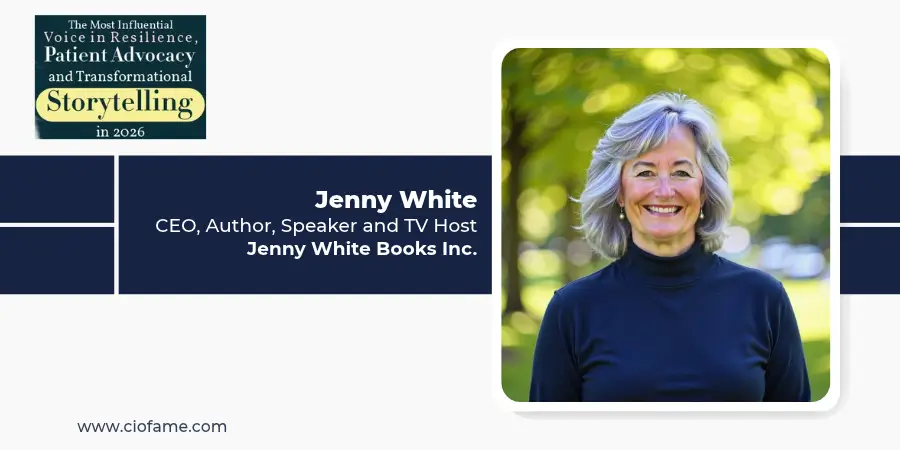
Healthcare is built around the promise of care, yet patients and nurses often find themselves struggling within systems burdened by staff shortages, tight budgets, long waiting times and decisions that can put efficiency ahead of human needs.
Having spent more than three decades inside these systems, Jenny White understands these struggles from the perspective of someone who once cared for patients and later experienced their vulnerability firsthand. Her journey took an unexpected turn in January 2024, when brain surgery left her facing the difficult task of learning to walk and speak again.
During recovery, writing opened a new path, giving her a way to communicate, rebuild her confidence and turn lived experiences into stories. Today, through Jenny White Books Inc., her medical thrillers, children’s books, speaking engagements and advocacy work carry a shared purpose: encouraging people to question, learn, find hope and make room for change.
A Childhood Moment
Jenny’s decision to enter healthcare began with an incident she witnessed as a child. While travelling with her father, she saw a car accident and begged him to stop so they could help the injured people. He continued driving, leaving her looking out of the back window with a feeling of helplessness that stayed with her.
In that moment, she decided that she would become either a doctor or a nurse. Nursing appealed to her because she enjoyed connecting with people and, at the time, it also seemed a more suitable career path for women.
In the 1980s, she qualified as a Registered Nurse (RN) and later returned to university to complete a Bachelor of Science in Nursing as the qualification became an entry-to-practice standard. Her professional life took her through several healthcare settings, each offering a different understanding of patient care. She worked on medical floors, in intensive care and trauma units, in public health and eventually in administration.
Every setting brought fresh responsibilities and opportunities to learn. She particularly enjoyed ICU trauma, which eventually encouraged her to pursue specialist training. Finding full-time employment after graduation proved difficult because the healthcare industry was experiencing cutbacks, layoffs and budget pressures. She began by working part-time at a couple of local hospitals, gaining the practical experience employers expected from new graduates.
She also understood that career progression required continued education. She invested time and money in specialist training before pursuing a Master’s degree in Healthcare Administration, with the ambition of becoming a nursing leader. For White, lifelong learning became an important part of professional growth.
Learning to Lead by Listening to Those Who Deliver Care
Jenny’s transition into healthcare leadership brought a different understanding of what makes a facility function well. As she moved into administrative responsibilities, she began recognising the importance of the people delivering care every day.
Beyond formal education, she paid close attention to the experiences of nursing staff, their concerns and their suggestions for improvement. She found that employees often had valuable insights into the problems affecting their units. When they were invited to contribute to solutions, they developed a stronger sense of responsibility towards the changes being introduced.
She also learned by observing the leaders around her. Some administrators created supportive workplaces, while others allowed hostile and unhealthy cultures to develop. She watched carefully, chose her mentors thoughtfully and took lessons from both good and poor examples of leadership. When workplace environments became toxic, she chose to leave, understanding that protecting her mental health was essential to remaining satisfied with her profession.
Her Master’s degree further strengthened her understanding of effective leadership. It introduced her to management theory, connected her with other healthcare leaders and allowed her to exchange strategies for addressing common challenges. She also developed an understanding of quality performance indicators and how they could be used to improve care within a facility.
As a Director of Nursing, she came to recognise that staff members were among the most important resources in healthcare. They needed respect, attentive leadership and a genuine place in decisions affecting their work.
Her leadership philosophy gradually centred on consistency, resilience, strategic thinking and accountability. Setting goals, evaluating outcomes and remaining open to new ideas became essential parts of her approach.
She also developed a strong view of what healthcare advocacy should accomplish. Having seen how financial decisions could influence patient care, she grew increasingly concerned about the business mentality within the industry. Budgets, executive bonuses, contracts and supply chains could take attention away from staffing, patient safety and the quality of treatment.
For her, healthcare is a human right, and the patient must remain central to every decision.
When the Nurse Became the Patient
After more than three decades of serving others, retirement was supposed to offer Jenny a different pace of life. However, near Christmas in 2023, she began feeling unwell and initially suspected that she might be having a stroke. She went to the emergency department, where doctors discovered a brain tumour.
The diagnosis brought an unexpected change to her life. She underwent brain surgery in January 2024, followed by a coma that left her with significant physical and cognitive challenges.
When she regained consciousness, she could neither walk nor speak. Much of her memory had disappeared, and she struggled to recognise familiar people and even remember her own identity. She also did not recognise her husband of twenty years.
For someone who had spent years helping patients recover, experiencing that vulnerability herself was profoundly different. She now understood the fear, dependence, uncertainty and frustration that patients experience when everyday abilities suddenly become difficult.
She knew that the road ahead would demand considerable effort, although she had little idea how long recovery would take.
Jenny recalls making a conscious decision during that period: she could give up, or she could fight. She chose to survive and thrive, setting herself the goal of regaining her abilities even before knowing how that would happen.
She sought help wherever she could find it. Prayer, spiritual guidance, online resources, physiotherapy and speech therapy became important parts of her recovery. Each day brought a different experience, with some days showing progress and others demanding patience.
Her physiotherapist gave her a piece of advice that continues to guide her: “If you can take one more baby step every day, you will climb Mount Everest.”
Jenny carried that thought into her daily routine, gradually learning to accept the time recovery required. She also began allowing herself to dream about possibilities again, even when the next step remained uncertain.
Finding Her Voice Through Writing
During speech rehabilitation, progress was slower than Jenny and her therapist had hoped. Her speech therapist suggested that she try writing down simple words and thoughts to see whether she could communicate through that process.
The exercise opened an unexpected door. She discovered that she could write, giving her a means of expressing her thoughts, emotions and frustrations while her speech was still developing.
Her first creative experiments came through children’s stories. Unable to recall much of her own childhood, she allowed herself to imagine the world through the eyes of a five-year-old. She created adventures about a young child and her dog, drawing on curiosity, imagination and simple experiences.
Writing these stories gave her a sense of achievement and helped restore her confidence. Once she had enough physical stamina, she began putting her imagined adventures on paper.
Her early books had simple language, clear messages and short storylines. She found particular joy in creating them and gradually began exploring ways to share them with children in her local community.
She also recognised that enjoying writing and understanding the craft were two different things. Determined to develop her abilities, she enrolled in online writing courses that allowed her to study around rehabilitation appointments and physical fatigue.
The lessons introduced her to fiction structure, character development and the process of building a complete story. She learnt to work with her imagination while drawing on experiences she already understood.
Her nursing career provided an extensive collection of real situations, while her recovery gave her an entirely new understanding of what patients experience. Together, these two perspectives offered the foundation for a different kind of storytelling.
Creating Abbey Roberts and Finding Medical Fiction
Jenny eventually developed a character named Abbey Roberts, a Registered Nurse working in an intensive care unit. She gave Abbey the same brain tumour diagnosis she had experienced, allowing the character to encounter many of the emotional and physical challenges that had become part of her own life.
Abbey struggled with returning to work, rebuilding her confidence, remembering professional skills and finding her place after a life-changing medical experience. Through the character, Jenny explored feelings she was still working through herself.
The experience became deeply personal. Writing allowed her to revisit difficult emotions, develop a new sense of possibility and find a way to express experiences that were difficult to communicate through speech alone.
Her medical background also made the transition into medical fiction feel natural. She had spent years working in the very environments she wanted to write about, including medical wards and ICU trauma units. She could draw on familiar settings, workplace pressures, patient interactions and difficult situations to create believable stories.
She had also been a reader of Robin Cook, whose medical thrillers had introduced her to the possibilities of combining medicine with suspense.
Once she understood the structure of a novel, developing plots became easier. Her stories continued to require several revisions, but she found that the ideas often emerged naturally from the experiences she had accumulated throughout her nursing career.
Retirement also gave her the freedom to discuss professional concerns openly. Having left nursing, she could write about situations that deserved public attention without worrying about workplace retaliation. She wanted to advocate for nurses, patients and the wider healthcare profession through stories that encouraged honest discussion.
Taking Control of Her Publishing Journey
Learning to write was one challenge. Understanding how to publish and distribute her work brought another.
Jenny initially explored traditional publishing, which required finding a literary agent who could present her manuscript to publishing houses. After spending time pursuing that route, she decided to self-publish so she could retain control over her writing, budget and publication schedule.
The decision brought additional expenses and required her to understand several parts of the publishing business herself. She also learnt about children’s book illustrations and experimented with AI-generated images to bring her stories to life.
Although self-publishing demanded considerable effort, it allowed her to work according to her own pace and rehabilitation needs.
Her company, Jenny White Books Inc., was established in 2024, with its operations based at 3494 Talbot Trail, Wheatley, Ontario, Canada. The business gradually developed into several connected areas.
Its children’s publishing arm includes the trademarked Molson and Jenny Adventure Series. The adult publishing division focuses on medical thriller fiction, particularly the Abbey Roberts RN series. Speaking engagements form another part of the business, while television production is becoming an additional avenue for sharing stories and ideas.
She also recognises the personal challenge of balancing her professional ambitions with family life. Her recovery has brought changes to her personality, including a greater preference for work and time spent alone. Her family and spouse have sometimes struggled to understand the drive behind her reinvention.
Learning to manage her energy, respect her physical limitations and make room for self-care has therefore become an important part of this new chapter.
Writing Stories That Ask Difficult Questions
Jenny’s medical thrillers carry a clear purpose. She wants readers to enjoy the suspense while considering the realities that patients and healthcare professionals encounter.
Her debut novel, The Triggering Scent, published on 27 March 2026 through FriesenPress, introduced readers to Abbey Roberts and the difficult circumstances surrounding her return to nursing.
After recovering from brain surgery, Abbey attempts to resume her work in an ICU, only to discover that the neurosurgeon responsible for botching her operation is now working in her city and within her hospital. The surgeon is methamphetamine-addicted, and Abbey faces a frightening decision about how to prevent further harm, even if speaking up threatens her own career.
The title itself came from White’s recovery. Following surgery, she experienced a heightened sense of smell, with familiar scents sometimes bringing back thoughts and memories. She incorporated this experience into Abbey’s story, using smell as a trigger that helps the character reconnect with her past.
The novel also explores the difficulties of returning to professional life after brain injury, including fatigue, memory loss and changes in executive functioning.
Her second novel, Terror at the Manor, examines the realities of nursing homes, while her third book, The Final Consent, explores informed consent and body donation.
Across the series, Jenny raises questions about workplace violence, staffing shortages, infection control, superbugs, malpractice, patient safety and the pressures created by tight healthcare budgets.
She also wants readers to see healthcare workers as human beings with their own struggles, emotions and personal circumstances. Nurses and doctors carry significant responsibilities, yet their ability to provide care can be affected by exhaustion, workplace conditions and the support available to them.
Her nursing perspective gives particular attention to the patient experience. While doctors diagnose and treat the causes of disease, nurses spend considerable time understanding the person as a whole, including emotional, spiritual, communication and family needs.
They witness the minute-by-minute changes in a patient’s condition, listen to concerns, explain interventions and help families understand what is happening.
Jenny wants readers to recognise this contribution and consider questions that are often left unspoken: Are healthcare workers safe to practise? Can patients trust every part of the system? Could an infection, staffing failure or medical error put someone at risk? Should healthcare decisions be driven primarily by financial considerations?
For her, the value of a medical thriller lies partly in the discussions it can begin. Readers should finish a story entertained, while also thinking about whether the situations portrayed could happen in real life and what should change to prevent them.
Using Stories to Educate, Empower and Inspire
Jenny’s children’s books and adult thrillers serve different audiences, yet both come from her desire to help others.
Through partnerships with Rotary and other service clubs and funding groups, Jenny works towards placing children’s books in daycares and libraries across her local community and Canada. She hopes these books will encourage early reading, develop imagination and give children opportunities to bond with parents and caregivers through shared reading.
For her, literacy offers children much more than the ability to recognise words. It encourages creativity, develops the mind and helps young readers imagine possibilities for themselves.
Her Rotary Literary Award, alongside coverage across 75 podcasts and 15 magazine covers and articles, reflects the growing reach of her work and personal story.
She has also been developing her speaking career, taking keynote speaker training to deliver meaningful talks about recovery, resilience and reinvention. Her message centres on hope, planning, persistence and the importance of taking small steps towards a future that feels worthwhile.
She has created a self-help workbook titled THRIVE, available through Amazon and her website as an affordable, self-directed digital resource. The workbook helps people reflect on their circumstances and consider how they would like their future to unfold.
Her work also includes podcast conversations about healthcare, healing and the experiences that shape people’s lives. Through these discussions, she hopes to question established practices, encourage wider awareness and give people facing difficult circumstances a reason to keep moving forward.
Expanding Her Voice Through Television
The growing response to her interviews and podcast appearances introduced Jenny to another opportunity. During an interview with someone from Hollywood, she was encouraged to consider hosting her own television programme, with the idea of sharing the stories of extraordinary people whose experiences could inspire others.
That conversation led to an invitation to host Inside the Story: Confidential, in partnership with The McCord List Network. The programme is scheduled to begin in autumn 2026 and is expected to reach 117 million homes.
The show will focus on people whose lives and experiences carry meaningful lessons, exploring stories of resilience, influence, reinvention and personal achievement.
For Jenny, television offers another way to continue the work she has begun through writing and speaking. She also plans to develop her own podcast, with a particular focus on healthcare systems around the world, the treatment of patients and the growing influence of AI on healthcare delivery.
She continues to follow developments in both healthcare and publishing through reading, research, networking and conversations with people working in the field. Her involvement in nursing organisations and women’s business groups also keeps her connected with professional communities and emerging ideas.
Choosing a New Purpose for the Years Ahead
Jenny’s professional ambitions remain closely connected to her desire to serve. She intends to continue developing the Abbey Roberts RN series, with several healthcare stories still waiting to be explored.
She also wants to expand her speaking and television work, using her experiences to encourage people who are dealing with trauma, career changes or personal setbacks.
Her understanding of success has changed considerably through these experiences. Having spent years working towards professional goals, she now places greater value on the ability to keep learning, discover joy and contribute something useful to others.
She describes herself as someone who enjoys following her own path rather than remaining caught in the expectations of a conventional career. It took a brain tumour and the difficult recovery that followed for her to recognise how much satisfaction could come from pursuing work driven by personal passion.
Her values remain honesty, integrity, truth and keeping her word. She also places importance on maintaining an open mind, respecting different voices, challenging established practices and remaining willing to step outside familiar territory.
As a former healthcare leader, survivor, author and advocate, she wants to be remembered for using her experiences to contribute to a better world. She hopes to become a recognised voice in medical thriller writing while continuing to question healthcare practices and encourage meaningful improvements.
She encourages experienced professionals considering a major career change to find their passion and pursue it, embracing the patience and willingness to learn new skills that the journey may demand.
She often returns to the importance of taking baby steps, developing resilience and accepting that every decision will not please everyone.
For Jenny, reinvention has become a continuing process of learning, creating and finding new ways to help others. Her journey has taken her through nursing, healthcare leadership, a life-threatening illness, recovery, publishing and public speaking, with each chapter opening another opportunity to contribute.
She hopes people remember her as a survivor who continued to serve, a nurse who gave patients a voice and an author who used storytelling to encourage change. Her ambition is to become a household name, admired for having the courage to step outside her comfort zone and attempt something meaningful.
As she puts it, “You never know what somebody else has gone through.”
That thought sits at the heart of her work, whether she is writing a medical thriller, speaking to an audience or encouraging a child to pick up a book. Her next chapter remains guided by the same purpose that first drew her towards nursing: helping people, sharing knowledge and finding ways to make a difference.
Featuring Details:
Company: Jenny White Books Inc.
Founded: 2024
Featured Leader: Jenny White
Designation: CEO, Author, Speaker and TV Host
Industry: Author and Publishing
Location: Wheatley, Ontario, Canada
Website: www.jennywhite.ca | www.speakerjennywhite.ca
Books:
- The Triggering Scent (Book 1)
- Terror at the Manor (Book 2)
- The Final Consent (Book 3, in development)
Recognition: Rotary Literary Award, 75 podcast appearances and 15 magazine covers and articles.
Social Media: