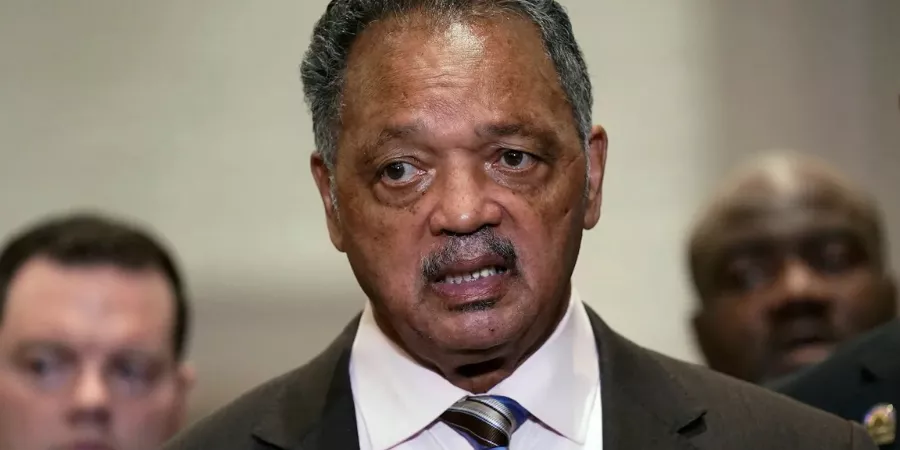
There’s a photograph from 1941 that doesn’t exist, but if it did, it would show a newborn baby in Greenville, South Carolina, who had no idea he would one day stand on stages demanding that America live up to its promises. That baby was Jesse Louis Jackson, and his story, the real one, not the sanitized version or the demonized caricature, is messier, stranger, and more fascinating than most people realize.
You probably know Jesse Jackson from somewhere. Maybe you’ve seen him at protests, heard his voice booming through speakers at rallies, or watched him pop up on news coverage during election seasons. But who is Jesse Jackson, really? And why does his story matter now, decades after his presidential campaigns and years since he dominated headlines?
The truth is, the Jesse Jackson story doesn’t fit neatly into our modern categories of hero or villain. It’s uncomfortable that way. It forces us to sit with contradictions, to hold multiple truths at once.
And that’s exactly why it’s worth understanding.
Who is Jesse Jackson
Jesse Louis Jackson is one of those figures who seems to have always been around, like a fixture of American political life that arrived fully formed. But nobody starts that way.
He’s a Baptist minister who became an American civil rights leader, a two-time presidential candidate who actually won primaries, and an international negotiator who freed hostages without holding any official government position. He founded Operation PUSH in 1971 and later merged it with the National Rainbow Coalition to create Rainbow/PUSH, organizations that sound vaguely inspirational but have actually done concrete work, forcing corporations to hire more minorities, negotiate better contracts, invest in Black communities.
Born on October 8, 1941, Jackson has spent more than 60 years in public life. That’s longer than most people spend being alive. And during those decades, he’s been called everything from a prophetic voice for justice to a publicity-seeking opportunist, sometimes in the same week by the same newspapers.
The Jesse Jackson biography you get depends entirely on who’s telling it. Supporters see a man who never stopped fighting for social justice activism even when it became unfashionable or politically inconvenient. Critics see someone who turned tragedy into personal advancement and never met a camera he didn’t like.
Both versions contain truth. That’s what makes his story so slippery to grasp.
Early Life and Background
The circumstances of Jesse Jackson early life weren’t just difficult, they were precisely designed to mark him as lesser. His mother, Helen Burns, was 16 and unmarried when she gave birth to him. His biological father, Noah Louis Robinson, was a married man who lived next door and already had a family. Robinson was a former boxer and local political figure, someone important enough that his abandonment of Jesse’s mother carried a particular sting.
In the 1940s South, being born out of wedlock wasn’t just shameful, it was a social mark that could define your entire existence. Children whispered about it. Adults used it to explain why you shouldn’t get too big for your britches. The shame was supposed to keep you small.
But something in young Jesse refused to shrink. His mother later married Charles Henry Jackson, a post office maintenance worker who adopted Jesse and gave him his name. Charles Jackson was, by most accounts, a decent man who worked hard and treated Jesse as his own. Still, Jesse knew the truth about his origins. Everyone in Greenville knew.
Jesse Jackson early life unfolded in a world split down racial lines with surgical precision. Separate schools, separate water fountains, separate everything. He attended Sterling High School, the Black high school, where he was a star quarterback and an excellent student. He had that particular combination of intelligence and charisma that teachers notice, the kind of student who doesn’t just succeed but makes success look inevitable.
But here is where the Jesse Jackson story starts to reveal its deeper currents. After leading his football team to victory one night, young Jesse and his teammates tried to celebrate at a local restaurant. They were turned away. Blacks weren’t served there. This wasn’t unusual, it happened all the time, but something about the timing made it pierce deeper. You could win the game, be the hero, carry the school to victory, and still be told you weren’t good enough to sit at a lunch counter.
That kind of humiliation either breaks you or forges you into something harder. For Jesse, it was clarifying.
He earned a football scholarship to the University of Illinois but left after experiencing the casual racism of a predominantly white campus in the early 1960s. He transferred to North Carolina A&T State University, a historically Black college where he could breathe easier, be himself, excel without constantly proving he had a right to exist in the space.
At A&T, he didn’t just study, he organized. He participated in sit-ins in Greensboro, putting his body on the line in the fight for civil rights activism history. These weren’t symbolic gestures. Students who sat at segregated lunch counters got beaten, arrested, expelled from school. They risked real consequences for refusing to accept indignity as their permanent condition.
The Civil Rights Movement Years
The Jesse Jackson civil rights movement involvement intensified when he moved to Chicago to attend the Chicago Theological Seminary in 1964. There, in 1965, he met Dr. Martin Luther King Jr., and the trajectory of his life shifted permanently.
King saw something in Jackson, that same combination of intelligence, charisma, and burning hunger to matter. He brought Jackson into the Southern Christian Leadership Conference and eventually appointed him to lead Operation Breadbasket, the organization’s economic arm focused on Chicago.
This is where Jackson’s strategic mind really emerged. While others focused on protests and legislation, Jackson understood that political activism in America required economic leverage. Operation Breadbasket used selective buying campaigns, essentially boycotts, to pressure businesses that served Black communities to also hire Black workers and stock products from Black-owned businesses.
It worked. Companies changed their practices not out of moral awakening but because it hit their bottom line. Jackson negotiated agreements worth millions of dollars, forcing corporations to invest in communities they’d previously only extracted from.
But then came April 4, 1968. Jackson was at the Lorraine Motel in Memphis when a bullet struck Dr. King on the balcony. The world exploded into chaos and grief.
What happened next remains one of the most controversial moments in the Jesse Jackson story. The morning after the assassination, Jackson appeared on NBC’s “Today Show” wearing a turtleneck he claimed was stained with King’s blood. He recounted King’s final moments, positioning himself as one of King’s closest confidants in those last hours.
Other members of King’s inner circle disputed Jackson’s account. Some said he wasn’t even on the balcony when King was shot, that he rushed up afterward. They accused him of using King’s death to elevate his own profile, of creating a narrative that placed himself at the center of history.
Jackson maintained his version of events. And here’s the thing, we can’t know with certainty what happened in those chaotic moments. But the controversy revealed something important about how Jesse Jackson influenced civil rights and how he’d be perceived for decades afterward: many saw him as a gifted leader genuinely committed to justice, while others saw an opportunist with a gift for self-promotion.
Both could be true. Complicated people contain contradictions.
Political Activism and Presidential Campaigns
After King’s death, Jackson could have faded into the background. Many expected the civil rights movement to splinter and lose momentum. Instead, Jackson founded Operation PUSH in 1971 and kept pushing, for economic opportunity, educational excellence, equality and racial justice movement expansion beyond what had been won in the 1960s.
But his most audacious move came in 1984 when he announced he was running for President of the United States. The idea seemed absurd to many. No Black candidate had ever mounted a serious presidential campaign. The political establishment, including many Black political leaders, thought he was wasting time and resources.
Jackson didn’t care. His Rainbow Coalition aimed to unite poor whites, Latinos, Blacks, Asian Americans, women, and working-class people around a progressive economic platform. He talked about ending apartheid in South Africa, cutting military spending, and investing in American communities. He spoke in Black churches and white union halls, on college campuses and in rural towns.
And people listened. His speeches had a rhythm borrowed from Black church tradition but addressing policy specifics. He could make economic inequality sound like a moral crisis, which it was. The Jesse Jackson achievements in 1984 weren’t about winning, he didn’t win the nomination, but about shifting what was possible, what could be discussed, who could run.
He registered millions of new voters. He won primaries in Louisiana, Washington D.C., and South Carolina. At the Democratic National Convention, he delivered a speech so powerful that even his critics had to acknowledge his oratorical genius. He talked about his own Jesse Jackson life journey and struggles, about growing up in poverty, about America’s promise and its failures.
Then came the “Hymietown” controversy. A Black reporter recorded Jackson using an anti-Semitic slur to refer to New York City during a private conversation. When the story broke, Jackson initially denied it, then admitted it, then apologized. The incident damaged his campaign and revealed a darker edge to his personality, casual prejudice he’d probably absorbed and never examined until forced to confront it publicly.
He ran again in 1988, and this time he was taken more seriously. He won Michigan. He finished second in delegates. Political analysts started discussing him as a potential Vice Presidential pick. The Jesse Jackson story had evolved from street activist to legitimate presidential contender, proof that the real Jesse Jackson story explained required acknowledging both his remarkable talents and his significant flaws.
Controversies and Complexities
Let’s be honest about the messy parts, because they matter. Jackson’s relationship with Louis Farrakhan, the Nation of Islam leader with a well-documented history of anti-Semitic rhetoric, created persistent problems. Jackson benefited from Farrakhan’s support in Black communities but faced fierce criticism for not denouncing him forcefully enough. He walked a tightrope, trying to maintain support across different constituencies while managing legitimate concerns about hate speech.
Financial questions have dogged Rainbow/PUSH for years. Critics have questioned the organization’s transparency, its effectiveness, whether Jesse enriched himself through his activism. Supporters point to concrete achievements, corporate diversity agreements, voter registration drives, community programs, but the questions never fully disappeared.
And then, in 2001, came another revelation that complicated his moral authority: Jackson had fathered a daughter with a Rainbow/PUSH staffer outside his marriage to Jacqueline Lavinia Brown, his wife of nearly four decades. He’d been counseling President Bill Clinton on moral leadership during the Monica Lewinsky scandal while hiding his own affair.
The hypocrisy was stunning. Jackson admitted it, apologized publicly, took a temporary step back from public life. But the damage was done. Here was a Baptist minister who’d preached family values and moral accountability, revealed to have profoundly failed to live up to his own standards.
These aren’t footnotes to the Jesse Jackson biography, they’re essential chapters. They’re part of understanding unknown facts about Jesse Jackson that the hagiographies ignore and the hit pieces overemphasize.
Jesse Jackson Achievements and Lasting Impact
But here’s what is also true: Jackson negotiated the release of American hostages in Syria in 1984. He convinced Cuban president Fidel Castro to release political prisoners. During the Kosovo conflict in 1999, he went to Belgrade and persuaded Serbian president Slobodan Milošević to release three captured American soldiers.
Think about that for a second. A private citizen with no official government position conducting international diplomacy and succeeding. That’s not normal. It required credibility, negotiating skill, and a willingness to take personal risks for human rights advocacy on a global scale.
His work in corporate America forced companies like Anheuser-Busch, Burger King, and major retailers to sign agreements worth billions in contracts for minority-owned businesses. Were these perfect solutions to systemic inequality? No. Did they create real economic opportunities? Yes.
Jackson’s voter registration drives added millions of people to electoral rolls, changing the math of American politics. His presidential campaigns made it possible for Barack Obama to be taken seriously two decades later. The path Obama walked, Jackson helped clear.
The leadership and legacy question is complicated because Jackson himself is complicated. He pioneered the modern intersection of American political leaders history and grassroots activism, showing how someone could maintain credibility in both worlds. He understood media in ways that earlier civil rights leaders didn’t, using television and press coverage to amplify messages and pressure powerful institutions.
Net Worth and Personal Life
Jackson’s estimated net worth of around $10 million makes some people uncomfortable. Shouldn’t a civil rights leader live modestly? But Jackson never embraced the idea that working for justice required a vow of poverty. He wrote books, gave paid speeches, earned salaries from his organizations. He argued that Black leaders deserved to be compensated for their work like anyone else.
He and Jacqueline married in 1962 and have five children together. Their son, Jesse Jackson Jr., served in Congress representing Illinois before pleading guilty to federal charges related to misusing campaign funds. He served prison time. The family’s public struggles added another layer to their complicated public narrative.
The 2001 revelation about his daughter born outside his marriage hurt his family deeply. Jackson acknowledged the pain he caused, particularly to his wife and children. He stepped back from public life temporarily, focused on his family, then gradually returned to activism.
His Jesse Jackson life journey and struggles include these personal failures. They’re part of who he is, not excuses, just facts that complicate the simple stories we prefer to tell about public figures.
The Real Story Emerges
So what’s the real Jesse Jackson story? It’s not the heroic narrative where a poor kid from South Carolina became a champion of justice through pure moral clarity. It’s not the cynical narrative where a talented opportunist used other people’s suffering to build his own brand.
It’s both. It’s neither. It’s more complicated than that.
Jackson is a man of genuine conviction who also has an ego that sometimes gets in the way. He’s devoted decades to fighting for social justice activism while also enjoying the spotlight maybe more than he should. He’s negotiated the release of hostages and made anti-Semitic comments. He’s been faithful to his principles and unfaithful to his wife. He’s forced powerful corporations to invest in Black communities and faced legitimate questions about his own organization’s finances.
The real Jesse Jackson story explained is that he’s human, brilliantly talented, deeply flawed, sometimes prophetic, occasionally hypocritical, always complicated. He represents what it looks like when someone refuses to accept the limitations society imposes but also carries all the baggage and contradictions any person accumulates over 80+ years of life.
His impact on civil rights activism history is undeniable. Without Jackson, American politics looks different. The conversation about economic justice, corporate responsibility, voting rights, all of it bears his fingerprints. Subsequent movements learned from his successes and his failures.
What surprises people about the Jesse Jackson story is not usually a specific fact they did not know. It’s the realization that public figures are never just one thing. Jackson can be a visionary leader who expanded what seemed possible and a flawed person who made significant mistakes. These are not usually contradictions, they are just the truth about how humans work.
From Greenville to the world stage, from illegitimate child to presidential candidate, from street activist to international negotiator, Jesse Jackson has lived multiple lifetimes worth of experience. The story doesn’t have a neat moral because life doesn’t work that way.
The surprising part? That’s exactly what makes it worth understanding.