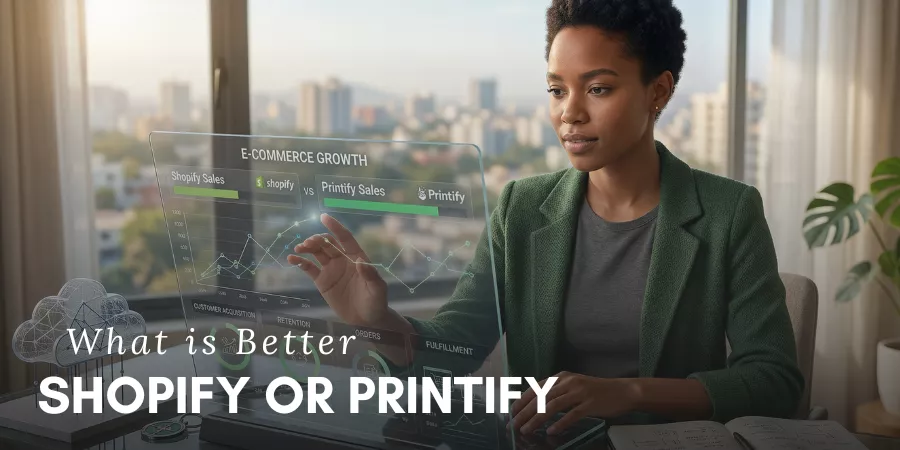
A lot of people start researching this question expecting to pick one winner. But Shopify and Printify are not fighting for the same job. One builds your store. The other ships your products. Choosing between them is a bit like asking whether you need a kitchen or a chef, the answer is usually both.
That said, if you are brand new to selling online, the difference genuinely matters. Getting this wrong wastes time and money.
5 Things to Know:
- Shopify is an ecommerce platform, it gives you a store, payments, and marketing tools.
- Printify is a print-on-demand service, it makes and ships custom products for you.
- You do not choose one over the other. Most sellers use both together.
- Shopify starts at $39/month. Printify has a free plan with a $29/month Premium tier.
- The Shopify + Printify integration takes about 15 minutes to set up and runs mostly on its own after that.
What is Shopify?
Shopify lets you build an online store from scratch, without needing to know how to code. You pick a domain name, choose a theme, list your products, and start accepting payments. It handles the infrastructure so you can focus on selling.
The platform processed over $292 billion in merchant transactions, and millions of businesses around the world run on it. It is not just for big brands. Solo creators, side hustlers, and independent businesses make up a huge chunk of its user base.
What Shopify gives you that matters most: your own storefront with your own domain, built-in payment processing, email marketing tools, analytics, and a massive app store. One of those apps is Printify.
What is Printify?
Printify flips the traditional product business on its head. Instead of designing something, manufacturing it, stocking it, and shipping it, you just design it. Printify handles everything else.
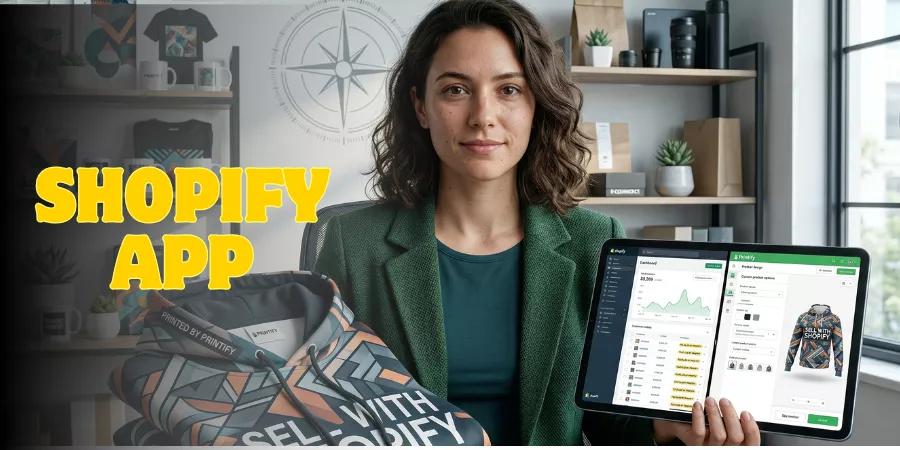
Here is a real example. You create a custom hoodie design inside Printify’s editor. You set your retail price and publish it to your store. A customer orders it. Printify charges you the base product cost, sends the order to one of their print suppliers, and ships the finished hoodie directly to your customer. You never see the product. You never hold stock.
Printify has over 300 customizable products, t-shirts, mugs, phone cases, canvas prints, tote bags, and more. It connects to Shopify, Etsy, WooCommerce, and a few other platforms. But it cannot sell products on its own. It needs a storefront.
The Actual Difference Between Shopify and Printify
Here is where most of the confusion comes from. People read “Shopify vs Printify” and assume they are two versions of the same thing, like comparing two ecommerce platforms. They are not.
Shopify is where selling happens. Printify is where fulfillment happens.
Your customers interact with Shopify, they browse your store, add to cart, and check out. They never know Printify exists. Once the order is placed, Printify quietly takes over: printing, packing, and shipping the product directly to your customer.
Think of it this way. Shopify is the shop front. Printify is the warehouse and shipping team behind it. You own the shop. You outsource the logistics.
Shopify vs Printify: Side-by-Side
| Shopify | Printify | |
| What it is | Full ecommerce platform | Print-on-demand fulfillment |
| Price to start | From $39/month (Basic plan) | Free plan available |
| Premium option | Shopify plan at $105/month | $29/month (20% product discount) |
| Transaction fees | 0.5–2% (none with Shopify Payments) | None |
| Needs inventory | Optional – depends on what you sell | No – Printify ships for you |
| Own storefront | Yes – fully customizable | No – needs Shopify, Etsy, etc. |
| Payment processing | Built in (Shopify Payments) | Not applicable |
| Product range | Sell anything | 300+ custom print products |
| Profit margins | You control pricing fully | Margin depends on base product cost |
| Setup time | A few hours to go live | Minutes per product |
| Scales well | Yes – built for growth | Yes – scales with your store |
| Best use | Build your brand and store | Add custom products without stock |
What Does Each Platform Actually Cost?
Pricing is one of the most practical questions, so let’s be specific.
Shopify Plans in 2026
- Basic: $39/month. Covers most solo sellers and early-stage stores.
- Shopify: $105/month. Better transaction rates, more staff accounts.
- Advanced: $399/month. For high-volume sellers needing detailed reporting.
- Transaction fees range from 0.5% to 2%, but drop to zero if you use Shopify Payments.
Printify Plans in 2026
- Free plan – unlimited product designs, up to five stores. Pay only when a customer orders.
- Premium – $29/month. Up to 20% discount on all products. Worth it once you hit consistent sales.
- Enterprise – custom pricing for high-volume operations.
The cheapest way to start: Printify free + Shopify Basic = $39/month total with no product risk. You only pay Printify when someone actually buys something.
How Profit Margins Actually Work
This is where beginners tend to underestimate things, and sometimes overprice or underprice their products as a result.
Let’s use a concrete example. A plain t-shirt on Printify might have a base cost of $12 including production. You set your retail price at $28. That’s a $16 gross margin before Shopify fees. On the Basic plan with Shopify Payments, your transaction fee is zero. So $16 minus your Shopify monthly cost spread across your orders.
Now add Printify Premium. That same shirt might cost $9.60, giving you $18.40 gross margin on the same sale. Over 200 orders a month, that $2.40 difference becomes $480. The $29/month Premium subscription pays for itself many times over.
The margin math is not complicated. The trap most beginners fall into is not calculating base costs properly before setting prices. Always start with Printify’s product cost, add expected shipping, then price above that with a margin you can live with, typically 35 to 50 percent.
Honest Pros and Cons
Shopify: What Works Well
- You own your store, your domain, your customer email list. That data is yours.
- Works for any type of product, not just print-on-demand.
- Shopify Payments means no extra fees on transactions.
- The marketing and analytics tools are genuinely useful from day one.
- Thousands of apps let you extend what the store can do.
Shopify: What to Watch Out For
- The $39/month cost starts the moment you subscribe, whether or not you make sales.
- Getting a store looking and converting well takes more time than most tutorials suggest.
- Third-party payment gateways trigger transaction fees, use Shopify Payments to avoid this.
Printify: What Works Well
- The free plan is genuinely functional. You can run a real business on it.
- No inventory, no upfront product investment. Zero financial risk on stock.
- The product catalog is wide. Most niches have something to work with.
- Global supplier network means reasonable shipping times in many markets.
Printify: What to Watch Out For
- Quality can vary between different print suppliers. Always order samples before selling at scale.
- You cannot sell without a storefront, Printify alone is not a complete business.
- Shipping timelines are outside your control once an order is placed.
- Thin margins on low-priced products. Price too low and there is almost nothing left after costs.
Who Should Use What: Real Scenarios
The Beginner Testing an Idea
You have a design concept and want to see if it sells before investing in anything. Start with Printify’s free plan and connect it to Shopify Basic. Upload three to five designs, open your store, and run a small ad or post organically. If it gets traction, scale. If it does not, you have spent $39 and learned something real.
The Creator Building a Merchandise Line
You already have an audience, YouTube, Instagram, a newsletter, wherever. Your followers want something they can buy. Printify is ideal here because you are not trying to run a product business full time. You pick ten products, design them once, and let them sell passively alongside whatever else you make.
The Side Hustle That Needs to Stay Lean
Not sure about Shopify’s monthly cost yet? Start on Printify connected to Etsy instead. Etsy has built-in traffic which removes the pressure to do all your own marketing from scratch. Once you understand your best-selling products, move to Shopify for more control and better margins long term.
The Entrepreneur Scaling a Brand
At this stage, Shopify is the spine of your business. You want full control over the customer experience, your email list, your ad tracking, your pricing. Printify handles one part of the product line, the custom merchandise side, while you potentially run other products alongside it. The two tools work well together without getting in each other’s way.
Can You Use Shopify and Printify Together?
Yes, and for most people selling custom products, this is the right setup. They are designed to connect.
The integration works through Shopify’s App Store. You install the Printify app, link your Printify account, and your products sync automatically. When a customer buys something from your Shopify store, the order flows to Printify without you touching anything. Printify bills you the base product cost, handles production, and ships directly to your customer.
The whole process from install to first live product takes about 15 minutes. After that, order management is largely hands-off.
How to set it up:
- Open the Shopify App Store and search for Printify.
- Install the app and log in to your Printify account (or create one, it’s free).
- Connect your Shopify store inside the Printify dashboard.
- Design your products in Printify and publish them directly to Shopify.
- Orders sync automatically from that point forward.
Which One Is Right for Your Situation?
If you are a beginner
Use both. Start with Printify’s free plan. Pair it with Shopify Basic. Keep your product count small at first, 5 designs across two or three product types. Focus more energy on understanding your customer than on perfecting your store.
If you are a creator or artist
Printify is a natural fit. You already have the creative side covered. What you need is a low-friction way to turn designs into products. Add a Shopify store with your own domain and you have a proper merchandise business that looks professional and runs quietly in the background.
If you are building a serious brand
Shopify is not optional, it is the foundation. Own your store, own your data, own your customer list. Use Printify as one of potentially several fulfillment solutions. At this level, the Printify Premium plan’s 20% discount on products makes a real dent in your unit economics.
If you are still deciding
The lowest-risk entry point is Printify free + Shopify Basic at $39/month total. If you make five sales in the first month, you have already learned more than any comparison article can teach you.
Mistakes Worth Avoiding
- Treating Shopify and Printify as competitors. They are not. One is a storefront, the other is a supplier.
- Using Printify without a sales channel. You cannot sell directly from Printify, you need Shopify, Etsy, or something similar.
- Pricing products without calculating base costs first. Factor in Printify’s product cost plus estimated shipping before setting your retail price.
- Skipping product samples. Quality can vary between print suppliers. Order one of everything before selling at scale.
- Paying for Printify Premium before you have consistent orders. Wait until you are selling regularly, that is when the 20% discount starts making financial sense.
- Overthinking the store setup. A clean, simple Shopify store with five strong products beats a complex store with fifty weak ones.
FAQ: Shopify vs Printify 2026
Is Shopify better than Printify?
They do different things, so the comparison is not really apples to apples. Shopify is better for owning and running an online store. Printify is better for producing and shipping custom products without inventory. For most people selling custom merchandise, using both together is the right answer.
Do I need Shopify to use Printify?
No. Printify also connects to Etsy, WooCommerce, Wix, Squarespace, and a few others. But Shopify is the most flexible option if you are serious about building your own brand. It gives you more control over pricing, customer data, and marketing than any marketplace will.
Is Printify free?
Yes, there is a genuinely functional free plan. You can create unlimited product designs and connect up to five stores at no monthly cost. You only pay Printify when an order comes in, they charge you the base product cost, which you have already built into your retail price.
Can beginners use Shopify?
Yes. The setup wizard walks you through the basics, and most people have a working store within a day. The harder part is learning how to market it, not how to build it. Shopify’s help documentation and community are solid if you get stuck.
Which is more profitable, Shopify or Printify?
Your profit comes from the gap between what you charge customers and what Printify charges you to fulfill orders. Shopify is a fixed monthly business cost. The most profitable setup tends to be Shopify Basic paired with Printify Premium once you are selling consistently, the 20% product discount on Premium covers its own cost quickly at moderate volume.
Is Shopify better than Printify for beginners?
For beginners, the better question is which to set up first. The answer is Printify, design your products there, then connect them to Shopify. That way you have something to sell before you start paying for the store. Then add Shopify to give your products a professional home.
What happens when someone orders from my Shopify store?
Once the integration is live, the order moves from Shopify to Printify automatically. Printify charges your account the base cost, sends the order to a print supplier, and ships directly to your customer with your branding. You do not need to manually process anything.
Key Takeaways
- Shopify is your store. Printify is your supplier. You almost always need both.
- Shopify starts at $39/month. Printify is free to start, you only pay per order.
- The integration between them is direct, fast to set up, and mostly automated.
- Printify Premium at $29/month pays for itself quickly once you hit regular sales volume.
- The lowest-risk way to start: Printify free plan connected to Shopify Basic.
- Profit margins depend on how you price against Printify’s base costs, always calculate this before listing products.
Read also: Best Shopify Apps for Beginners in 2026