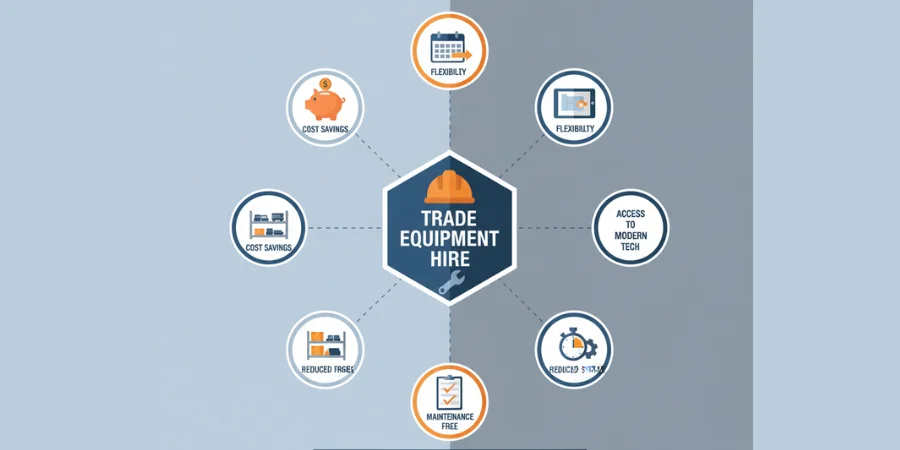
| Key Takeaways for Project Managers The 65% Rule: Financial analysis consistently shows that hiring is mathematically superior unless a tool’s utilization rate exceeds 65% of the working year. Below that threshold, ownership generates dead capital. Compliance Offloading: Hiring from a reputable provider offloads the legal burden of maintenance logs, tag-and-test certification, and Safe Work Method Statement (SWMS) documentation to the provider. Tech-Agility: Access to IoT-enabled smart tools increases on-site productivity by up to 22% compared to legacy owned equipment. Hiring provides this access at a flat rate. ESG Readiness: In 2026, many Australian government tenders require documented carbon footprint compliance. Newer and electric hire fleets help contractors meet these requirements without capital investment. Storage Economics: Commercial storage costs for heavy plant equipment in Sydney and Melbourne have increased by 40% since 2022. Hiring eliminates this ongoing overhead entirely. |
In 2026, the decision to use trade equipment hire rather than purchase equipment outright is no longer purely a cash flow decision. It is a strategic one, driven by the convergence of rising storage costs, accelerating tool technology, tightening WHS compliance requirements, and new ESG reporting obligations embedded in government tender frameworks.
Australia’s construction and trade sector is operating in a fundamentally different environment from five years ago. IoT-enabled precision tools, electric machinery, digital tag-and-test certification, and the 2026 WHS legislative updates across multiple states have changed the calculus of ownership versus access. For project managers and contractors evaluating how to equip their next job, the data increasingly points in one direction. This guide covers the six most strategically significant reasons, with specific Australian context and the financial logic that sits behind each one.
Hire vs. Buy: 2026 Decision Matrix for Project Managers
| Factor | Hiring Equipment | Purchasing Equipment |
| Upfront Capital | Low (Operating Expense) | High (Capital Expenditure) |
| Maintenance Costs | Included — zero downtime risk | Internal staff and parts costs |
| Safety Compliance | Pre-certified, SWMS ready | Internal audits and testing required |
| Technology Access | Always the latest model | Fixed asset — depreciates rapidly |
| Storage Requirements | Zero — returned after project | Ongoing cost, especially in metro areas |
| Scalability | Scale up or down instantly | Limited to owned inventory |
| ESG / Carbon Metrics | Access to newer electric fleet | Older fleet often fails tender requirements |
| Break-Even Point | Superior under 65% annual utilization | Superior only above 65% utilization |
Reason 1: Immediate Access to High-Tier and IoT-Enabled Technology
| The Problem 2026 construction tools now feature IoT tracking, precision sensors, and telematics. Purchasing this technology is capital-intensive and depreciation is rapid. Most owned fleets are already running equipment that is two to three technology cycles behind current. | 2026 Strategy Use hiring to access the latest model for each specific job rather than deploying owned equipment that may be under-specced for the task. This allows smaller contractors to bid on more complex, higher-margin contracts. | Actionable Step Before your next project quote, identify which tasks would benefit from IoT-enabled or electric-powered tools. Request these specifically from your hire provider. The productivity differential often justifies the hire cost within the first week on site. |
Expert Insight: Access to smart tools increases on-site productivity by up to 22% compared to legacy equipment. For hire customers, this technology arrives at a flat weekly or daily rate with no capital commitment.
The pace of tool technology development in the construction sector has accelerated significantly in the 2024 to 2026 period. Telematics-enabled equipment now provides real-time data on fuel consumption, usage patterns, and maintenance requirements. Precision sensors on cutting and leveling equipment reduce rework rates. Electric-powered alternatives to traditionally combustion-based machinery are now commercially viable across a broader range of applications and are increasingly specified in contracts operating under environmental compliance obligations.
For a contractor who purchased their fleet three to five years ago, the gap between their owned equipment and current-generation hire stock is material. On jobs where this technology differential affects output quality, precision, or speed, the cost of that gap can exceed the hire cost of accessing better equipment. The calculus is not complicated: if the tool you own produces results that require more time to achieve or more rework to correct than a hire alternative, you are paying a hidden premium to use your own equipment.
The broader strategic implication is market access. Contractors who can deploy current-generation tools are competitive on project types that contractors with older owned equipment cannot price effectively. The hire model converts this technology barrier from a capital access problem into a project-by-project operational decision. According to guidance from Safe Work Australia, current-generation equipment also typically carries enhanced safety certifications that align more readily with 2026 WHS requirements, reducing compliance friction on site.
What to Do Now
Review the equipment used on your last three projects and identify any tasks where output quality, speed, or compliance was constrained by tool capability. For each identified task, request a demonstration or specification sheet from your hire provider for the current equivalent model.
Reason 2: The 65% Rule: Eliminating Dead Capital and Hidden Costs
| The Problem Owned equipment that sits unused for more than 35% of the working year generates dead capital: depreciation, storage costs, insurance, and maintenance expenses that accumulate regardless of utilization. | 2026 Strategy Calculate your utilization rate for each major asset. The 65% Rule states that hiring is financially superior for any tool used less than 65% of the working year. For metro-based contractors, add current storage cost data to the calculation. | Actionable Step List every owned tool with a replacement value above $5,000. For each, calculate the number of working days it was actively deployed in the last 12 months. Divide by 250 (standard working days). Any asset below 65% utilization is a candidate for transition to hire. |
Expert Insight: In Sydney and Melbourne, commercial storage costs for heavy plant equipment increased by 40% between 2022 and 2025. For a mid-size contractor running a mixed fleet, this storage overhead alone can exceed $40,000 annually before depreciation is factored in.
The financial case for the hire model is most clearly visible when the full cost of ownership is calculated honestly. Most contractors account for the purchase price and the ongoing maintenance cost. Fewer account for the opportunity cost of capital tied up in depreciating assets, the storage and insurance overhead, and the administrative burden of maintaining compliance documentation for owned equipment.
The 65% utilization threshold is a practical decision tool. It reflects the point at which the total cost of ownership, amortized across the actual productive use of the asset, equals the cost of hiring an equivalent asset for the same number of days. Below 65%, hiring is cheaper. Above 65%, for assets used nearly every working day of the year, ownership begins to generate a positive return. The key question for any contractor is whether they can honestly place their major assets in that upper tier.
For many trade contractors, particularly those whose work is project-based rather than continuous, the honest answer is that most of their fleet sits below the 65% threshold. Seasonal demand, project gaps, and the variable nature of trade work mean that most owned equipment spends a significant portion of the year in storage rather than generating revenue. The hire model converts that dead period into a simple absence of cost rather than an accumulation of it.
What to Do Now
Run the utilization calculation for your top five highest-value owned assets this month. Be honest about idle days. For any asset below 65% utilization, calculate the annual cost of ownership, including storage, insurance, maintenance, and depreciation, and compare it to the equivalent hire cost for your actual usage days. Let the numbers drive the decision.
Reason 3: WHS Compliance and SWMS Readiness
| The Problem As of July 2026, multiple Australian states have lowered the threshold for High-Risk Construction Work under updated WHS legislation. Non-compliant equipment on site creates both safety exposure and regulatory liability for the principal contractor. | 2026 Strategy Use hire providers who supply equipment that is pre-certified, tag-and-tested, and accompanied by current safety documentation ready for inclusion in your Safe Work Method Statement (SWMS). This offloads compliance verification to the provider. | Actionable Step When requesting equipment from a hire provider, explicitly ask for the current tag-and-test certification, the maintenance log, and any applicable safety data sheets. Confirm that the documentation aligns with the WHS requirements of your specific state or territory. |
Expert Insight: Non-compliance with WHS equipment requirements under the 2026 legislative updates carries penalties of up to $50,000 for individuals and $250,000 for corporations per incident in most Australian jurisdictions.
Australia’s WHS legislative framework has undergone significant updates in the 2024 to 2026 period, with particular impact on the construction and trades sector. The harmonized WHS legislation, administered and updated through Safe Work Australia, now applies more stringent requirements to a broader category of construction work, including reduced thresholds for what constitutes High-Risk Construction Work requiring a formal SWMS.
For contractors operating owned equipment, the compliance obligation is entirely internal. The maintenance logs, tag-and-test records, operator certification documentation, and equipment-specific safety data must all be maintained, updated, and made available for inspection at any time. The administrative overhead of running a compliant owned fleet is substantial and typically underestimated, particularly by smaller contractors who lack a dedicated safety officer.
The hire model offloads this obligation to the provider. Reputable hire companies operate under their own stringent maintenance and certification schedules precisely because their entire business model depends on equipment that passes site inspection. When a contractor hires from an established provider, the certification documentation arrives with the equipment, and the maintenance compliance record is the provider’s responsibility. This is not a minor administrative convenience. In the event of a WHS inspection or incident investigation, having that documentation clearly attributed to a certified provider rather than internally generated significantly reduces the contractor’s exposure.
What to Do Now
Review the current WHS requirements for your state or territory, particularly any updates effective from January 2026. Identify any equipment in your owned fleet that may now fall under the updated High-Risk Construction Work classification and assess whether your current documentation meets the new standard.
Reason 4: Scalability for Peak Workloads Without Long-Term Debt
| The Problem A sudden project win can paralyze a small or mid-size firm that does not own sufficient equipment. Purchasing to meet peak demand creates long-term debt obligations and assets that will be underutilized once the peak passes. | 2026 Strategy Implement a Hybrid Fleet Model: own your core, frequently-used basics and use a hire partner to scale up for peak demand periods without taking on capital expenditure or long-term debt. | Actionable Step Define your core fleet as the equipment used on more than 65% of your working days. Everything required for project-specific or peak-demand work above that baseline should be sourced from a hire partner. |
Expert Insight: Contractors using a Hybrid Fleet Model report 30% lower capital expenditure across a five-year period compared to those who purchase to meet peak demand, while maintaining equivalent on-site capability.
The growth constraint for many trade businesses is not a lack of demand. It is the inability to resource unexpected project wins or concurrent workloads without either declining the work or making capital commitments that stretch the balance sheet. The traditional answer was to purchase more equipment and absorb the debt. The 2026 alternative is a more disciplined framework.
The Hybrid Fleet Model operates on a straightforward principle. The equipment you need every working day belongs in your owned fleet. The equipment you need for specific project types, unusually large volumes, or concurrent overlapping jobs belongs in your hire relationship. This distinction allows a contractor to maintain a lean, highly utilized owned fleet while still being able to resource any project that comes through the door.
The financial benefit is twofold. First, the capital saved by not purchasing peak-demand equipment is available for other business priorities, including investment in the core fleet, working capital, or business development. Second, the hire cost for peak periods is a direct project cost that can be priced into the quote, making it recoverable from the client rather than absorbed as overhead. This changes the unit economics of taking on larger or more complex work in a way that outright purchase does not.
What to Do Now
Map your last 12 months of projects and identify the top three equipment requirements that were driven by specific project types rather than routine work. For each, calculate how many working days per year they were deployed. If any are below the 65% threshold, they are candidates for your hire rather than own category going forward.
Reason 5: Expert Logistical Support and Precision Site Delivery
| The Problem Site access in dense urban areas and complex construction zones is a significant logistical challenge in 2026. Moving owned heavy equipment between sites consumes billable hours, requires certified operators, and creates scheduling dependencies. | 2026 Strategy Use hire providers who offer precision delivery and pickup as part of the hire agreement. This removes the transport and logistics overhead entirely and allows your team to focus billable hours on productive site work. | Actionable Step When comparing hire providers, include delivery and pickup capability, vehicle access requirements, and scheduling flexibility as evaluation criteria alongside equipment specifications and rates. The logistical service is part of the total value. |
Expert Insight: Contractors who externalize equipment logistics through their hire provider recover an average of 4 to 6 billable hours per week that were previously absorbed by internal transport and coordination tasks.
Urban construction sites in Australian capital cities present increasingly complex access and logistics challenges. Congestion zones, time-restricted delivery windows, permit requirements for large vehicle access, and high-density site environments make the movement of heavy plant equipment between locations a skilled logistical operation rather than a simple transport task.
For contractors running owned equipment, this logistical burden typically falls on internal staff. Experienced operators spend time driving rather than working. Project coordinators manage transport schedules alongside their primary responsibilities. In some cases, specialist transport providers are engaged separately, adding cost and coordination complexity. None of this is productive time in the traditional sense.
Established hire providers have built logistical capability into their service model because delivery and pickup reliability is a direct competitive differentiator. Their drivers understand site access requirements, carry the appropriate vehicle licences and permits, and are experienced in coordinating with site managers on timing and positioning. For the contractor, this capability arrives as part of the hire agreement rather than as a separate procurement and coordination task.
What to Do Now
On your next project that requires hired or relocated equipment, document the time spent on internal logistics, including driver hours, coordination calls, and scheduling management. Use this as a baseline to calculate the true cost of self-managed equipment logistics versus provider-managed delivery and pickup.
Reason 6: ESG Metrics and Environmental Sustainability for Government Tenders
| The Problem Many 2026 Australian government infrastructure and construction tenders now include mandatory environmental compliance criteria. Contractors operating older owned fleets may be unable to meet carbon footprint or emissions standards required for tender eligibility. | 2026 Strategy Access newer and electric hire fleet options to meet ESG and carbon metrics required for government tender submissions without capital investment in fleet replacement. | Actionable Step Before submitting your next government or council tender, review the environmental compliance requirements. Identify any equipment categories where your owned fleet does not meet the specified emissions or fuel efficiency standard and source compliant alternatives from your hire provider. |
Expert Insight: In 2026, approximately 35% of Australian state and local government infrastructure tenders include mandatory ESG or sustainability criteria. Contractors unable to demonstrate compliant equipment specifications are excluded from tender consideration regardless of pricing.
The integration of environmental, social, and governance criteria into Australian government procurement frameworks has accelerated substantially in the 2024 to 2026 period. What began as a preference signal in tender evaluation has in many jurisdictions become a mandatory threshold. Contractors whose equipment fleet does not meet specified emissions standards or whose operations cannot demonstrate compliance with relevant sustainability requirements are now excluded from certain categories of government work at the evaluation stage, before price is even considered.
For contractors running owned fleets that were purchased before the current generation of electric and low-emission machinery became commercially viable, this creates a market access problem that cannot be resolved without either significant capital investment in fleet replacement or a strategic shift in how equipment is sourced. The hire model addresses this directly.
Modern hire fleets are typically younger than owned contractor fleets because hire companies invest in regular stock renewal as a competitive requirement. The newest electric and hybrid equipment in the hire inventory is available to contractors on a project-by-project basis without the capital commitment of outright purchase. For a contractor whose work includes a mix of commercial and government projects, this means the ability to deploy ESG-compliant equipment specifically for government tenders while continuing to use their owned fleet on projects where these requirements do not apply.
What to Do Now
Review the last three government or council tenders you submitted or were eligible for. Identify whether ESG or environmental compliance criteria were present. If so, compare the equipment specifications required against your current owned fleet. For any gap, confirm with your hire provider that compliant alternatives are available and obtain the relevant certification documentation in advance of your next submission.
Trade Equipment Hire in 2026: The Strategic Choice
The six reasons covered in this guide reflect a fundamental shift in how Australia’s construction and trade sector should evaluate the hire versus own decision. Trade equipment hire in 2026 is not a budget compromise. It is an operational strategy that delivers technology access, compliance offloading, financial efficiency, logistical support, and ESG readiness in a single arrangement.
The contractors who will be most competitive in the 2026 to 2030 period are those who build their businesses around lean, highly utilized owned assets supplemented by strategic hire relationships that give them access to whatever the next project requires. This is not about renting instead of owning. It is about deploying capital where it generates the highest return and accessing capability where the capital case for ownership does not exist.
For further reading on the compliance and safety culture that underpins effective project management, explore the guide on building a positive workplace culture and site safety. For contractors managing workforce screening as part of their site security and compliance framework, the guide on national criminal record checks and on-site security compliance provides a practical overview of current Australian requirements.
FAQ Section
What is the 65% Rule for trade equipment hire?
The 65% Rule is a financial threshold used by project managers to evaluate whether equipment ownership or hire is the more cost-effective choice. If a tool is actively deployed for less than 65% of the working year (approximately 162 working days), the total cost of ownership, including depreciation, storage, insurance, and maintenance, typically exceeds the equivalent hire cost for those actual usage days. Below 65% utilization, hiring delivers a better financial return.
What WHS documentation do I need when hiring construction equipment in Australia?
Reputable hire providers supply equipment with current tag-and-test certification, maintenance logs, and applicable safety data sheets. For inclusion in your Safe Work Method Statement (SWMS), you will need the equipment’s certification record, the operator manual, and any hazard-specific safety instructions. Confirm these are included with your hire agreement before the equipment arrives on site.
How does trade equipment hire help with ESG compliance for government tenders?
Modern hire fleets are regularly renewed and typically include newer electric and low-emission equipment that meets current Australian government tender environmental criteria. By hiring specifically for projects with ESG requirements, contractors can demonstrate compliant equipment specifications without investing in fleet replacement. Ask your hire provider for the fuel type, emissions rating, and year of manufacture for any equipment you intend to use on a government tender.
Is it cheaper to hire or buy construction equipment in 2026?
The financial answer depends on your utilization rate. For tools and machinery used less than 65% of the working year, hiring is consistently the lower-cost option when total cost of ownership (purchase price, depreciation, storage, insurance, maintenance) is compared to actual hire cost for equivalent usage days. For equipment used nearly every working day, ownership begins to generate a positive financial return. The 65% Rule provides a practical threshold for making this calculation on a per-asset basis.
What should I look for when choosing a trade equipment hire provider in Australia?
Key evaluation criteria include ACIC-accredited maintenance and safety certification processes, the age and condition of their fleet, delivery and pickup logistics capability, the availability of IoT-enabled or electric equipment, and their familiarity with the WHS documentation requirements of your state or territory. A provider who can supply both the equipment and the current compliance documentation in a single arrangement will reduce your on-site administrative overhead significantly.