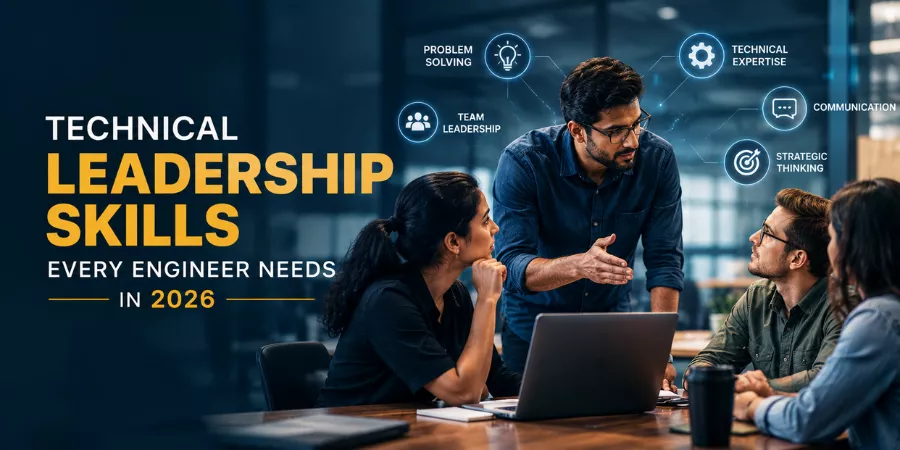
Engineering leadership has changed. An engineer can no longer lead effectively by simply being the person who knows the most about the technology.
AI can now generate code, review parts of a codebase, explain technical problems and automate routine development work. In Stack Overflow’s 2025 Developer Survey, 84% of respondents said they were using or planning to use AI tools in their development process, while 51% of professional developers said they used AI tools daily.
That shift makes judgment more valuable, not less.
The engineers moving into senior technical roles in 2026 need to understand architecture, make decisions under uncertainty, communicate with people outside engineering, develop other engineers and connect technical choices to business outcomes. These are the technical leadership skills that separate someone who is highly capable technically from someone others can trust to lead difficult work.
What is Technical Leadership Skill?
A technical leadership skill is the ability to use engineering expertise to guide technical decisions, solve complex problems, influence a team and deliver outcomes without losing sight of business or customer needs.
Technical leadership does not necessarily mean becoming an engineering manager. A staff engineer, principal engineer, architect or senior individual contributor can all provide technical leadership without having direct reports.
That difference is important in 2026 because many engineering organizations need people who can lead through expertise and influence rather than hierarchy.
The World Economic Forum’s Future of Jobs Report 2025 lists analytical thinking as the most important core skill for employers, with seven in 10 companies considering it essential. Leadership and social influence also rank among the leading core skills, while AI and big data, networks and cybersecurity, and technological literacy are among the fastest-growing skills.
Which Technical Leadership Skills Matter Most in 2026?
The strongest engineers are not trying to master every new tool. They are learning how to make sound decisions when the tools, requirements and constraints keep changing.
Below are the technical leadership skills that matter most.
1. Systems thinking
A senior engineer has to see beyond the component in front of them.
Changing an API may affect reliability. A database decision may affect costs six months later. A seemingly simple feature can create security, scalability or maintenance problems elsewhere.
Systems thinking means understanding those connections before making the decision.
It also means asking questions that a narrower technical approach might miss:
- What happens when usage grows tenfold?
- What does this change do to reliability?
- What are the security implications?
- How difficult will this be to maintain?
- What happens when the original team is no longer responsible for it?
The World Economic Forum identifies systems thinking as a skill expected to remain increasingly important through 2030.
2. Technical decision-making
Leadership often comes down to making a decision when there is no perfect answer.
Should the team build or buy? Should the system be rewritten or gradually improved? Is the performance problem worth fixing now? Should a new technology be introduced when the existing one still works?
Good leaders make the trade-offs visible.
They look at evidence, listen to the people closest to the problem, understand the risks and then commit. They also know when a decision is reversible and when it is not.
This is one of the most important technical leadership skills because teams lose momentum when every significant decision remains open indefinitely.
3. Architecture and technical vision
Technical leaders need enough architectural depth to understand where a system is going, not just where it is today.
That includes knowing how services interact, where dependencies exist, what could become a bottleneck and which technical debt actually deserves attention.
The goal is not to produce elaborate diagrams for their own sake. A useful technical vision gives engineers a clear direction while leaving enough room for them to solve problems independently.
In an AI-heavy development environment, this becomes even more important. Recent industry reporting describes engineers increasingly moving toward roles involving architecture, orchestration and verification as AI takes on more implementation work.
4. AI literacy and responsible AI use
In 2026, technical leadership without AI literacy is becoming difficult to defend.
That does not mean every engineer needs to become an AI researcher. It means leaders should understand what AI tools can realistically do, where they fail, how their output should be verified and where human judgment remains essential.
The Stack Overflow survey found that 52% of developers either do not use AI agents or use only simpler AI tools, while 38% said they had no plans to adopt AI agents. At the same time, among developers using AI agents, 69% said the agents had increased productivity.
The numbers point to an important leadership responsibility: adoption should not become a race to automate everything.
A technical leader needs to decide where AI creates value and where it introduces unacceptable risk.
5. Communication
Technical knowledge loses much of its value when a leader cannot explain it.
An architect may understand exactly why a proposed solution is dangerous, but the explanation has to change depending on the audience. Engineers may need the implementation details. A product manager may need the trade-off. A senior executive may need to understand the cost, risk and business consequence.
Strong communication is therefore one of the technical leadership skills for engineers that becomes more important with seniority.
PMI’s research similarly identifies communication, collaborative leadership, problem-solving and strategic thinking as four of the most critical interpersonal capabilities for project professionals.
6. Mentoring and developing engineers
A technical leader should not be the team’s permanent answer machine.
If junior engineers bring every difficult problem to one senior person, the team has created a dependency rather than a leader.
Good mentoring involves asking better questions, explaining reasoning, giving useful feedback and gradually handing over responsibility.
The measure of success is not how many problems the leader personally solves. It is how many problems the team becomes capable of solving without them.
The World Economic Forum also lists talent management and teaching and mentoring among skills gaining importance as workplaces evolve.
7. Prioritization
Engineering teams rarely have the luxury of fixing everything.
There will always be technical debt, performance improvements, security work, customer requests, new features and infrastructure changes competing for attention.
A technical leader needs to distinguish between what is important, what is urgent and what simply happens to be interesting.
This requires understanding the business context.
A technically elegant project that solves a minor problem may be less valuable than a less glamorous change that prevents a major customer issue.
8. Stakeholder management
Engineers increasingly work across product, security, finance, operations, sales and leadership teams.
That makes stakeholder management one of the practical technical leadership skills for engineers who want to operate at a broader level.
The job is not to please everyone. It is to understand what different groups need, identify conflicts early and make technical constraints visible before they become delivery problems.
A strong technical leader can tell a product team that a deadline is unrealistic without turning the conversation into an argument.
What are the Best Technical Leadership Skills Examples?
Some technical leadership skills examples are easier to recognise in real situations than on a résumé.
An engineer demonstrates leadership when they:
- Stop a rushed deployment because they identify a serious reliability risk.
- Simplify an architecture that has become unnecessarily complicated.
- Bring security into a design discussion before implementation begins.
- Explain a technical trade-off clearly enough for a nontechnical stakeholder to make a decision.
- Create standards that help several engineering teams work consistently.
- Challenge an attractive technology when it does not solve the actual problem.
- Help another engineer take ownership of a difficult project.
- Take responsibility when a technical decision turns out to be wrong.
Notice that none of these examples requires a management title.
Which Soft Skills for Engineering Leaders are Most Important?
The best soft skills for engineering leaders are not about being charismatic. They are about making other people more effective.
Listening is one of them.
A leader who immediately gives an answer can miss information that would have changed the decision. Engineers often know where a system is fragile because they work with it every day.
Curiosity matters too. So does emotional control. Technical disagreements can become personal very quickly, particularly when people have spent weeks building something.
Other valuable soft skills for engineering leaders include:
- Empathy
- Conflict resolution
- Negotiation
- Giving and receiving feedback
- Active listening
- Adaptability
- Accountability
- Influencing without authority
PMI describes these interpersonal capabilities as “power skills” because they help leaders work with teams, stakeholders and sponsors rather than simply manage tasks.
How do Technical Leadership Skills Differ from Technical Management?
Technical leadership is about direction, judgment and influence. Technical management is more concerned with planning, coordination, resources, delivery and operational execution.
The two overlap, but they are not interchangeable.
A technical leader might decide which architecture the organization should adopt and explain why. A technical manager may then coordinate people, timelines, budgets and dependencies to make that work happen.
Some useful technical management skills examples include resource planning, project tracking, risk management, capacity planning, performance management and delivery coordination.
An engineer can therefore become an influential technical leader without becoming a people manager.
What are the Soft Skills for Engineering Leaders that Engineers Often Overlook?
The ability to disagree well is one.
Senior engineers are expected to challenge assumptions. But being right is not enough. If every disagreement becomes a battle, colleagues eventually stop engaging.
Another overlooked skill is knowing when to stop talking.
A technical leader does not need to dominate every design review. Sometimes the best contribution is a question that makes the team see the problem differently.
Writing is equally important. Design documents, technical proposals, incident reports and decision records allow ideas to travel without the engineer being present to explain them.
These soft skills for engineering leaders are especially valuable in distributed teams, where much of the technical conversation happens asynchronously.
How Can Engineers Build Technical Leadership Skills?
Start before receiving a leadership title.
Take ownership of a problem that crosses team boundaries. Volunteer to write the design document. Lead a technical discussion. Mentor someone who is less experienced. Present a difficult trade-off to a nontechnical audience.
Then ask for feedback.
The World Economic Forum estimates that 39% of workers’ existing skill sets are expected to be transformed or become outdated between 2025 and 2030. It also reports that 50% of workers had completed training, reskilling or upskilling measures, up from 41% in its 2023 report.
That is a useful reminder for engineers: technical leadership is not something that suddenly appears after a promotion. It develops through repeated exposure to harder decisions and broader responsibilities.
What Makes Good Technical Leadership Skills Different from Ordinary Engineering Ability?
Good technical leadership skills allow an engineer to multiply the effectiveness of other people rather than simply producing excellent individual work.
An outstanding engineer might solve a difficult production problem in three hours.
An outstanding technical leader might help the team understand why the problem happened, improve the system so it does not recur, teach others how to diagnose similar failures and influence the organization to address the underlying weakness.
The second form of impact is harder to measure, but it scales much further.
That is ultimately the shift from senior engineer to technical leader: moving from being responsible for your own output to becoming responsible for the quality of technical decisions around you.
What will Technical Leadership Look Like in the AI Era?
AI will change the work, but it will not remove the need for technical leadership.
If anything, it raises the standard.
When machines can produce implementation options quickly, leaders have to become better at deciding which option should exist in the first place. They need to understand architecture, risk, security, product priorities and organizational constraints.
The 2025 Stack Overflow survey shows the scale of the change: 84% of respondents were already using or planning to use AI tools, while 51% of professional developers reported daily use. Yet only 17% of AI-agent users said agents had improved collaboration within their team, compared with 69% who said agents increased productivity.
That gap is revealing.
Making an individual engineer faster is not the same thing as making an engineering organization better.
The leaders who understand that difference will be valuable.
How to Become a Technical Leader without Becoming a Manager?
How to become a technical leader starts with taking responsibility beyond your assigned ticket or project.
Look for problems that affect several people. Learn to explain trade-offs. Build relationships with product and business teams. Mentor engineers. Write down decisions. Develop enough business awareness to understand why a technically sound decision may still be the wrong decision.
Most importantly, stop measuring your value only by how much code you personally produce.
The future technical leader is increasingly the person who can bring together technology, people and judgment.
Frequently Asked Questions
Are technical leadership skills only important for software engineers?
No. The same principles apply across software, mechanical, electrical, civil, manufacturing, aerospace and other engineering disciplines. The technologies differ, but engineers still need to make decisions, manage trade-offs, communicate and influence others.
Can an individual contributor become a technical leader?
Yes. Staff engineers, principal engineers, architects and other senior individual contributors frequently provide technical leadership without managing employees directly.
Which technical leadership skills should an engineer develop first?
Start with communication, systems thinking, decision-making and mentoring. Technical depth remains essential, but leadership becomes more valuable when that expertise can influence decisions and help other engineers succeed.
Are technical skills becoming less important because of AI?
No. AI is changing how technical work is performed, but engineers still need enough technical understanding to evaluate AI-generated output, recognise risks and make architectural decisions. Current developer data suggests AI adoption is widespread, while confidence in its ability to handle complex work remains limited.
What is the biggest mistake new technical leaders make?
Trying to prove that they are the smartest person in the room.
Leadership becomes more effective when the goal shifts from demonstrating expertise to improving the quality of the team’s thinking and decisions.
Key Takeaways
- Technical leadership is no longer just about technical expertise. Engineers increasingly need analytical thinking, communication, adaptability and leadership alongside deep technical knowledge. The World Economic Forum ranks analytical thinking as the top core skill and leadership and social influence third among employers’ core skills.
- AI is raising the value of engineering judgment. Stack Overflow’s 2025 survey found that 84% of developers use or plan to use AI tools, but 46% do not trust AI output accuracy. Technical leaders therefore need to know when to use AI, when to question it and how to verify its results.
- Systems thinking matters as much as coding ability. Senior engineers have to understand how architecture, security, reliability, cost and product decisions affect one another rather than solving problems in isolation. Systems thinking is among the skills expected to remain important through 2030.
- People skills are now part of technical leadership. Communication, empathy, active listening, mentoring and conflict resolution help engineers influence decisions and develop stronger teams. The WEF ranks empathy and active listening among today’s core workforce skills.
- The best technical leaders multiply their team’s impact. Leadership is not about being the person who solves every difficult problem. It is about creating sound technical direction, developing other engineers and helping teams make better decisions independently.