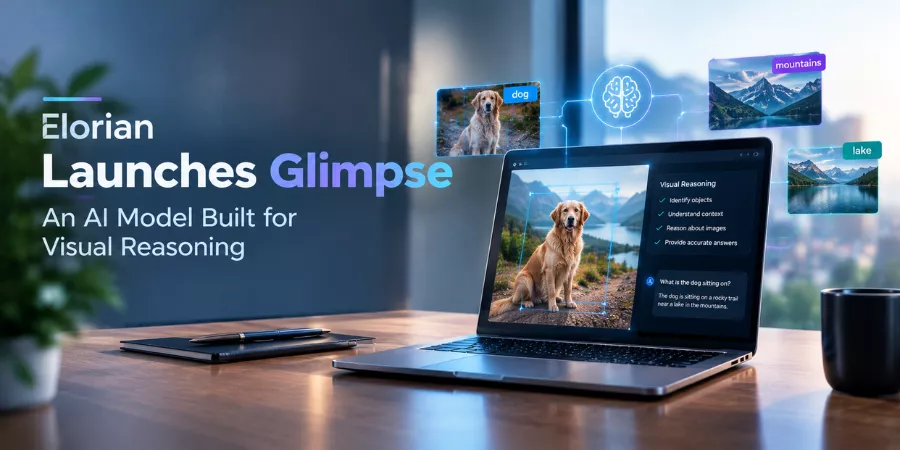
Artificial intelligence startup Elorian has released Glimpse, its first AI model designed to reason directly with visual information rather than relying primarily on textual descriptions of images. The research preview, announced on October 16, 2026, introduces an approach that lets the model revisit visual evidence during its reasoning process, including zooming into image regions, extracting video frames and using code to measure or compare what it sees.
Founded by former Google DeepMind researcher Andrew Dai, Elorian is positioning Glimpse around a limitation that remains important for multimodal AI: a model may describe a picture convincingly yet struggle to understand the spatial relationships, symbols or physical details that determine what is actually happening.
The release marks Elorian’s move from a research thesis to a product that developers can begin evaluating through API access. Its chat interface is currently waitlist-only, according to TechCrunch. The company is betting that stronger visual reasoning could prove valuable in robotics, scientific research and media production, where understanding images and video is often more important than simply describing them.
Why Elorian Believes AI Needs to Reason with Images
Most people interpret a visual scene by moving between observation and closer inspection. Someone looking at a board game can recognise symbols, compare pieces and infer which player is ahead without first converting every detail into a written description.
AI systems can struggle with this process. In TechCrunch’s interview, Dai recalled photographing a board game after playing with friends and asking an advanced AI model to identify who was winning. The model could not reliably interpret the game’s symbols and visual conventions.
That experience illustrates the distinction behind Glimpse. Recognising objects or generating a caption is different from working out how those objects relate to one another, what their arrangement implies or which details need further examination.
Elorian argues that conventional vision-language systems often translate images into representations that support text-based reasoning. Its alternative is to let the model return to the visual evidence while solving a problem, rather than treating its initial interpretation as sufficient.
The difference is significant for tasks where a small visual detail can change the answer. Reading a scientific chart, interpreting a mechanical drawing or understanding the sequence of actions in a video may require close inspection, comparisons and measurements that a broad description cannot provide.
How Glimpse Works: A Model That Can Inspect Its Evidence Again
Elorian calls the mechanism behind Glimpse a “visual scratch space”. During reasoning, the model can revisit the original visual input, crop a particular region, extract relevant video frames or run code to measure and compare details.
The process is closer to examining evidence than answering from a first impression.
- Inspect the visual input
The model receives an image, chart or video and identifies the information relevant to the task.
- Return to important details
It can focus on a smaller region or select particular video frames when the initial view does not provide enough evidence.
- Compare or measure
Code can help quantify visual information or compare details instead of relying exclusively on a verbal description.
- Produce an evidence-based answer
The goal is to use the additional visual examination to support a more accurate conclusion.
The underlying idea is not entirely new. TechCrunch notes that OpenAI introduced crop-and-zoom capabilities during reasoning in its o-series models in 2025. Elorian’s distinction is that it has built its model around this approach rather than adding it as a supporting capability.
That difference raises an important technical question: how much can a model improve by inspecting its evidence repeatedly, and how efficiently can it decide which details deserve closer attention? The answer will depend on the model’s accuracy, its ability to choose useful visual operations and the cost of those additional steps.
Elorian’s Benchmark Claims and What They Actually Show
Elorian says Glimpse outperforms OpenAI’s GPT-6 Astra on scientific chart reasoning and short-form video captioning, while producing competitive results on other visual reasoning tasks. The company also says it trained the model with a small team using a few hundred GPUs and that Glimpse is substantially smaller than the frontier systems used for comparison.
These claims offer an early indication of what Elorian wants the model to demonstrate, but they should be interpreted carefully. The reported comparisons come from Elorian’s own evaluations; the announcement does not establish that independent researchers have replicated the results.
Benchmark performance also does not automatically translate into better results across all practical tasks. A model that excels at interpreting a scientific graph may still struggle with unfamiliar objects, complex instructions or visual information captured under poor conditions.
For businesses considering Glimpse, independent testing will be important. Useful evaluations would compare models on identical datasets, disclose testing conditions and measure performance on the tasks a customer actually needs to complete.
Why Elorian is Targeting Video-Heavy Industries First
Elorian’s initial target customers include robotics companies, scientific laboratories, media organisations and creative businesses. These sectors work with substantial amounts of visual information, making it difficult or expensive to extract every relevant detail manually.
Three applications stand out.
- Robotics: Understanding scenes, object positions and movement could help developers build systems that interpret their surroundings more reliably. Visual reasoning alone, however, does not establish that a model can safely control a robot.
- Scientific research: Researchers could use visual reasoning to examine charts, experimental images and other visual evidence. Accuracy and reproducibility would remain essential, especially when results inform scientific conclusions.
- Media and creative production: Systems that can inspect video frames and compare visual details could help with footage analysis, content organisation and selected production workflows.
The commercial opportunity lies in reducing the effort required to interpret visual data. A model that can reliably answer questions about lengthy footage or extract measurements from scientific images could save time for teams that currently depend on manual review.
However, the benefits will depend on the quality of the results, integration costs, privacy requirements and the extent to which the system reduces work rather than creating additional verification tasks.
From Visual Reasoning to Robots That Can Act
Elorian’s longer-term ambition extends beyond interpreting visual information. Dai told TechCrunch that the company ultimately wants to develop models that can build an understanding of a scene and use it to select actions, including controlling robots. The company aims to build what it describes as the world’s best visual reasoning model in 2027.
This ambition connects visual reasoning with a broader challenge in AI: moving from recognising what is happening to deciding what should happen next.
For example, identifying an object on a factory floor is one task. Determining whether it can be safely picked up, selecting an appropriate movement and executing that action without damaging nearby equipment is considerably more demanding.
Such systems must account for physical constraints, uncertainty and unexpected changes in their surroundings. They also need reliable control mechanisms and safety measures. Glimpse’s current research preview should therefore be understood as an early step towards that larger objective, rather than evidence that the company has already solved autonomous physical action.
What Glimpse Could Mean for the AI Industry
Elorian’s launch reflects a broader question facing AI developers: whether progress will come primarily from making language-centred models larger or from developing systems that represent and reason about different forms of information more effectively.
The company’s approach suggests that visual reasoning may need dedicated attention, particularly for problems where spatial relationships, measurements and physical context cannot be expressed adequately through short textual descriptions. Its earlier research thesis also places visual understanding at the centre of its ambition to develop AI capable of tackling more complex real-world tasks.
Yet the distinction between a promising research direction and a commercially successful product remains important. Glimpse must demonstrate consistent performance outside selected benchmarks, offer practical value to developers and justify its operating costs against competing models.
For now, Elorian has introduced a model built around a specific proposition: AI should be able to revisit what it sees and investigate visual evidence while solving a problem. Whether that approach becomes a major advantage will depend on how well it performs when developers put it to work on real images, videos and scientific tasks.