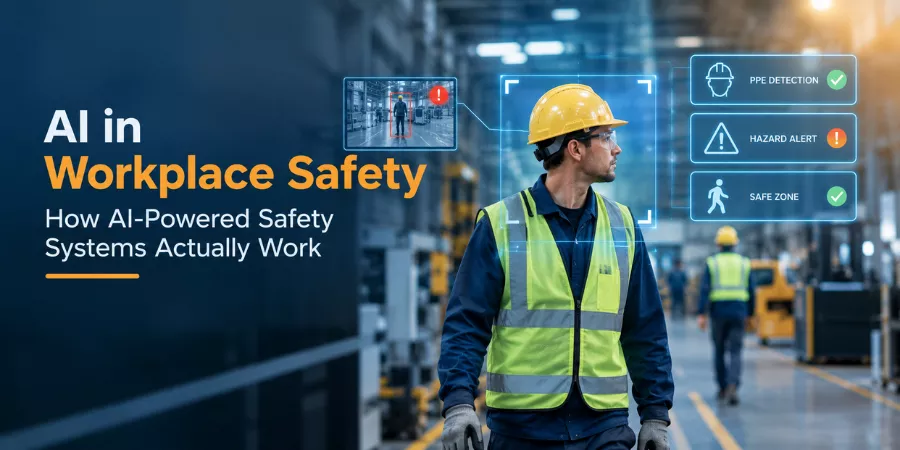
AI in workplace safety is moving well beyond cameras and alarms. By linking sensors, software and emergency response tools, it helps organisations spot incidents sooner and act on them faster.
Safety has long been a patchwork. Cameras record, sensors trigger alarms and radios keep people talking, but someone still has to piece it all together before deciding what to do. That’s the gap artificial intelligence is starting to close, giving safety teams one clearer view of an incident as it unfolds.
The shift is picking up commercial speed. On October 20, 2026, physical AI startup Firefly came out of stealth with a $20 million Series A led by Definition Capital, with BoxGroup and Susa Ventures also taking part. It’s building a platform that blends purpose-built hardware, AI software and a customer’s existing infrastructure to detect incidents and help coordinate the response. It’s already running across three campuses at Front Range Community College in Colorado.
Firefly’s story points to a bigger change in AI in workplace safety: the goal is no longer just watching what happens, but helping people understand an incident and respond sensibly. Whether it works comes down to reliable alerts, a good fit with daily operations and better results in real workplaces.
What is AI in Workplace Safety?
In simpler terms, workplace safety with AI means the utilization of artificial intelligence technology with the support of sensors, cameras, software, and internet-connected devices to identify hazards, check present circumstances, measure risks, and react during emergencies.
The exact set of functions performed by the system depends on the specific set of instruments present in it; the system can warn against unsafe behavior, identify anomalies, determine surrounding conditions, or analyze past injuries for frequently occurring threats.
Common applications include:
- Computer vision in safety: analysing camera footage to spot hazards, restricted-area entry or other events that need attention.
- Sensor-based monitoring: using connected devices to detect excessive heat, gas concentrations or equipment abnormalities.
- Predictive risk analysis: studying past incident records and operational data to find patterns that call for preventive action.
- Automated incident alerts: notifying the right people as soon as a system detects a potentially dangerous event.
- AI emergency response: pulling information from several devices together so response teams can understand what’s happening and act.
These tools solve different problems. A camera-based AI security system might help identify an emergency inside a building, while an industrial setup is more likely to watch for chemical exposure, machine faults or worker health. The best workplace safety technology is the one matched to the hazards you actually need to control.
How Do AI-Powered Safety Systems Work?
The details vary, but most AI-powered safety systems follow the same four-step rhythm: collect, analyse, add context and respond. It’s the simple loop behind most AI in workplace safety deployments.
- Collect information from cameras and sensors
The system pulls data from whatever devices are available: security cameras, environmental sensors, access-control systems, radios and specialised safety hardware. Each one contributes a different piece of the puzzle. A temperature sensor in an industrial facility might catch an abnormal rise in heat, while a nearby camera shows what’s happening in that area.
The whole system is only as good as this data, so accuracy, timing and compatibility between devices matter a great deal.
- Analyse events with AI
AI models will then try to find patterns that indicate a problem. Computer vision models process images and video while other models take sensor inputs, audio, or equipment data. An event could be flagged when someone enters a restricted area, sees a pattern that is out of the ordinary, or gets an input beyond a specific threshold. Some preprogrammed rule or more analysis later would determine if an alert should be raised. Some installations may implement edge AI where data is processed locally, so that incident detection does not depend on the information being sent back and forth to the cloud.
But AI incident detection isn’t infallible. Poor lighting, blocked camera views, faulty sensors and unfamiliar conditions can all cause missed detections or false alarms. That’s why systems need testing in realistic conditions, not just in a demo.
- Combine signals to build context
One alert rarely tells the whole story. A sensor can say something is wrong without saying why, and a camera can show activity without revealing the hazard behind it.
Sensor integration solves this by merging relevant signals into a fuller picture. A safety team might receive a sensor alert along with the location of the affected equipment and the relevant camera footage. That context helps people judge how urgent something is, which is especially useful in large facilities where several systems may fire at once.
- Deliver alerts and coordinate the response
When an incident fulfills the conditions for an alert to be raised, the system is able to notify the relevant individuals of the incident, provide information about the incident, and assist the relevant parties. AI tools for emergency response provide assistance in locating where the incident occurred and communicating with the relevant parties about the incident. This includes routing messages to specific teams and connecting alerts to communication systems that are already in place.
One thing is worth remembering: an alert doesn’t resolve an emergency. People still need clear responsibilities, dependable communication and procedures for situations that demand immediate action.
Firefly’s $20 Million Bet on Connected Safety
Firefly is a useful real-world example of how these pieces can fit together. Its Ember Safety Management platform is designed to connect existing equipment, such as cameras and radios, with specialised hardware and emergency response management software.
According to SiliconANGLE’s October 20 report, the company also offers wearable panic buttons, AI beacons that support panic-button triangulation and gunshot detection, and a network gateway that keeps connected systems talking to each other.
The idea is to bring together information that would otherwise sit scattered across separate devices, then use it to detect incidents, add context and help safety teams organise their response. At Front Range Community College, that means data from three campuses flows into one unified system.
For anyone following AI in workplace safety, the funding round signals investor appetite for physical AI beyond robotics. Firefly plans to expand across education, healthcare and enterprise settings.
What stands out is that Firefly’s pitch is about coordination between systems, not just a new camera or a standalone detection model. That could appeal to organisations that have already invested heavily in safety equipment but struggle to make the data from those devices work together.
Still, a funding announcement and an existing deployment don’t prove much on their own. They don’t show how far the system cuts response times, prevents injuries or improves safety outcomes. That evidence has to come from real operational use.
Where AI Safety Technology Can Make a Difference
AI safety technology can support many kinds of workplace risk management, though what works depends on the industry. In practice, AI in workplace safety looks quite different from one site to the next:
- Manufacturing and warehouses: camera analytics and connected sensors can help identify some unsafe conditions, monitor equipment and point attention to areas that need inspection.
- Schools and large campuses: connected cameras, panic buttons and communication systems help safety staff understand incidents and coordinate a response.
- Hospitals: integrated systems may help security teams manage emergencies across big buildings, subject to privacy rules and clinical workflows.
- Construction sites: suitable sensors and computer vision can support hazard monitoring, but they can’t replace site inspections or established safety controls.
- Industrial facilities: environmental monitoring can flag abnormal heat, gas or other readings before conditions get worse.
The US National Institute for Occupational Safety and Health (NIOSH) notes that AI can bring new workplace risks as well as benefits. Employers therefore need to assess the technology itself, the equipment it controls and how it changes working conditions (NIOSH guidance).
What Are the Risks and Limitations of AI in Workplace Safety?
Deploying AI in workplace safety takes more than installing software. Organisations need to know what the system can detect, what it might miss and who is still responsible for acting on its output.
Key things to think about:
- False alarms: too many wrong alerts can overwhelm response teams, while missed detections leave hazards unaddressed.
- Privacy: camera footage, location data and worker-monitoring information need to be collected and handled under clear policies.
- System reliability: network failures, power cuts and incompatible devices can all undermine the response.
- Human oversight: people need the authority and training to verify alerts, challenge wrong outputs and make calls in an emergency.
- Accountability: employers must decide who investigates an alert, who escalates it and who confirms the corrective action was completed.
The Occupational Safety and Health Administration (OSHA) recommends ongoing hazard identification, workplace inspections and investigation of incidents and near misses. AI in workplace safety can support all of that, but it doesn’t replace the work of spotting hazards, assessing risk and putting corrective measures in place (OSHA guidance).
What Should Businesses Evaluate Before Adopting AI in Workplace Safety?
Before spending money, ask what problem you’re actually trying to solve and whether AI is the right answer. A practical evaluation should cover:
- Detection performance: how accurately does it identify the hazard in real operating conditions?
- Response time: does it shorten the time to recognise an incident, alert the right people and start acting?
- Integration: can it work with your existing cameras, sensors, access-control systems and communication tools?
- Operational reliability: what happens when connectivity drops or a device stops working?
- Measurable outcomes: can you track false alarms, response times, recurring hazards and corrective actions?
- Worker involvement: have employees and safety representatives been consulted on the system’s purpose, limits and use of data?
Answering these questions helps separate a promising demo from a system that delivers dependable day-to-day value.
Conclusion
AI is opening the door to connecting safety equipment that has always worked in isolation. As models, sensors and edge AI improve, systems may get better at interpreting events locally, sharing the right information and supporting faster decisions.
Firefly’s approach shows one possible direction: combining existing infrastructure with specialised hardware and software that helps people coordinate. Its long-term value will depend on reliability, measurable results and the ability to scale across very different environments.
For businesses, the goal should stay simple. AI in workplace safety is most useful when it helps organisations recognise hazards, make better-informed decisions and prevent harm. Technology can strengthen that work, but real safety still comes down to sound procedures, well-trained people and a commitment to fixing risks before someone gets hurt.
Author’s Note:
While researching this topic, I realised how much we take workplace safety for granted until something goes wrong. I have often thought about how a small delay in noticing a problem or informing the right person can make a difficult situation even worse. That is what made me curious about how AI could help make workplaces safer.
What caught my attention about Firefly was its approach of connecting cameras, sensors and communication systems rather than treating each piece of equipment separately. It made me think about how technology can be more useful when it helps people work together, especially during emergencies. At the same time, I believe we should not depend on technology blindly. AI can help detect risks and send alerts, but people still need to make the right decisions and take responsibility.
For me, the biggest takeaway is simple: workplace safety is not just about having better equipment. It is about noticing problems in time, responding effectively and making sure people feel safe where they work.