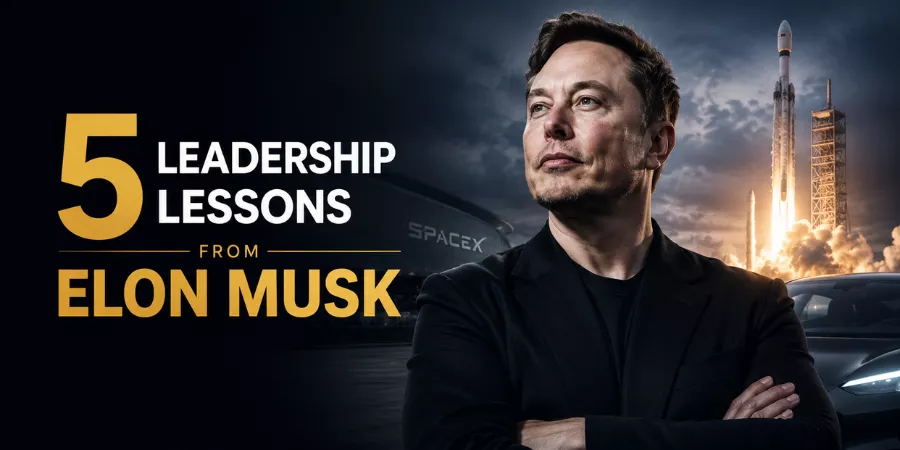
Love him or hate him, it is almost impossible to ignore what Elon Musk has pulled off.
Whether you agree with his late-night tweets or his extreme management style, the guy has built multiple multi-billion-dollar companies from scratch across completely unrelated industries. Electric cars, orbital rockets, satellite internet, brain implants, he does not just enter fields; he usually end up setting the curve.
Right now, Tesla brings in roughly $95 billion in annual revenue. SpaceX essentially owns the commercial launch market, hauling around 80% of all global payload weight into orbit. And Starlink quietly blew past 10 million active subscribers worldwide.
So, how does he actually pull this off? Strip away the social media noise, and you find a very specific, almost brutal leadership playbook. Here are five lessons we can all steal from it.
1. Stop Doing Things Just Because “That’s How It’s Done”
Most of us solve problems by looking at what everyone else is doing and making small tweaks. Musk calls this reasoning by analogy, and he hates it. Instead, he uses First Principles thinking: breaking a problem down to its absolute physical limits and building back up from zero.
When he started SpaceX, aerospace vendors tried to sell him basic rockets for $65 million a pop. He thought that price tag was ridiculous, so he sat down and calculated the actual cost of the raw materials, aluminum, titanium, copper, and carbon fiber.
Turns out, the raw materials only made up about 2% of the rocket’s price tag. Everything else was markup, overhead, and legacy inefficiency. By deciding to build components in-house, SpaceX managed to drop Falcon 9 launch costs to under $1,500 per kilogram, a massive drop from the historical industry average of $10,000 to $20,000 per kilogram.
The Takeaway: The next time someone tells you something costs too much or takes too long, ask why. Dig past the industry excuses until you hit the raw facts, then figure out a better way forward.
2. Delete Before You Optimize
If you have ever worked in a big company, you know how easy it is to end up with bloated processes. Musk relies on a simple, 5-step engineering rule to keep his teams lean, and the order matters immensely:
- Question every requirement (make them less dumb).
- Delete the part or process step.
- Simplify or optimize what is left.
- Speed up cycle time.
- Automate.
Notice where “automate” is? It is at the very bottom.
Back when Tesla was going through absolute production hell with the Model 3, automated robots spent months struggling to stick noise-dampening fiberglass mats onto battery packs. Musk walked the line, asked why the mats were even there, and found out they did almost nothing for cabin noise. He deleted the step entirely, instantly fixing a huge bottleneck on the line and saving millions.
The Takeaway: We love jumping straight to automating tasks or buying software to make things faster. First, ask yourself if the task even needs to exist at all.
3. If the Ship is Sinking, Get into the Trenches
There is nothing worse than an executive issuing orders from a corner office while their team works 80-hour weeks in a crisis. Musk’s leadership style can be grueling, but nobody can accuse him of staying on the sidelines.
During that brutal 2018 Model 3 ramp-up, Tesla was about 12 days away from bankruptcy. Instead of running things from a remote headquarters, Musk literally lived on the Fremont factory floor, sleeping on a couch or under his desk so he could help mechanics clear assembly line jams at 3:00 AM.
That hands-on push helped Tesla scale production from under 2,000 cars a week to a stable 5,000 per week, sparking the run that eventually pushed Tesla past a $1 trillion market cap.
The Takeaway: True credibility comes from shared struggle. When your project hits a wall, step up alongside your team. You will boost morale and see the real problems firsthand.
4. Tear Down the Corporate Game of “Telephone”
In standard corporate structures, messages travel through an annoying game of phone tag: an employee talks to their manager, who talks to a director, who talks to another director, who finally talks to their team.
Musk banned this across his companies. He told everyone flat out that if they need to talk to someone in another department to solve a problem, they should just talk to them directly, no approvals needed, regardless of titles.
Because they cut out middle-management friction, SpaceX manages to launch over 100 orbital missions a year with a head count much leaner than traditional defense contractors like Boeing or Lockheed Martin.
The Takeaway: Corporate hierarchies usually exist to protect ego and authority, not to move fast. Give your team permission to bypass red tape if it helps them solve problems quicker.
5. Fail Fast, Learn Faster
A lot of corporate cultures train people to cover their mistakes and play it safe. Musk takes the complete opposite approach: if you are not failing, you are moving too slowly.
While traditional aerospace firms spent years running digital simulations before building a single test craft, SpaceX built early Starship prototypes quickly and flew them. Yes, several of them ended up blowing up on the landing pad, but every single explosion gave their engineers massive amounts of real-world sensor data.
Because of that rapid feedback loop, SpaceX went from fiery test crashes to catching a 230-foot rocket booster in mid-air with giant mechanical arms in just a few short testing cycles.
The Takeaway: Playing it safe is often the riskiest thing you can do. Frame failure not as a disaster, but as the fastest way to get real data for your next attempt.