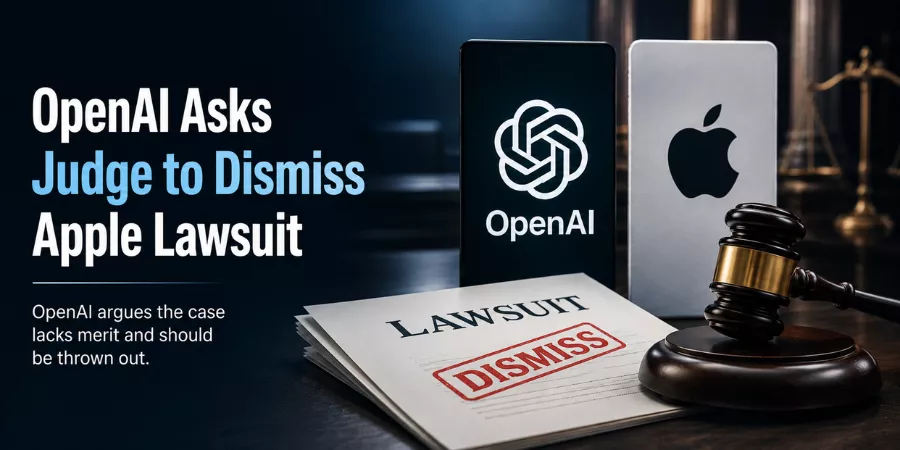
OpenAI filed a motion in federal court on Wednesday asking a U.S. judge to dismiss Apple’s trade secrets lawsuit, arguing the iPhone maker failed to identify any legally protectable confidential information and is using litigation to compensate for its own failures in AI development and talent retention.
The 31-page filing is OpenAI’s first formal legal response since Apple sued in July and sets the stage for a courtroom fight over one of the most consequential questions in consumer technology: who controls the next generation of AI hardware.
Learn basics of the Apple vs. OpenAI case here.
What OpenAI Filed and What it Actually Argues
The motion is unusually combative. Variations of the word “fail” appear nearly 50 times across 31 pages. That is not an accident. OpenAI’s legal team made a deliberate choice to frame Apple not as an injured party protecting its intellectual property, but as a company lashing out after falling behind.
“Apple’s complaint fails to sufficiently describe the information for which it claims trade secret protection; its generalized product development categories are not sufficient to survive a motion to dismiss,” OpenAI said in the filing.
Three distinct legal arguments run through the motion.
- Apple never identified the secrets: This is the foundational claim. Under trade secrets law, a plaintiff cannot simply allege that confidential information was stolen, it must identify specifically what that information is. OpenAI argues Apple failed to demonstrate it owned “a protectable trade secret” or to “plausibly allege misappropriation” by any of the defendants. Without that specificity, the lawsuit has no legal floor to stand on.
- OpenAI builds something categorically different: “OpenAI has no use, need or desire for Apple’s trade secrets. OpenAI is building something entirely new and different from anything at Apple,” lawyers wrote in the filing. The argument here is not just that OpenAI did not take Apple’s information, it is that Apple’s hardware development knowledge would be irrelevant to what OpenAI is building anyway.
- Apple created the data problem itself: This is the sharpest turn in the filing. OpenAI’s motion counters that Apple reviewed personal iMessages left on company devices and created confusion by encouraging employees to use personal iCloud accounts for work, intermingling corporate and personal data. “Apple cannot transform the foreseeable consequences of its own systems and policies into evidence of theft by former employees who were not aware of their latent access,” the filing states. That argument, if it lands with the judge, reframes the entire case, from OpenAI stealing Apple’s data to Apple’s own policies making clean separations impossible.
What Apple Alleges
Apple filed its lawsuit in July, accusing OpenAI of systematically acquiring and exploiting Apple’s confidential information through former employees, recruiting practices, and supplier relationships to accelerate its push into the consumer hardware business.
Apple has also applied for a preliminary injunction, requesting the court to bar OpenAI from using its alleged trade secrets and to allow forensic examination of OpenAI’s devices. Apple subsequently disclosed it had identified another 11 former employees who may be involved in similar conduct.
That number sits on top of the more than 400 former Apple employees who have joined OpenAI since the company began its hardware push, a migration that forms the factual spine of Apple’s complaint.
What Happens If the Judge Grants or Denies the Motion to Dismiss
If the judge grants the motion to dismiss Apple’s lawsuit, the case ends unless Apple is permitted to file an amended complaint that identifies the trade secrets with the specificity the law requires. Discovery never begins. OpenAI avoids years of litigation and, crucially, avoids the internal exposure that comes with it.
If the judge rejects OpenAI’s motion, the lawsuit proceeds and discovery begins. That means internal emails, hardware development documents, recruiting interview records, and employee testimony all become fair game for Apple’s legal team. For a company that has been conspicuously secretive about its hardware ambitions, that exposure carries real strategic cost, regardless of the eventual legal outcome.
Apple must submit a written response to OpenAI’s motion by August 19, 2026.
The Broader Picture Neither Company Wants to Discuss Publicly
The timing of this lawsuit, and OpenAI’s aggressive response to it, makes more sense when you step back from the legal filings and look at the competitive context.
Analysts believe OpenAI is working on a phone or other device of its own, a product that, if successful, would direct consumer attention away from Apple’s iPhone. Apple and OpenAI are simultaneously partners, OpenAI’s technology powers features in Siri, and emerging rivals for the same hardware category. That combination makes the lawsuit read less like a routine IP dispute and more like a preemptive move to slow a competitor before it gains manufacturing footing.
OpenAI’s motion explicitly calls the lawsuit “baseless and pretextual,” framing it as Apple’s attempt to make up for “its shortcomings in the market for talent and retaining its employees, and its failures to integrate AI into its products.” That language goes well beyond standard legal positioning. It is a public argument, filed in a court document, that Apple is losing the AI race and using litigation as a substitute for competitive strategy.
Apple has not yet responded to the motion.
What Comes Next
Related hearings are scheduled for October 1, 2026, in San Jose federal court. Apple is expected to file its opposition by August 19, after which the judge will decide whether the case proceeds to discovery or ends at the pleading stage.
The outcome will carry implications that extend beyond this particular dispute. A ruling that trade secret claims require more specificity than Apple provided would raise the bar for similar lawsuits across the AI industry, where talent movement between companies is constant and the line between general skills and proprietary knowledge is perpetually contested.
OpenAI is simultaneously fighting a separate motion to dismiss Apple’s lawsuit in another case, filed by Elon Musk’s xAI, using almost identical language about talent freedom and unfounded allegations. In that filing, OpenAI said talented employees “have every right to go where they choose, and OpenAI has the right to hire them.”
The legal posture is consistent. OpenAI is building a defense, across multiple fronts, that reframes AI talent poaching as workers exercising ordinary career freedom, rather than IP theft dressed up as recruitment.
Whether that argument survives judicial scrutiny in either case is a question the October hearing will begin to answer.