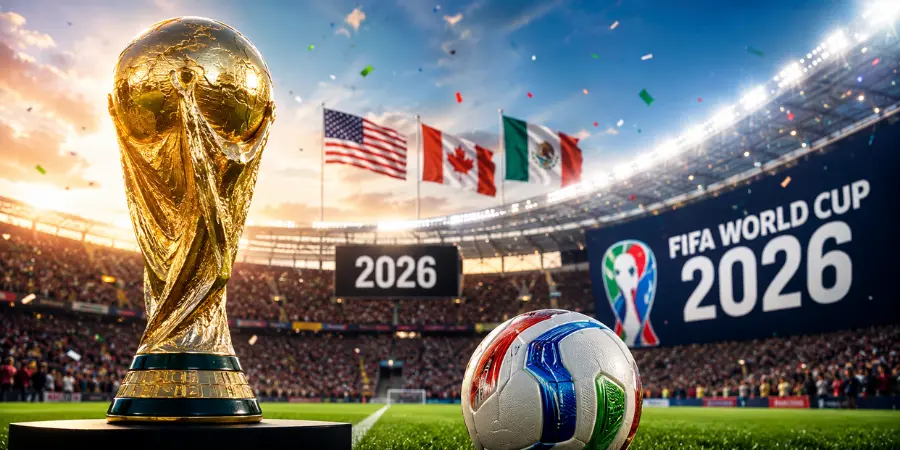
The FIFA World Cup 2026 has officially kicked off, and it is already making history. Hosted jointly by the United States, Canada, and Mexico, this is the first edition of the tournament to feature three host nations and 48 competing teams. With 104 matches scheduled across 16 cities and 40 days of football, the 2026 edition is the largest and most ambitious World Cup ever staged.
A New Era for World Football
For the first time in the history of the tournament, three countries are sharing hosting responsibilities. The United States is home to 11 host cities, while Canada and Mexico each contribute two and three cities respectively. This tri-nation model is a deliberate strategy by FIFA to maximize global audience reach and commercial opportunity.
The expanded 48-team format replaces the previous 32-team structure, giving more nations a chance to compete on football’s biggest stage. Groups now consist of three teams, with the top two from each group and eight best third-placed teams advancing to the Round of 32. The total number of matches has increased from 64 in Qatar 2022 to 104 in 2026.
Key Highlights from the Opening Days
The tournament has delivered memorable moments right from the opening fixtures. Lionel Messi, leading defending champions Argentina, scored a hat-trick against Algeria in Group J, equalling the record for most career World Cup goals. His three goals came exactly 20 years after his World Cup debut, marking a landmark moment in football history.
Kylian Mbappe led France to a Group I opening win over Senegal, while Erling Haaland scored twice as Norway defeated Iraq. England beat Croatia 4-2 in Group L, with Harry Kane netting two goals in the first half. The opening days have already seen record-breaking stadium attendance, with FIFA President Gianni Infantino confirming that June 16, 2026 saw 281,223 fans inside stadiums in a single day, the highest in World Cup history.
Host Cities and Stadiums
The 16 host cities span three countries and include some of the most iconic sports venues in the world. In the United States, matches are being played in New York/New Jersey, Los Angeles, Dallas, San Francisco Bay Area, Miami, Atlanta, Seattle, Boston, Kansas City, Houston, and Philadelphia. Canada hosts matches in Toronto and Vancouver, while Mexico features matches in Mexico City, Guadalajara, and Monterrey.
FIFA has temporarily renamed several stadiums to neutral tournament identities to protect the exclusive branding rights of official commercial partners. This is standard practice for World Cup venues under FIFA’s strict anti-ambush marketing regulations.
The Sponsorship Structure: How FIFA Funds the World Cup
The FIFA World Cup 2026 operates on a structured three-tier sponsorship model. This framework balances global brand visibility with regional market relevance and represents the most commercially sophisticated World Cup in the tournament’s history. FIFA is on track to exceed its projected revenue target of 13 billion US dollars for the 2023 to 2026 commercial cycle, with marketing rights alone generating 965 million US dollars in 2025.
Tier 1: FIFA Partners (Highest Level)
The top tier consists of seven global brands that hold long-term, multi-tournament rights with FIFA. These are the highest-ranking commercial partners and are known as FIFA Partners. The confirmed Tier 1 FIFA Partners for 2026 are:
- Adidas (Official Match Ball Supplier and Technical Partner)
- Coca-Cola (Official Beverage Partner, partner since 1974)
- Visa (Official Payment Partner, partner since 2007)
- Hyundai and Kia (Official Automotive Partner)
- Lenovo (Official Technology Partner)
- Qatar Airways (Official Airline Partner)
- Aramco (Official Energy Partner)
Adidas: The Highest Sponsor of FIFA World Cup 2026
Among all official partners, Adidas holds the most prominent commercial position at the FIFA World Cup 2026. The German sportswear brand has been a FIFA partner since 1970 and recently signed its largest-ever sponsorship deal with FIFA, reported to be valued at over one billion US dollars and running through 2030.
Adidas supplies the official match ball used in every game of the tournament. The brand also outfits several national teams and creates tournament merchandise, fan experiences, and stadium activations across host cities. At the FIFA World Cup 2026, Adidas’s three-stripe branding is present on every pitch, in every stadium, and across every official FIFA publication.
Adidas sponsors some of the most successful national teams in the tournament including Argentina, Germany, Spain, and Japan. Argentina, the reigning World Cup champions, wear Adidas kits, giving the brand direct visibility through one of the tournament’s strongest title contenders.
Tier 2: Official World Cup Sponsors
The second tier covers brands with global rights specifically for the 2026 tournament. These include AB InBev and Budweiser (Official Beer Partner), McDonald’s (partner since 1994), Bank of America (FIFA’s first-ever global banking partner, confirmed in 2024), Frito-Lay (Lay’s), Verizon (Official Telecommunications Partner), Hisense, Mengniu Dairy, and Unilever. Tier 2 deals are reported to range between 65 million and 95 million US dollars.
Tier 3: Regional Supporters and Official Suppliers
The third tier includes regional and city-specific supporters such as Airbnb, American Airlines, The Home Depot, Valvoline, Salesforce, Kraken (Official Crypto Exchange Supporter), and Diageo. This tier allows localized brands to activate campaigns in specific markets such as North America, Europe, or South America, at a more accessible entry level.
What Makes FIFA World Cup 2026 Commercially Unique
The 2026 edition introduces a new city-level sponsorship structure, allowing each host city to secure up to 10 local supporters. This adds a hyper-local marketing layer on top of FIFA’s global commercial framework. The result is the most layered sponsorship ecosystem in World Cup history, with global giants, tournament-specific brands, and local partners all activating simultaneously across 16 cities.
FIFA expects global viewership for the 2026 tournament to reach billions, building on the five billion viewers who followed Qatar 2022. For brands, this scale makes the FIFA World Cup one of the most effective marketing investments in global sports.
Looking Ahead
With the group stage underway and iconic names like Messi, Mbappe, Haaland, and Harry Kane already making their mark, the FIFA World Cup 2026 is set to deliver extraordinary football across North America. The expanded format, record attendance, and the biggest sponsorship program in the tournament’s history all point to a month of football that will be remembered for generations.