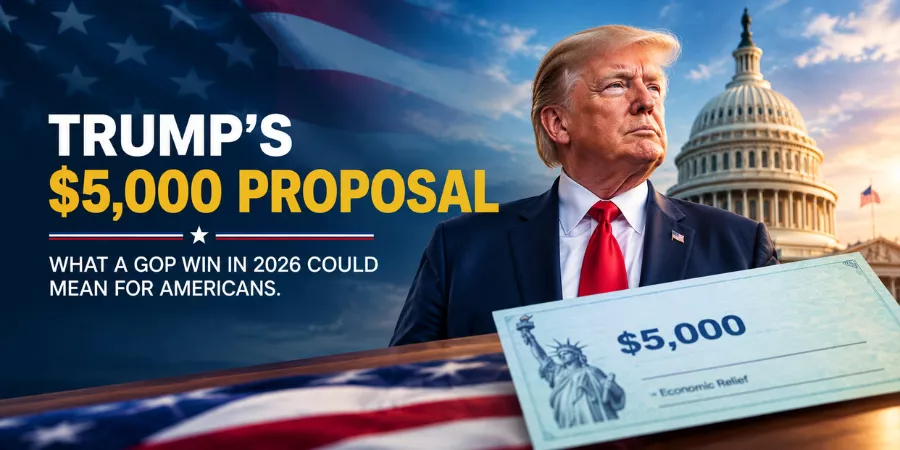
President Donald Trump has promised a $5,000 payment to every adult US citizen if Republicans retain control of Congress in the 2026 midterm elections, calling the proposed payment a “Trump dividend.”
Trump made the announcement during a Republican midterm convention in Dallas, where he urged voters to treat the election as a referendum on his presidency. The proposal immediately drew questions over how it would be funded, whether Congress would approve it and whether such a payment could add to the US budget deficit and inflation.
Will Trump really give every American $5,000 after the 2026 midterms?
Trump has promised a $5,000 payment if Republicans win both chambers of Congress, but the payment has not been approved and there is no confirmed plan for distributing the money.
Trump told supporters that if Republicans win, “you win with us and you get $5,000,” describing the proposal as a dividend.
His announcement came ahead of the November 3, 2026, midterm elections, when voters will decide control of the US House and Senate.
For now, the $5,000 payment is a political promise rather than an approved federal program. Any large-scale payment would require legislation and a funding mechanism.
Who would be eligible for Trump’s proposed $5,000 payment?
Trump said the payment would go to US citizens, with reporting indicating that the proposal is aimed at adult citizens.
The US has roughly 240 million adult citizens. At $5,000 per person, that would put the potential cost at about $1.2 trillion if every eligible adult received the full amount.
However, Trump has not provided detailed eligibility rules.
Vice-President JD Vance also appeared to soften the proposal, suggesting that a future version could be means-tested, which would mean higher-income Americans could receive less or potentially nothing.
That leaves several important questions unanswered, including the income limits, whether the payment would be taxable and how eligibility would be determined.
How much would Trump’s $5,000 dividend cost?
The proposed Trump dividend could cost about $1.2 trillion if roughly 240 million adult US citizens received $5,000 each.
Marc Goldwein of the Committee for a Responsible Federal Budget estimated that the plan would cost around $1.2 trillion in one year.
That would be a huge federal expenditure. The figure is also larger than the combined cost of the three rounds of COVID-19 stimulus checks, according to Goldwein’s assessment.
The size of the proposal is one reason economists and lawmakers have questioned how the government would pay for it.
Republican Representative Chip Roy of Texas publicly questioned the financing, saying he wanted to know how the administration planned to cover a cost that could exceed $1 trillion.
Would Trump’s $5,000 payment increase the US deficit?
Critics say a $5,000 payment could significantly increase the federal deficit unless it is fully financed through new revenue or spending cuts.
The issue comes at a difficult time for US government finances. The country’s national debt passed $40 trillion in August, according to the Guardian’s report.
The federal government collected about $210 billion in tariff and excise tax revenue during 2026 through September 8, according to figures cited by the Guardian from the Bipartisan Policy Center.
That is far below the estimated $1.2 trillion cost of paying $5,000 to every adult citizen.
At the current pace of tariff collections, it would take several years of revenue to generate an amount comparable to the proposed payment, assuming all of that money were directed toward the dividend.
Could Trump’s $5,000 dividend cause inflation?
Economists have warned that sending more than $1 trillion into the economy could add to inflation, particularly if the payments were financed through new borrowing.
Marc Goldwein warned that such a payment could produce a significant increase in both the federal deficit and inflation.
The concern is straightforward: if millions of Americans suddenly receive thousands of dollars to spend, demand for goods and services could rise. If supply does not increase at the same pace, prices can come under additional pressure.
The actual effect would depend heavily on how the payment was financed and how Americans used the money.
Why is Trump’s $5,000 payment being called a bribe?
Critics have accused Trump of using a direct cash promise to influence voters ahead of the 2026 midterm elections.
The proposal has attracted criticism from Democrats and some Republicans.
California Governor Gavin Newsom accused Trump of trying to “buy your vote,” while the Democratic National Committee described the proposal as another example of an unfulfilled promise to provide Americans with direct payments.
The criticism is particularly strong because Trump tied the proposed payment directly to a Republican victory in November.
Trump’s announcement also comes after previous proposals for stimulus payments, including earlier suggestions involving payments funded through government savings or tariff revenue.
What have Republicans said about Trump’s $5,000 payment?
Republicans are divided over the proposal, with some supporting it and others questioning how it could be financed.
Ohio Senator Bernie Moreno said he would work on legislation to pass the Trump dividend after the November election.
Vance, however, suggested that the final proposal could look different from Trump’s initial promise and could be limited through means testing.
The disagreement highlights one of the biggest unanswered questions surrounding the Trump $5,000 dividend: what would the actual legislation look like?
When would Americans receive the $5,000 Trump dividend?
There is currently no confirmed payment date because the $5,000 dividend has not been approved by Congress.
Trump has tied the promise to a Republican victory in the 2026 midterm elections, but winning the election would not automatically create a federal payment program.
Legislation first must be considered and voted through in Congress and then signed into law, so this idea could only actually become a program once all lawmakers agree. At that point, the program’s budgetary and operational details would need to be decided upon.
In the meanwhile, U.S. citizens should treat the $5,000 from Trump as an empty, campaign promise, rather than a legitimate, official federal stimulus payment.
The proposal is likely to remain a major talking point as Republicans and Democrats campaign for control of Congress ahead of the November midterm elections.