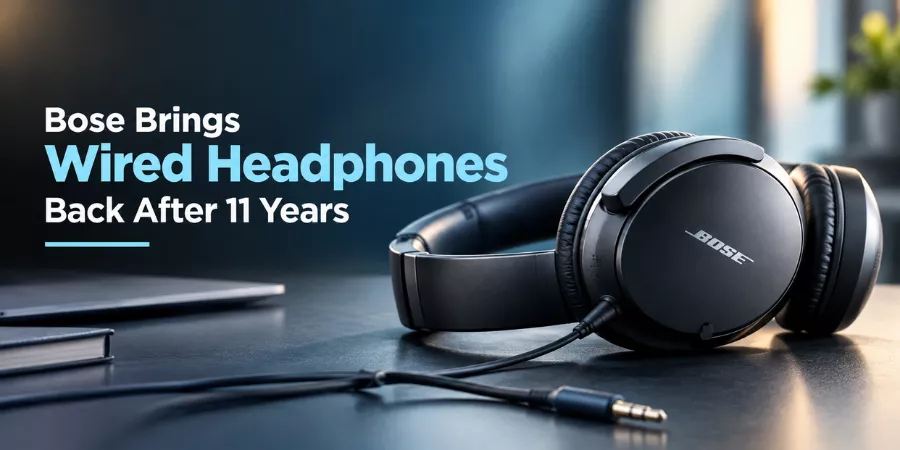
Bose is bringing Wired Headphones back after more than a decade, but its new product is not simply a nostalgic throwback. The $99 Bose Noise Cancelling Wired Earbuds combine a USB-C connection with active noise cancellation, lossless audio support and physical controls, while eliminating the need for Bluetooth pairing or a rechargeable earbud battery. Bose says the earbuds will begin shipping October 15, 2026.
The launch comes as wired audio is quietly making a comeback. Circana reported that wired headphone sales grew 3% in 2025 after five consecutive years of decline. Sales increased 10% during the second half of 2025, while revenue rose another 20% during the first six weeks of 2026.
Bose’s timing, therefore, is more interesting than a simple return to an older format.
Why is Bose Bringing Wired Headphones Back?
Consumer interest in wired audio has been rising, particularly among younger users.
Circana’s research found that the wired category recovered across multiple brands and price points rather than because of one successful product. The research firm also identified nostalgia and affordability as two factors behind the revival. Wired models had an average selling price of about $13 in 2025, compared with $99 for Bluetooth headphones.
Bose has responded with a premium version of the concept.
The company’s new earbuds retain the simplicity of a cable but add features normally associated with higher-end wireless products. They use Bose’s QuietControl noise-cancellation technology and offer Quiet, Aware and ANC-Off modes.
The result is a product aimed at people who want modern audio features without adding another device that needs to be charged.
What are Bose’s new Noise Cancelling Wired Earbuds?
The new earbuds connect directly to compatible phones, tablets and computers through USB-C. Bose lists them at $99 in the US, with Black, White Smoke and limited-edition Dewdrop Mint versions.
| Feature | Bose Noise Cancelling Wired Earbuds |
| Price | $99 |
| Connection | USB-C |
| Noise cancellation | QuietControl ANC |
| Listening modes | Quiet, Aware, ANC Off |
| Microphone | Inline |
| Controls | Three-button remote |
| Water resistance | IPX4 |
| Audio | Lossless, up to 24-bit/48kHz |
| Shipping | October 15, 2026 |
The USB-C connection supplies the power required for the earbuds, including their noise-cancellation functions. That means users do not have to charge the earbuds before listening. Bose says no pairing or app is required.
That is one of the product’s biggest differences from wireless earbuds.
Why Does USB-C Make the Return of Wired Audio Different?
The traditional wired-earbud experience was built around the 3.5mm headphone jack. That connection has become far less common on modern smartphones.
Bose instead uses USB-C, allowing the earbuds to connect directly to compatible current-generation devices. The company says they work with many Android phones, USB-C iPhones, tablets and computers.
The connection also supports lossless audio and low-latency playback. Bose says the earbuds can output audio at up to 24-bit/48kHz, while the wired connection makes them suitable for uses such as gaming and video where latency can matter.
There is one important limitation: USB-C compatibility is not universal across every device, and Bose says non-USB adapters will not provide the power required to operate the earbuds.
What Makes These Different from Ordinary Wired Earbuds?
Active noise cancellation is the major differentiator.
Basic wired earbuds generally depend on the physical seal of the ear tips to reduce surrounding sound. Bose’s new model uses four microphones, two on each earbud, to support its QuietControl noise-cancellation system. Users can switch between Quiet, Aware and ANC-Off modes through the inline remote.
The cable also includes volume, playback and call controls, along with a microphone.
The earbuds come with three ear-tip sizes and two stability-band sizes. They are rated IPX4, meaning they can handle everyday splashes and sweat but are not designed for submersion.
Are Wired Headphones Making a Comeback?
The sales data says the category is recovering, although wired audio remains much smaller than wireless.
Circana reported that true wireless products accounted for 65% of all headphone dollars in 2025. At the same time, wired products began growing again after years of decline.
That suggests the two formats can coexist.
Wireless earbuds remain convenient for exercise, commuting and situations where freedom from cables matters. Wired products have their own advantages: no Bluetooth pairing, no earbud charging routine and extremely low connection latency.
The price difference can also be significant. Circana’s $13 average selling price for wired headphones compared with $99 for Bluetooth models shows why inexpensive wired products can appeal to consumers looking for basic audio without paying for wireless hardware.
Bose is targeting a different part of that market by putting premium features into the wired format.
Bose’s 11-Year Gap is Part of the Story
Bose’s return is notable because the company spent much of the past decade building its reputation around wireless noise-cancelling products.
The company’s current portfolio still includes wireless QuietComfort headphones and earbuds. The new wired earbuds are therefore an addition to that portfolio rather than a replacement for Bluetooth products.
That makes the launch more revealing. Bose is not abandoning wireless technology. It is responding to evidence that consumers are once again interested in having a physical connection.
The company is essentially updating an old format for a USB-C world.
What Bose’s Return Means for the Headphone Market
The revival of Wired Headphones is not simply about nostalgia.
Consumers are showing renewed interest in products that are inexpensive, straightforward and familiar, while Bose has demonstrated that wired audio can still accommodate modern features such as active noise cancellation and lossless playback.
For users, the choice is becoming less about wired versus wireless as a permanent preference and more about choosing the right connection for a particular situation.
Bose’s $99 earbuds put that idea into a mainstream product from one of the industry’s best-known audio brands.
The cable is back. The technology around it has changed.