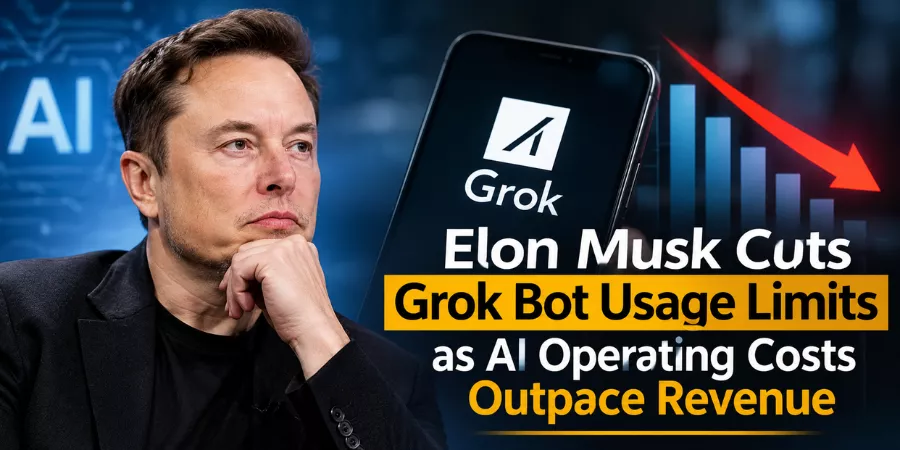
Grok Bot usage limits are the caps on how much agent work a subscriber can run each week before the allowance runs out. Elon Musk has now said publicly that serving Grok Bot costs too much compared with the revenue it brings in.
If your weekly allowance disappeared earlier than normal, this article explains what Musk said, why AI agents cost so much to run, and what the situation means for you.
What Did Elon Musk Say About Grok Bot Costs?
On November 1, Musk replied to an X user and wrote that the cost of serving Grok Bot was “unsustainably high relative to revenue.” The reply followed complaints from subscribers who had used up their weekly capacity several days before the usual reset.
The complaints built up over the Halloween weekend. Some subscribers said their usage meters moved from about 50% to 100% overnight, even though their agents had not been given new work. Others said their allowances ran out after fairly light use.
Musk has not published the actual cost of running Grok Bot, a revenue breakdown, or a revised usage policy. He has also not announced a reset for affected subscribers. Everything beyond the quote is therefore interpretation, and readers should treat it that way.
Why Is Grok Bot So Expensive to Run Compared with a Chatbot?
An AI agent is software that carries out multi-step tasks on its own, rather than replying once to a single prompt. Grok Bot works through a virtual computing environment, so it can complete tasks beyond writing text.
That design explains the cost problem. A chatbot uses compute for a few seconds per reply. An agent keeps a working environment open, reads and re-reads context, calls tools, and tries again when a step fails. A single task can therefore consume many times the compute of a normal chat.
Why is My Grok Bot Usage Meter Rising When I Am Not Using It?
This is the most common complaint, and SpaceX has not given an official answer. One plausible, unconfirmed explanation is that agents keep running background steps after the user stops typing.
Another is that the platform changed how it counts usage. Only SpaceX can confirm the cause, which is why subscribers should keep their own records (see the steps below).
How Can Grok Bot Be Growing Fast and Still Lose Money?
A product can grow quickly and still lose money on each heavy user. According to reporting on the company’s earnings call, SpaceX President Gwynne Shotwell said Grok Bot had about 800,000 paid weekly users in early October, more than double the previous month.
SpaceX also reported that artificial intelligence made up 52% of its income in a filing last month. Its renamed Super Intelligence division recorded a $431 million profit, which would have been higher without $1.2 billion in one-time costs from the Cursor acquisition.
A division can be profitable while one product struggles against its own operating costs. Growth can even make the problem worse. If the most active subscribers are also the most expensive to serve, every new heavy user adds cost faster than revenue.
Has Grok Cut Usage Limits for Subscribers Before?
Yes. Earlier reporting shows a pattern. In May 2026, subscribers complained that image and video generation limits had been cut sharply, and Musk replied that limits would be increased. Around the same time, users noticed that the top SuperGrok Heavy tier changed its wording from “near-unlimited usage” to “highest usage limits.”
Grok subscription plans have been sold on generous access, and the underlying compute costs keep pushing the company to tighten it. Subscribers on the Cursor forum have raised the same complaint about Grok Bot, with some saying a week of included usage lasts only a day or less of heavy work. These are user reports, not company figures.
What Should Grok Bot Subscribers Do Now?
Musk also asked whether upgrading to a higher-usage plan was too expensive for users. That suggests a paid tier above the current ones is possible, but no new pricing has been announced.
Until SpaceX publishes how usage is counted, I would suggest three practical steps:
- Record your usage meter at the start and end of each work session for a week, so you can show support exactly when the meter moved.
- Reserve the agent for tasks that save real time, and handle simple edits and questions with a cheaper tool.
- Avoid annual prepayment until the allowance rules are written down.
Can AI Agent Businesses Make Money on Flat Monthly Plans?
They can, but only when the average user stays well below the plan’s cost, and agents push users toward the top of that range. Agents promise research, browsing, and multi-step business work, yet each of those tasks costs more to deliver than a chat reply.
In my assessment, there are two realistic ways out: metered pricing, where heavy work is billed by consumption, or tighter caps that keep flat plans profitable. Both frustrate customers, and Grok Bot appears to be trying the second approach first. The deciding test is whether SpaceX explains the rules clearly. Subscribers can accept a limit they understand far more easily than a meter that moves without explanation.
The key question is no longer how fast AI agents gain users. It is whether the revenue from everyday use can pay for the computing power behind it.